
 Big news from our pantry: starting today, and running through the rest of the harvest season, clients of Bread for the City’s food pantry will enjoy a new level of choice: all fresh produce, for any who want it!
This is a true milestone in our Nutrition Initiative, which is now heading into its fourth year of great progress in advancing the health of our community. In 2008, we overhauled our menu to feature all healthful items; in 2009, we committed to provide at least one item of fresh produce in every bag; last year, we adapted a “choice” system that enabled clients to decide what items they wanted (strategically promoting fruits and vegetables in the process). As a result, our clients are reporting increased satisfaction and increased preferences for healthier, greener offerings.
Now, thanks to the tremendous success of our Glean for the City program, we’re pleased to offer clients the option to skip canned goods entirely. If clients want to receive all fresh produce, we’re now happy to provide it! It’s a great step for the health of our community. Says our nutrition maven Sharon Gruber: “Health-wise, our menu of canned goods is already pretty good -- with minimal additives, low sugar and sodium, and so on. But fresh veggies just taste better, which encourages people to have more of them. And if eaten raw, they have enzymes and other healthy things that are missing from many canned foods.”
“Plus,” Sharon adds, “the diversity of our fresh produce will far outshine the canned goods we offer. People can try new things, get things that are otherwise cost-prohibitive, and get more of an array of vitamins and minerals.”
As our client and garden volunteer Erika Moses explained to WAMU’s Sabri Ben-Achour last week in our rooftop garden, this kind of exposure even in small amounts can have substantial impacts on people’s diets. (Listen to that story in Real Audio here, Windows media here.)
As great as all this is, we can’t help but also note that this all-fresh step will actually save us money! The gleaned produce is obtained for free from regional farms and local markets. The only costs are staff time, transportation, and some equipment like bins and gloves; that works out to about 20 cents per pound, by far the cheapest of all our food items. This will greatly help our pantry’s budget for the winter months. (Which is especially important, since food prices are on the rise again.) That said, we do expect a need to increase our capacity for storing all this produce. During the harvest months, our pantry staff pack their fridges literally to the max. In fact, last year, we lost some produce to rotting and had to cut the harvest season short due to lack of storage.
To fulfill this pledge to our clients throughout the year, we very well may need to expand our fridge capacity! That may cost us as much as $15,000! Can you help us maximize our freshness? Donate today to help us upgrade our fridge capacity.
This great step forward is made possible by two essential sources of support. The first is farms and farmers markets -- so a huge thank you to the West End Farmers Market of Alexandria and the Bloomingdale Farmers Market here in Northwest. And the second is people like you -- so please support our efforts today.
June 1, 2011
Want it fresh? You got it.


May 31, 2011
Our Garden: Grandly Opened!
On May 20th, we officially opened the new Rooftop Garden at our Northwest Center. The weather was perfect, the garden was blooming, and we had a great turnout -- our heartfelt thanks to everyone who made it possible!
Check out this great slideshow of photos from the event below (or browse the full set on Flickr).
Among our guests was WAMU’s Sabri Ben-Achour, who produced this report that aired last Friday on Metro Connection -- check it out online. (Real Audio here, Windows media here)
As Mr. Ben-Achour notes in his report, our rooftop garden project is all about bringing people closer to our food -- and to each other. On those fronts, it’s already a great success! The space is not just beautiful; it also fosters opportunity for us to work together and learn from each other about how to work for healthier lifestyles and stronger communities.
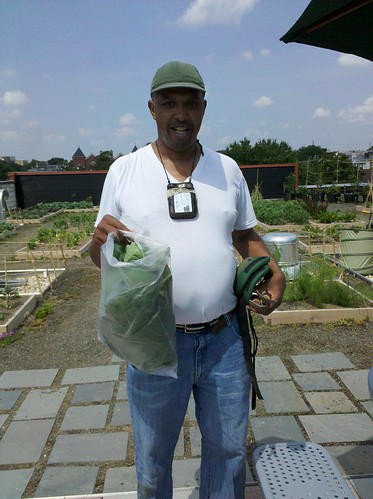
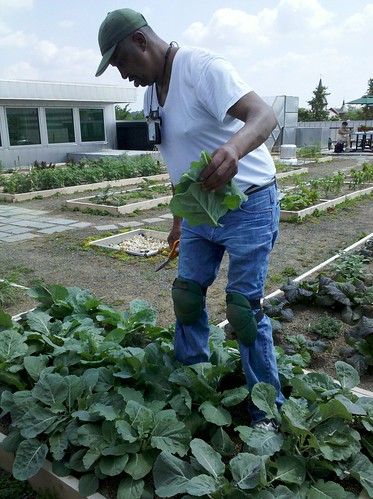 Indeed, just days after our big buzzy Grand Opening, we quietly conducted the very first harvest from our garden. Longtime Bread for the City client George joined us during "open garden" hours (Mondays and Wednesdays, 9am-noon, by the way), and he clipped bags of leaves from our collard greens which are already overflowing their bed. George took some for home, and brought the rest down to the pantry to share with folks there.
"I can't have a garden at home," George tells us, "and I’ve wanted a chance to do this work for so long.” We’ve known George for a while, and we can say that we’ve never seen him so happy and excited.
So we want to say a huge Thank You to all those who attended the ribbon-cutting event and have donated in support of the program so far. This has all been made possible by your support.
Of course, this is just the beginning. We’re also building our Southeast Center garden, and we've just begun to develop programming for each site. We need your help to keep this going. And the best way to help is to give:
For $25, we can purchase and maintain five plants for an entire season.
For $50, we can organize a complete gardening-and-nutrition workshop.
Gifts of $100 or more will be honored with a name or phrase of your choosing to be painted by members of our community onto ceramic pots.
Gifts of $1,000 will be honored with the dedication of an entire bed!
Help us make this community strong and green. Give to the green roof gardens today.
May 25, 2011
Prep For Success: from the shelter to the job
We recently heard from Bread for the City’s new job developer, Malton Edwards. Malton has been working in our Pre-Employment Program, working entirely with residents of Wards 7 and 8, where the unemployment rates are some of the highest in the nation.
Out of eight students in our last PEP program, we’ve already helped six find jobs. (That may not seem like a big number, but given how challenging our job market is here -- and how many challenges our clients face along the way -- it’s no small feat.) And under Malton's leadership, this program is already doubled in size, with an all-time high of 16 students in its newest class.
Let’s take a look at one of PEP’s recent success stories: Eric Dyer.
 Eric is a 46-year-old native Washingtonian. He used to work in utilities, and also has experience as a mechanic. But he lost his job years ago, and eventually his home. He kept trying to get his life back on track -- with little to show for it.
“I took a few job training programs,” Eric says. “But they just give you the classes and once you’re done, that’s that. It’s over.” And that wasn’t enough.
Eric didn’t even have proper shoes, for instance. And that’s what brought him to Bread for the City.
“I came here in search of clothes,” Eric recalls. “I saw a flyer for the Pre-Employment Program and was initially a little skeptical, because I’d just completed the computer training course and it didn’t get me anywhere. But Stacey [Smith, a Bread for the City social worker] came to talk to me and I decided to do the program.”
“At first,” Eric says, “PEP seemed to be about real basic stuff. Eventually I realized that these were, you know, big questions. Not just ‘how do you go walking down the street looking for jobs?’ but ‘what do you need to get it done?’ ‘How do you feel about yourself?’ ‘What will it take to get you where you want to be?’”
PEP classes are two days a week, with a group of about 10 or 15 people who are learning the life skills that they need to be ready for employment. This personal development is incorporated with our comprehensive services, as we make sure that our participants can address their myriad challenges at once.
“It was a really different experience for me,” says Eric. “For one, there were small things like bus tokens. That makes a huge difference in me being able to stick with it all the way through, every time. Otherwise, how would I be able to get there? Other programs, maybe you get one farecard and that’s it. If you’re not able to take every step along their certain path on your own, you can slip through their cracks. You’ll get something like ‘I’m sorry, we can’t help you with that.’”
“But you need all kinds of means to get up from the bottom,” says Eric. “And Bread can help you get it covered.”
In the course of PEP, Eric acquired the clothes, customs, and even simple confidence that he’d need to get a job.
“It’s been awesome to see Eric’s success,” says Stacey Smith. “It’s a transformation. He comes in here from the homeless shelter, he shaves and puts on a suit and tie and heads out with a Blackberry like a professional. It’s like Clark Kent to Superman.”
Even with this transformation, however, getting a job can still require a lot of support. Among other places, Eric applied for a cook position at the Hard Rock Cafe; when he called back to inquire about it, however, they told him that that they couldn’t find his application.
“In the past, that would have been it - end of story. But Malton followed up with me and then followed up with them and made sure that I was right where I needed to be.”
And surely enough, Eric now has a job at the Hard Rock Cafe.
“It’s long and hard and my feet are sore. It’s hard to work such long hours into the night when you’re staying in a shelter, especially because come 7am you have to leave the shelter. So that’s hard. But Melissa Mitchell is now helping me search for housing, and she’s helping me find educational resources.”
We’re excited to see all the progress yet to come from Eric, our other PEP participants, and our job development program as a whole. And we need your support to help this program thrive! PEP is looking for mentors to work closely with PEP participants in their job readiness training -- contact Stacey Smith (ssmith [at] breadforthecity [dot] org) to learn more.
And PEP is still not a fully-funded Bread for the City program! Your donation will make a huge difference as we engage in this transformative work -- so give today.
May 24, 2011
City Council votes tomorrow. Ask them to save our safety net today.
The City Council votes tomorrow on the budget for Fiscal Year 2012. Chairman Kwame Brown, responding to public pressure, showed leadership to restore a portion of the cuts.
Save Our Safety Net reports that his budget will include $24 million to partially fund Interim Disability Assistance, homeless services, and Temporary Assistance for Needy Families. But there are still $32 million in cuts on the table, and instead of using all progressive revenue to fund the safety net, the Chairman and others are planning to use a portion of the money to reverse the marginal income tax increase proposed by the Mayor.
Please take a minute today to email your Councilmembers to ask them to fully fund safety net programs. They need to hear from you. If you have time, call their offices as well. The numbers are below.
Take a look at this amazing video from Save Our Safety Net. It will inspire you as you talk to your elected officials:
Here's what Save Our Safety Net reports is still being cut:
-- $2m from childcare subsidies
-- $2m from Local Rent Supplement Program, eliminating the vouchers
-- $18m from the Housing Production Trust Fund
-- $900k from Children's Mental Health Services
-- $1.3m from Domestic Violence Services
-- $600k from the Low-income Heating and Energy Assistance Program
-- $3.3m from Interim Disability Assistance, leaving 1000 on the waiting list and 600 removed from the program
-- $3.5m million from homeless services, for transportation to shelters, feeding, and supportive services
And here are the numbers to call the City Council as well as email:
Kwame Brown (Chairman) 724-8032
Vincent Orange (at-large) 724-8174
David Catania (at-large) 724-7772
Phil Mendelson (at-large) 724-8064
Michael Brown (at-large) 724-8105
Jim Graham (Ward 1) 724-8181
Jack Evans (Ward 2) 724-8058
Mary Cheh (Ward 3) 724-8062
Muriel Bowser (Ward 4) 724-8052
Harry Thomas, Jr. (Ward 5) 724-8028
Tommy Wells (Ward 6) 724-8072
Yvette Alexander (Ward 7) 724-8068
Marion Barry (Ward 8) 724-8045
Jen Budoff, Council Budget Director 724-8139
May 23, 2011
Save IDA: Save Dollars and Save Lives
We’ve blogged a lot about Interim Disability Assistance (IDA), a program that provides low-income District residents with $270 a month while they wait for Social Security to approve them for disability benefits. We’ve even advocated for a similar program for TANF recipients, to help them get on SSI and pay TANF costs back to the District. We are pleased to note that such a program appears in the Mayor’s proposed TANF budget for Fiscal Year 2012, but we vigorously oppose another line in the budget—one that would completely eliminate the IDA program, putting more than 900 lives in turmoil. Watch this video from SOME and the DC Fiscal Policy Institute to learn about the support IDA provided to three men who are too disabled to work:
I work in the legal clinic, and represented a client with a similar story. Ms. C has several serious mental illnesses, along with orthopedic problems that have left her with pins and screws in several joints. She had worked for many years in the construction and food service industries, but she became sicker and was no longer able to work. She applied for benefits in September 2008; it took two denials and 31 months for her to have a hearing before one of Social Security’s administrative law judges. Ms. C was homeless, and IDA helped her afford some important items, like soap and socks and bus passes. Bread for the City represented Ms. C at her hearing and won.
Ms. C is now entering Bread for the City’s representative payee program and is excited to have an income she can use to apply for apartments. In addition, Ms. C won back benefits for all the months she was awaiting Social Security’s decision. She will be able to pay the District back for all the IDA she received, and can use the remaining lump-sum payment for expenses such as a security deposit -- and even potentially an apartment of her own, though even on a budget with Social Security benefits, this is no easy task (and still more budget cuts threaten to make it even harder). But it’s clear that Social Security benefits will dramatically increase Ms. C’s stability, and IDA was the bridge that helped her get there.
As we blogged about on Tuesday, our social services program helps people apply for these benefits. Our cases have a very high approval rate, as we gather medical evidence, write supportive reports, and advocate with the disability examiners. If social service clients or other low-income DC residents have their initial application for benefits denied, and are then denied at the reconsideration stage, Bread for the City’s legal clinic evaluates their cases for representation at a hearing before an Administrative Law Judge. Staff attorneys, volunteer attorney Bruce Mayor (who has been representing Bread clients in Social Security matters for nearly a decade!), and non-attorney interns and volunteers gather medical records, write briefs, and attend hearings for the clients we accept. We also refer cases to attorneys through the DC Bar Pro Bono Program.
And we’ve been remarkably successful. Our social services program has helped 43 people apply for benefits so far this year and already 23 have been approved. Meanwhile, our legal clinic just won our 27th hearing of 2011. All 27 of those victories are for people who have been denied benefits at earlier stages in the process! That’s a lot of federal dollars coming to low-income DC residents: to spend in local businesses, to reduce the need for emergency assistance, to keep up with rent and avoid eviction. The cases our legal clinic alone has won so far in 2011 will bring over $220,000 in federal dollars into the District each year, and provide much-needed stability to dozens of disabled people who are unable to work.
We are eager to continue to make money for the District, but we need help. It’s much easier to represent a client that can afford a phone, transportation, and sometimes even a stable address. These basics for communication and peace of mind enable faster determinations and ultimately more money in back payments for DC. We hope the City Council will find the money to keep this program.
You can tell them to do so yourself. Contact Chairman Kwame Brown at 724-8032 or kbrown@dccouncil.us, and tell him something along the lines of this:
The Interim Disability Assistance Program is an essential part of the safety net for District residents with disabilities. It’s also a mechanism for drawing down federal revenue to serve extremely low-income District residents and for transitioning those disabled individuals to a federal income source that will better allow them to sustain themselves. Please do not allow IDA to be eliminated and ensure that it has the funds necessary to serve those who need it.


 Posts
Posts


