
We are looking to hire a Database Administrator to work part-time in our Finance Office. Compensation includes a competitive non-profit salary, depending on experience.
Responsibilities:
· Input gift information into fundraising software
· Reconcile gift records with accounting system
· Support Accounts Receivable Manager
· Compose and mail donor acknowledgments
· Assist with general office duties
· Other duties as assigned
Requirements:
· 1 – 2 years experience working in a finance or fundraising office
· Knowledge of Microsoft Office products
· Knowledge of Raiser’s Edge and/or Financial Edge a plus
· Strong interpersonal skills, and an ability to work well with a wide variety of people
· Strong time management skills, and the ability to juggle multiple projects at once
· Strong written and oral communication skills
· Desire to work for a nonprofit serving DC’s most vulnerable residents
If you are interested in joining the dedicated staff at Bread for the City please send your resume with a cover letter to humanresources@breadforthecity.org. No phone calls please.
EO/AA. Bread for the City is open to all qualified applicants regardless of race, ethnicity and national origin, age, gender, physical ability, sexual orientation, gender identity or religious affiliation.
August 31, 2010
Looking for a part-time database administrator


August 25, 2010
Major Tenant Victory at Marbury Plaza!
“This was once a great building,” says April Goggans of Marbury Plaza, the place she calls home. The 1,500 resident complex was once the site of a community of black professionals and middle class families. Soul legend Isaac Hayes also called it home. “It was known as ‘the jewel of the community,’” says April.

But that was decades ago, before a long string of ownership changes brought a pattern of neglect and decay. Residents have endured years of broken heat and plumbing, poor security, rodent infestations, even some serious accidents. At times entire days have passed without air conditioning, which can be life-threatening to the buildings' many elderly residents.
Thanks to the dedicated efforts of April, her fellow tenants, Bread for the City lawyers, and even city officials like Attorney General Peter Nickles, Marbury Plaza’s long decline is about to reverse. Last week, the tenants reached an initial settlement with the owners of the housing complex, who will invest $5 million into repairs and upgrades. (See coverage in the Washington Post here.)
“This victory demonstrates the power that tenants have when they act collectively,” says Phylisa Carter, Bread for the City’s community lawyer, who worked most closely with the Marbury Plaza tenants. “By articulating clear demands and taking action, these ordinary people were able to hold landlords -- and government officials -- accountable.”
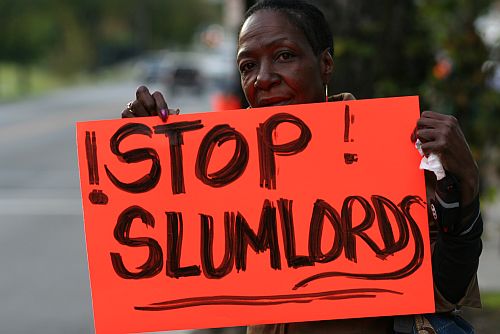
This success came after years of hard work. Tenant organizing efforts at Marbury actually date back to 2005, when an explosion in a laundry room killed a mother and young daughter. Tenants organized RAMP (Residential Association of Marbury Plaza) to build support for the family of the victims -- and also to push for investigations, repairs, security, and upgrades. Led by Connie Chic Smith and Vanessa Vedder, RAMP saw some measure of success. Vincent Gray, then Ward 7 Councilmember, attended their meetings. Security at the building began to improve. Tenants did not see many building repairs -- but they did learn their rights.
Years later, Marbury Plaza’s owners started looking to sell. DC’s Tenant Opportunity to Purchase Act (TOPA) gives tenants the right to attempt to purchase their building before a landlord sells it to a third party. This was when April got involved: she helped launch the Marbury Plaza Concerned Tenants Association (MPCTA), which worked with the Office of Tenant Advocate to make a purchase proposal for the tenants. In the end, both bids fell through.
But now that the Marbury Tenants Association was mobilized, they picked up where RAMP left off. “Each day at Marbury Plaza brought the possibility of any number of things going wrong. Intermittent heat, hot water and air conditioning, roaches, mice, leaks -- it was always something,” according to April. Tenants decided to take things to another level.
April first came to Bread for the City in October of 2008, seeking legal advice for a rent strike. A group of ten tenants were ready to withhold their rent in demand of improvements. They knew that by taking this action they were risking their very homes -- but they believed the law was on their side.
“When Bread for the City heard there were major problems with the building and the tenants had decided to hold the management accountable, I didn’t hesitate to offer our assistance,” recalls Stacey Long, who was Director of Advocacy at Bread for the City at the time, and helped initiate the relationship. “We recognized [Marbury’s] significance as a fixture within the community.”
This connection made for a strong team. “As the tenants designed their overall campaign plan, we were able to offer our legal skills to help them achieve specific campaign goals,” says Phylisa Carter.
“This is the essence of community lawyering,” she explains. “We offer our tactical legal capacity as one key piece of the process for a community trying to build its own power.”
“Bread for the City helped us get educated and organized,” explains April. “They have a great depth of experience and knowledge, and they were able to work with us in a way that wasn’t soft and wasn’t hard, if that makes sense. It was like they were the glue that helped hold us all together. They helped us gain access to justice.”

With BFC’s legal guidance, tenants had confidence that they could sustain the rent strike without losing their homes. The strike grew from 10 to 80 tenants; and when the tenants were sued in Landlord/Tenant court for non-payment of rent, our lawyers represented them. Many of these tenants were struggling with unemployment, or elderly and receiving public assistance (like social security insurance). When they needed help, we were able to connect them to services like our food pantry and case management. When another fire left victims without a wardrobe, our clothing bank became an essential resource for them.
With Bread for the City representing the tenants in negotiations, the case came to the attention of DC Attorney General Peter Nickles.
“The Attorney General was instrumental in bringing all of the parties to the negotiating table,” says Phylisa, “including the Office of the Tenant Advocate and the Department of Consumer and Regulatory Affairs [the city agency that handles housing inspections].” Under his direction, relatively swift progress was made towards resolving the rent strike and reaching a settlement that would satisfy all parties.
Just this month, the settlement was announced: The management company has agreed to invest $5 million into repairs and upgrades. Tenants will also receive significant abatements on their rent.
The deal is not yet officially done. 80% of the rent strikers must first sign on to the settlement -- but April is cautiously optimistic. “I think this is a really positive step for everyone,” explains April. “We’re looking at a complete replacement of the major systems like air conditioning, heat, hot water, ventilation... and we’re talking about real permanent repairs, not quick fixes that would just break right away. We’re looking to see new things like security cameras, more secure access to the building, and compliance with ADA [Americans with Disabilities Act].”
“Despite fears about putting our whole lives on the line, we stuck it out and had a huge victory.” Furthermore, the experience has been an invaluable political and organizational education for Marbury tenants. “I believe we [at Marbury Plaza] are the first tenant group in the city to have gone through both a TOPA process and a housing code violations campaign. We know what we’re doing now, we now how the system works. If the owners try to sell again, we’ll be ready to buy it ourselves.”
In the meantime, there’s lots of other good work to be done. “This settlement gives us, as a tenant’s association, the opportunity not to be tied up in court,” says April with excitement. “We’re able to spend our time and energy building community, hosting events, doing parent education -- health education and finance education. We can make Marbury the jewel of the community once again.”
And you can help Bread for the City continue to work with tenants across the city, empowering them to assert their rights and gain control over their homes. It's hard work -- but as we see through this victory, it's transformative work. Make a donation to our legal clinic today: www.breadforthecity.org/marburyplaza
August 24, 2010
Paging Dr. Seuss to the Medical Clinic
 Back to school is a busy time of year for families here in the District. It’s also a busy time of year in our medical clinic, as parents strive to ensure that their children are up-to-date with their check-ups and vaccinations before that first day of class.
But shots are not the only thing distributed here at Bread for the City. Nearly all young children who visit our medical clinic also walk away with a new book to read.
These books are provided through Reach Out and Read, a national program of which we became a DC coalition member in 2007. This program is designed to promote the love of reading to children at a young age (infant to 5-years-old) in order to establish the early foundations of literacy. Families served by the program read together more often, and their children enter kindergarten better prepared to succeed, with larger vocabularies, stronger language skills, and a developmental edge over their peers. With nearly one in five DC residents functioning at or below the basic prose literacy level, this program is a simple way that we can help future generations break the cycle of illiteracy and, in turn, poverty.
Believe it or not, a medical clinic provides a fine setting for encouraging literacy – especially a medical home like ours, in which we practice holistic primary care. Parents are encouraged to bring their kids in regularly and often for well child exams and to assess development in the critical formative years (many parents don’t even need the encouragement).
By using books during routine exams, providers empower families with the tools to develop language skills, vocabulary, and concepts—building blocks essential not only for reading, but also good health. Promoting healthy lifestyles with families is a basic principle, but now providers can also promote reading and the love of learning during exams.
For parents who themselves are illiterate, this task poses special difficulties—as they might prefer for their children not to see them struggling with reading themselves. However, even these parents can help. Our providers encourage parents who struggle with reading to simply describe for their children what is happening in the pictures on each page, and work with the child to correlate the image with the words being spoken and shown on printed page. This collaborative process is educational and bonding.
But in households where the budget is tight, necessities (food, rent) often take precedence over items such as books, much to the detriment of the child’s educational development. For many parents, a free book and a word of encouragement makes a world of difference – and for the child, it gives them a reason to look forward to the next visit to Bread for the City.
To our family nurse practitioner, Heather Rivasplata, the Reach Out and Read Program is made worthwhile when she sees children who have participated in our program go on to success in school. One such success is Jerson, a second grader and medical clinic patient for the past four years. Jerson and his family dropped by last week for a check-up and his parents mentioned how much he has really taken to reading books, many of which they’ve received from our clinic. At hearing this, Heather informed him and his parents about the local libraries, where Jerson can borrow any number of books for free. Jerson’s eyes lit up at hearing that remarkable news; in all likelihood, he has already become a new regular at his local branch.
So what can you do to help? We are currently accepting donations of new or gently used children’s books at our Northwest Center location. We need books for pre-school children the most. Bi-lingual books, especially in Spanish, are particularly welcome. Books can be dropped off at our Northwest Center location at 1525 7th Street, NW. Should you have any questions about making book donations, please contact Erin Garnaas-Holmes at eholmes@breadforthecity.org. And remember, every book we receive will give yet another family a reason to foster the love of reading in their children.
August 23, 2010
A Rooftop Garden, One Pot at a Time
 Local. Organic. Sustainable. Great buzzwords. But for an organization dedicated to meeting so many urgent immediate needs, "going green" can seem like a daunting prospect.
Yet even the smallest seed can, with care, grow into great bounty. So, recently, at our Southeast facility, we've started planting some seeds in the one part of our building that isn't already bursting at the seams: the roof.
Up to this point, the roof has primarily been known as a great place to get locked out on. But now it features the budding of a small experimental container garden. So far this season, we have been growing radishes, tomatoes, and several types of herbs, including parsley, mint and oregano. Someday soon, we hope this garden will be the inspiration for lots of inter-generational learning, as well as "some darn good cooking."
| Sherita Evans, Community Resources Coordinator |
Sherita adds that the recent loss of Food Program Director Ted Pringle has motivated her to redouble commitment to the garden project. "As a site of rebirth and growth," she says, "this is a proper memorial to Ted."
Though its productive capacity will be limited, the garden can produce ample herbs to complement the food from our pantry, which will be especially great for our new cooking workshops. This makes it a special complement to our Nutrition Initiative: an opportunity to demonstrate the cooking process from start to finish. "We want to show clients that growing your own food isn't hard even in small spaces like balconies and window sills," says Sharon Gruber, our Nutrition Consultant. "And the results are that much better!
 |
| Sharon's workshops can include basic gardening and the use of fresh herbs and veggies |
Despite the small scale of the project, we see big implications -- like the opportunity for parent-child gardening classes, which could bring families closer together while bringing them closer to the food they eat. Recent research has show childhood fruit and vegetable consumption doubles when children are exposed to the process of growing and preparing their food. Moreover, "food habits and eating patterns learned in early childhood continue into later childhood and early adulthood...This means that emphasizing healthy food choices at an early age can have a major impact on a person's future health," says a study recently published in the journal Nutrition and Dietetics.

One driving force behind the project's progress so far has been Anna Melton, a familiar volunteer face around Bread for the City Southeast. Anna, who recently moved to the neighborhood, has cultivated a community garden in her own backyard, and believes in the transformative power of communal green space.
Anna approached Garden District, a popular garden store in the Columbia Heights neighborhood. We're pleased to say that Garden District provided our new garden with its first donation: 4 bags of soil, a few pots and several plants, including tomatoes, oregano and parsley. Old City Green also pledged six pots of mint and nine pot of stevia, a natural sweetener that will provide a healthy alternative to the processed sugar found in most packaged and prepared foods.
Most exciting of all: Frager's Hardware (just across the river from us) pledged to donate marjoram, basil, fennel, chives, catnip (which you can actually cook with), and sage -- but when Anna came to pick it up, they also decided to chip in about 5 flats of cabbage and cauliflower. "[The plants] don't look great, since it's near the end of the growing season, so people might not have been eager to buy them, and they might otherwise have gone to waste" says an excited Anna. "But they're still very much alive and will thrive with a little bit of attention and sun." Altogether, this donation has more than doubled the size of our fledgling garden -- thank you Frager's!
Anna now plans to canvas additional local hardware and garden stores, and is looking for help and donations. She says: "We are hoping for pots of all sizes and types, vegetable and herb seedlings and cuttings, potting soil and plant supports (ie: trellises and garden wire). If you would like to help, please contact me at anna.r.melton@gmail.com"
Above all, this project is ultimately about the two things that Bread for the City strives for most: dignity and respect. Says Anna, "even having a small pot of something you can say you grew yourself is pretty amazing."
August 19, 2010
Bags, Bags and More Bags!
The numbers are even more impressive than it may seem at first glance. Our food packages are pretty heavy (at least three complete days’ worth), so we triple-bag each parcel to ensure our clients can get it all home safely. That means each reusable bag replaces two plastic bags and a paper bag, which means that this reusable bag drive has already saved 40,000 plastic bags and 20,000 paper bags in our pantries alone.

As we’ve said before, this is not just good for the environment -- it’s also a real help to our clients, who are already over-budget and overwhelmed. For people with a monthly food budget of well under $100, the 5¢-per-bag Bag Tax takes a significant toll at the check-out line.
One thing we haven’t talked about yet is how these reusable bags also benefit Bread for the City. Plastic bags cost us 5¢ a piece, and paper bags cost 8¢, so these reusable bags save us 18¢ per client. with your help, BFC has already saved $3,600. That is $3,600 left in our food budget to spend on nutritious food for our clients.
All this benefit compounds over time, too. We’re already seeing clients bringing bags back for this month’s food -- we estimate that on any given day, 25% of our pantries’ clients bring back reusable bags. We did take some measures to ensure a high rate of return: since we hand out only one reusable bag per client, we remind clients that if they bring their reusable bags back, for re-use, they can receive an extra pound of fruits and vegetables of their choosing. (Thanks to our Glean for the City project, this additional outlay of fresh produce costs us literally nothing.)
One mother at our Southeast pantry told me, “I like the variety of vegetables. My kids love veggies and now ... we can get the good food we can’t afford at the grocery store from Bread for the City.”

On that note: our search for reusable bags is never over. Already, 15 organizations, churches, law firms have donated reusable bags to our pantry, no to mention the generous individual contributions. You can help too by organizing a reusable bag drive at work or in your community. Or just clean out your own pantry and send them our way! Contact Jeffrey Wankel at jwankel@breadforthecity.org for details.
August 17, 2010
Gleaners Rescue Corn
This past Saturday, Parker Farms and Bread for the City hosted yet another Glean for the City adventure. Our mission this time around was especially critical - rescuing yellow corn.
"I've never seen it this bad," said Rod Parker, shaking his head. "1% infestation is bad. 5% and you might break even. We're at 8% right now."  Rod is referring to a pest known as corn earworm. (They're pretty gross.) This season, the infestation is so bad that Rod has been forced to abandon over 80 acres of corn. Eighty. Acres. Rod says it's just not cost effective to fight them anymore.
That's where our gleaning heroes came in. We made the 90 minute trek down to Parker Farms in Colonial Beach, VA to rescue the corn and bring it back to our clients at Bread for the City-- the worm free corn, that is. While a high percentage of corn is infested with the corn earworm, an even higher percentage of corn is perfectly edible. (And really delicious! Ever eat corn right off the stalk? Can't get much fresher than that...) After a couple hours' work, our 12 volunteers gleaned over 2,000 pounds of fresh, free, delicious yellow corn. Check out the August 14 photo gallery on our Flickr page.
Without our volunteers and Glean for the City, 80 acres of corn would become 80 acres of compost. (Really expensive compost.) Although devastated with the loss of so much corn, Rod says that the blow is softened by knowing that Bread for the City can make use of what is left of his corn crop. While we won't be able to rescue all of the corn, we can do our part to salvage what we can; 2,000 pounds at a time. And you can help! Contact Vince Hill at VHill@BreadfortheCity.org to sign up for a gleaning trip. With the harvest season about to kick into high gear, there are plenty of gleaning trips left. Don't miss out!
August 12, 2010
Kudos to Client Choice
We’ve previewed this new project on Beyond Bread before: in A Week of Choice, food pantry coordinator Jeffrey Wankel told you that, “after two successful dry-runs, Client Choice...went live for an entire week at our Southeast Center,” teaching us all a very important lesson. “Our clients love the ability to choose what food they receive from our pantry. This alone makes it a priority for us to implement Client Choice as a permanent feature of our food program.”
So we’re pleased to report that the Southeast pantry is now all Client Choice all the time--to the rave reviews of clients, staff and volunteers.
According to Food Coordinator Tony Weldon, the Client Choice program “sets us apart from a church basement, or something like that, even just with the visual effect,” he explains.
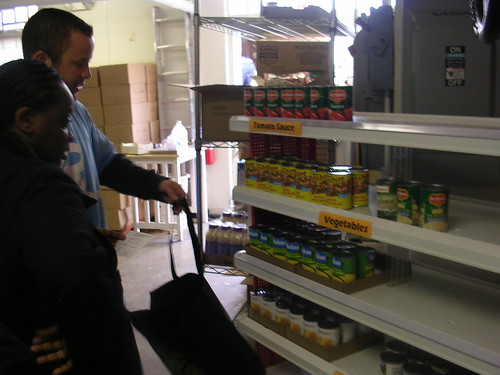
The pantry now boasts new shelving units and a layout that is carefully constructed to guide clients through the array of options. After a few months of tweaking, Jeff is proud to note that the “cycle time” (i.e., the average length of each client’s time checking in and receiving their bags) is now comparable to the previous system.
Most of all, the clients love it. “This is their words,” Tony said: “‘Wow! Ya’ll stepped your game up!”
Another positive side-effect of this new system: volunteers and clients actually get to know each other. “Client choice has opened the lines of communication.. and there is noticeably more constructive feedback.” Volunteers are able to learn more about the clients they serve, and clients enjoy seeing familiar faces month after month.

Meanwhile, Client Choice has made our staff less busy. That may seem counterintuitive, since there are more decisions being made with every single bag we give out. And yet, prior to Choice, Tony and his food pantry staff were responsible not only for distributing bags to clients, but also for supervising the volunteers who stuffed bags. Managing both sides -- on top of the day-to-day logistics of orders and deliveries and so on -- stretched pantry staff to their limits. With Client Choice, clients pack their own bags, while volunteers guide them from station to station. It’s all one process. Tony and his staff still oversee pantry operations, but they’re left with more time to chat with clients, get to know volunteers, and tinker with big-picture aspects of the system.
“We still get to see their smiles, and that is great,” said Tony.
Client Choice has become more than just an experimental program, or a way to shake things up in the food pantry world. It is a chance for our clients to exercise their independence even in the most difficult of circumstances. And it is a testament to the commitment and dedication of the late, great Ted Pringle, who -- in his final months at the pantry -- took just one look at the Client Choice experiment and declared his utmost support for the program.
Jeff, who helped develop the Client Choice program in SE, hopes to “make Client Choice an organization-wide initiative,” once the pending Northwest Center expansion broadens the food pantry space to allow for a similar setup. Eventually, Jeff hopes both food pantries will feature slanted produce tables and a larger variety of food, to give our clients an even more independent shopping experience. It’s going to be difficult, budget-wise, but Jeff says that “this is something we just have to do. We really have no choice.”
August 11, 2010
Bread's First CSA Share!
Bread for the City has often written about our wish list and the generous volunteers and contributors that make our work possible, but sometimes there is someone who gives BFC and our clients something we didn’t even know we needed.
Take, for example, Martha Byers. A District resident, Ms. Byers was initially interested in purchasing a Community Supported Agriculture [CSA] share herself but realized it was an unrealistic addition to her lifestyle. CSA shares provide, for a yearly fee, fresh produce from local, often organic farms, which share-holders pick up weekly at a designated site. Although Ms. Byers loved the idea of supporting local farmers while supplementing her groceries with fresh fruits and vegetables, “I don’t cook (much) and my work schedule would make it a hardship to pick up the stuff anyway.”
Instead, Ms. Byers donated her share to Bread for the City, providing our clients with another option for their fruits and veggies in a unique contribution to our food security efforts. “As much as it’s [in] the media about CSAs, and the nutrition needed for undeserved areas, I thought I could...contribute to a concrete need,” said Ms. Byers.
Marie Hoffman, a regular BFC volunteer who works as a front desk administrator in the medical clinic, picks up the CSA weekly and reports the donation often brings in even more produce than planned. The CSA pickup site sometimes provide an extra share to non-profits towards the end of the pick-up period, and BFC has been the benefactor of this practice several times. In an email to Ms. Byers, Ms. Hoffman said, “the produce-- vegetables and fruits-- are amazing. And we always manage to receive at least one more full share: your goodwill is contagious, you see!”
Thank you Martha Byers and Marie Hoffman for your creative contributions of Bread for the City clients!
-------------------------------
Over the last 20 years, Community Supported Agriculture (CSA) has become a popular way for consumers to buy local, seasonal food directly from a farmer. To find a CSA near you, please visit http://www.localharvest.org/csa/.
August 5, 2010
The Mega-Glean!
Post by BFC intern Vicky Gan.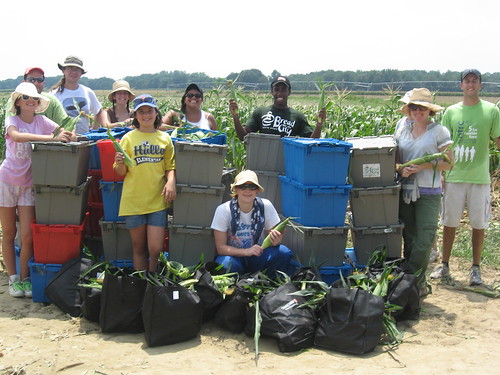
This Saturday, August 7th, Bread for the City will send out our largest Glean for the City expedition yet. This time, we will be partnering with Miriam’s Kitchen, which provides hot meals and case management services to homeless men and women. 35 dedicated Bread for the City volunteers will be joined by 15 Miriam’s Kitchen volunteers. We’ll drive to Parker Farms with a fleet of vehicles that will bring back almost 4,000 pounds of sweet corn.
This is our second season of Glean for the City, and our first collaborative glean. We expect to pack both of our pantries pretty much to capacity. Miriam’s Kitchen, which has recently begun serving dinner in addition to breakfast, will be using the sweet corn to make corn salad, corn soup, and good ol’ corn on the cob.
The organization’s development and volunteer manager, Ashley Lawson, has this to say about the upcoming event:
We very rarely have full ears of corn to serve our guests, so we are very excited to spend the day picking enough corn so each Miriam’s guest can get their fill of corn for dinner next week. Our volunteers are looking forward to this unique afternoon, and we are grateful to Parker Farms for being so generous with their crop. Even more so, we are appreciative to Bread for the City for the invitation to collaborate. We hope this is the start of many gleaning days!
We’ll also be sharing some of our glean with the DCPCA’s Ward 8 ‘Family Fun Day’ on August 14, 2010. The event will be from 11AM to 3PM at Ketcham Elementary School (1919 15th Street SE), and will offer food (corn and more!), exercise and fun activities with live music and local vendors providing tips and information on healthy living. (Contact Emily Roberts at (202) 638‐0252, x220.)
If you’re interested in volunteering, or if your community group or organization might want to partner with us on future mega-gleans, please email Vince Hill. In the meantime, if you'd like to support this work, you can help us cover the cost of transportation and other things like bins, bags, gloves, and so on, by making a donation to Glean for the City today.


 Posts
Posts


