Showing posts with label client choice. Show all posts

December 28, 2010

Quality: Improved

Bread for the City’s food pantries have recently changed the way we give out food, switching from pre-packaging grocery bags to a Client Choice model. It can be difficult to change the ways we've been working for decades, but we're being careful to use quality improvement (Q.I.) tactics -- carefully measuring discrete changes to our system, one by one. The positive results are happening quickly.

Once we'd already achieved our desired cycle time (i.e. the length of an average client visit into the pantry) in the Client Choice model, we turned our attention to another Quality Improvement measure: increasing the amount of fresh veggies that our clients choose to take home.

Fresh vegetables are essential to good health; and since our nutrition initiative began 2 years ago, Bread for the City has drastically increased our produce distribution. But we don’t just want to give away more produce; we want our clients to want more produce. And we think that Client Choice provides a great opportunity to educate about the health benefits of fresh produce -- and also a great metric by which to gauge our progress.

Our food pantry offers a variety of vegetable options, both canned and fresh. So we simply kept track of the ratio of fresh vs. canned veggies that clients chose to take home. During our first sample, 41% of veggies taken home were fresh. That’s not bad (keep in mind many elderly and disable patients require the ease of cans, and large families often opt for cans because they take up less space in bags)...but we thought we could do better.

So the following week, we tested two tweaks, in search of quality improvement:

1) We moved the produce to eye level and added one extra produce display shelf.

2) We installed signs with easy to read produce names and nutrition facts (Ex: "Eating greens lowers cholesterol and helps your heart!").

These simple changes packed an impressive punch. In our second sample, we observed a 61% take home rate for fresh veggies -- that's a 20% spike from our first sample!

We're going to continue to experiment with the layout and procedure in our food pantries in the new year. And of course we're always eager to hear your ideas. All interested parties are encouraged to come take a tour, see how it works, volunteer a bit, and let us know *your* ideas.

November 3, 2010

Getting Better All the Time

On September 23rd, Bread for the City started implementing our Client Choice model in our Northwest Food Pantry, based on its great success in our Southeast Center.

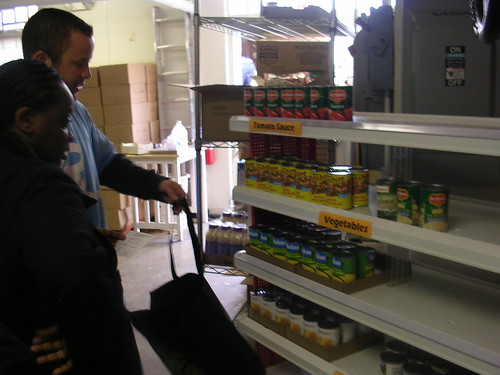
I’m pleased to report that Northwest client choice is running smoothly, thanks to the efforts of staff and volunteers and the willingness of clients to try something new. Gone, now, are the days of prepackaged grocery bags, repetitive meals and wasted food! Instead, our pantry has a spiffy, spacious new layout that’s more like a grocery store than a warehouse.

It’s a pretty major change that pivots away from the way our food pantry has worked for decades—and it was undertaken gradually, methodically, and to widespread satisfaction. Feedback tells us that this new system is favored over our old system by clients, volunteers, and staff!

All part of the plan. Specifically, the plan for Quality Improvement. Quality Improvement (QI) is a specific organizational development model that we’ve adopted at Bread for the City in order to assess and improve our own services. The basic idea of QI is that we can improve our services by making slight changes, tracking measurable data that reveals the effect of that small change, and then continuing to tweak and assess accordingly.

For example, in the food pantry, we’ve been tracking “cycle time”, or how long it takes one client to enter the pantry, get processed in our computer system, and go through the pantry to pick out their food. Cycle time before client choice would hover between 4 and 5 minutes.

As you can see in the graph below, our “cycle times” in the the Southeast food pantry shot up when we first implemented Client Choice, but they consistently improved thereafter, to the point where it was just as fast as it was before Client Choice -- even faster!


We had a few hiccups that taught us useful information, like that the cycle time depends heavily on volunteers. Using the QI method, we determined that if we don’t have enough volunteers on any given day, the cycle time shoots up (like it did in early April) -- but as our volunteers learn the new system over time, cycle time gradually decreases.

Once our staff and volunteers knew the best ways to run the system, it was easy for them to help transfer the model to our Northwest center. We’ve been running client choice in NW for almost a month, and cycle time started off at and has hovered around 5 minutes.

This is just one of the QI initiatives that Bread for the City has taken on. We’ve also used QI to improve both staff and client use of our phone system, wait-time for our medical clinic patients, and ways that our staff shares information. (Special shout-out here goes to BFC's Special Projects Manager Julia Eddy, our Super QI Enfabulousinator.)

Bread for the City: good work is good, better work is even better!

August 12, 2010

Kudos to Client Choice

Communities east of the Anacostia River suffer from an infamous shortage of grocery stores, and here at Bread for the City we’re doing our part to counteract that lack: we’ve made our food pantry a lot more like the shopping experience.

We’ve previewed this new project on Beyond Bread before: in A Week of Choice, food pantry coordinator Jeffrey Wankel told you that, “after two successful dry-runs, Client Choice...went live for an entire week at our Southeast Center,” teaching us all a very important lesson. “Our clients love the ability to choose what food they receive from our pantry. This alone makes it a priority for us to implement Client Choice as a permanent feature of our food program.”

So we’re pleased to report that the Southeast pantry is now all Client Choice all the time--to the rave reviews of clients, staff and volunteers.

According to Food Coordinator Tony Weldon, the Client Choice program “sets us apart from a church basement, or something like that, even just with the visual effect,” he explains.


The pantry now boasts new shelving units and a layout that is carefully constructed to guide clients through the array of options. After a few months of tweaking, Jeff is proud to note that the “cycle time” (i.e., the average length of each client’s time checking in and receiving their bags) is now comparable to the previous system.

Most of all, the clients love it. “This is their words,” Tony said: “‘Wow! Ya’ll stepped your game up!”


Another positive side-effect of this new system: volunteers and clients actually get to know each other. “Client choice has opened the lines of communication.. and there is noticeably more constructive feedback.” Volunteers are able to learn more about the clients they serve, and clients enjoy seeing familiar faces month after month.


Meanwhile, Client Choice has made our staff less busy. That may seem counterintuitive, since there are more decisions being made with every single bag we give out. And yet, prior to Choice, Tony and his food pantry staff were responsible not only for distributing bags to clients, but also for supervising the volunteers who stuffed bags. Managing both sides -- on top of the day-to-day logistics of orders and deliveries and so on -- stretched pantry staff to their limits. With Client Choice, clients pack their own bags, while volunteers guide them from station to station. It’s all one process. Tony and his staff still oversee pantry operations, but they’re left with more time to chat with clients, get to know volunteers, and tinker with big-picture aspects of the system.

“We still get to see their smiles, and that is great,” said Tony.

Client Choice has become more than just an experimental program, or a way to shake things up in the food pantry world. It is a chance for our clients to exercise their independence even in the most difficult of circumstances. And it is a testament to the commitment and dedication of the late, great Ted Pringle, who -- in his final months at the pantry -- took just one look at the Client Choice experiment and declared his utmost support for the program.

Jeff, who helped develop the Client Choice program in SE, hopes to “make Client Choice an organization-wide initiative,” once the pending Northwest Center expansion broadens the food pantry space to allow for a similar setup. Eventually, Jeff hopes both food pantries will feature slanted produce tables and a larger variety of food, to give our clients an even more independent shopping experience. It’s going to be difficult, budget-wise, but Jeff says that “this is something we just have to do. We really have no choice.”


April 26, 2010

A week of choice!

After two successful dry-runs, Client Choice recently went live for an entire week at our Southeast Center, and these experiments have made one thing perfectly clear: our clients love the ability to choose what food they receive from our pantry. This alone makes it a priority for us to implement Client Choice as a permanent feature of our food program.

Permanently instituting Client Choice is going to take time and work. Our average "cycle time" (the total time it takes for a client to receive a bag) is a lean 4 minutes in the regular pantry setup; during the choice experiments our cycle time averaged 6.7 minutes. That's not bad, but we do want to keep our pantry as efficient as possible -- so we intend to tinker with the pantry's layout, adding new tables that mimic a grocery store experience.

We are also developing a volunteer training module, breaking out everything step-by-step, so that experienced volunteers can easily train first-timers, and staff have the help they need to carry the extra workload.

Even with increased cycle times, however, we find that most clients don’t mind the extra waiting. As one client explained, “I don’t mind waiting if I get to shop for what I like. This is fun!” This sentiment is music to our ears. But despite this, we want to be sensitive to people's schedules. Sometimes a client needs to make a job interview, catch a bus, or pick up their kids from school. So we intend to offer a choice for choice. If clients need to rush out, pre-made bags will be ready and waiting for them.

Client Choice embodies the very mission of BFC: identifying opportunities to meet people's needs in an environment of dignity and respect. For people who often have little control over their circumstances, we believe it is important to establish an opportunity for them to decide what food they need from us. With that in mind we will continue our choice experiment and make improvements until it becomes a permanent feature of our pantry.

March 17, 2010

Client Choice 2.0

We recently took the first step in an exciting new direction for our food pantry: opening up our menu so that clients can choose which foods they receive.


This first experiment (conducted on Jan 28th) received glowing feedback from clients, who really appreciated being able to select the items in their grocery bag. It was also, however, far from practical: the average time it took to distribute each bag – from the moment a client was called to the moment they walked away with their bag – was 12 minutes. (Our pantry’s normal average “cycle time” is 4 minutes.)

Carefully examining the results of this experiment, we arrived at 2 primary goals for our client choice endeavor: reduce cycle time and increase client-volunteer interaction. Our hunch was that these objectives can be best achieved together.
So last week, we took our second step in this great experiment.

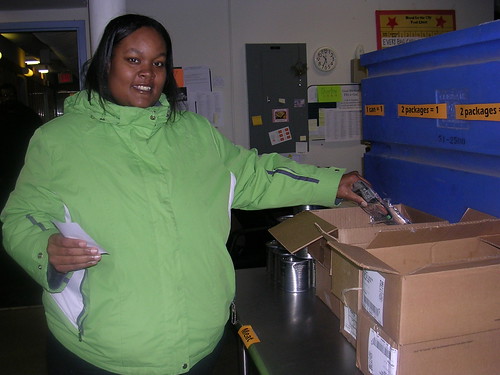
This time, instead of our staff accompanying clients as they “shopped” through the pantry, we assigned volunteers to specific food stations. (These volunteers came from Elizabethtown College on alternative spring break). These helpers would greet each client at each station, politely explain the options and help clients load their bags.

People noticed this improved “customer service”. One client remarked that “this is like shopping at my own little Costco!”

Furthermore, we were thrilled to note that these stationary volunteers reduced congestion and improved cycle times. This second experiment dropped the average cycle time to 7 minutes – within reach of our standard non-choice cycle time of 4 minutes!

One result was less tangible but possibly just as important: the engagement between our volunteers, our staff, and our clients. Normally, our volunteers just sort cans and pack bags. This was a totally different experience. As volunteer Amy Yoder explained, “I used to work in a soup kitchen and they never let us interact with clients. Here I was able to talk to the people I am helping.” As a result, the room was filled with positive energy. Direct contact allowed clients and volunteers to become more connected and understand things about one another. The clients learned about the people helping them; and the volunteers began to understand why choice is so important. This is why Erin Garnaas-Holmes, BFC’s volunteer coordinator, calls client interaction ‘the holy grail of volunteering’ .

Volunteer Stephanie Carroll added, “I think choice gives clients a greater sense of self-respect. Instead of just receiving a handout, they seem really happy to have a choice. Everyone was smiling.”

We’re going to keep experimenting with client choice, and will keep you updated. In the meantime, we’ll leave you with this comment: “On a scale of 1-5, I give this a 10. You have got to keep this going. I love choosing. Before I used to get things I didn’t like. I will still eat it; but it makes me happier to have my favorites. You all NEED to keep this up!”

March 4, 2010

Our new pantry experiment: Choose your food

Most days, clients of Bread for the City’s pantry take a number, wait their turn, and receive a standard bag of pre-packaged groceries. These bags are carefully balanced to provide a rounded set of food items – canned fruit and vegetables, a packet of rice, a meat item, etc, in proportion with the size of a client's family. Recently, however, we started to change things up a bit.

In the past few years, as part of our mission to serve and care for people in an atmosphere of dignity and respect, we’ve overhauled our pantry menu to feature an array of more nutritious items. The results of that Nutrition Initiative were really positive: healthier diets and higher client satisfaction.

Now we are experimenting with pantry innovation once again: exploring opportunities to enable client choice in our pantry menu. We envision a food pantry in which people can select which food they bring home, just like they would at a grocery store.

To be sure, this would be a logistical challenge. But there’s quite a few reasons why client choice would be an effective process. For one, Bread for the City is not the only source of food for our clients; many clients may already have sufficient amounts of certain kinds of food, but may be in greater need of others. Some of our clients have special dietary needs that make certain foods especially important, and others not helpful at all. And most of all, as our nutrition consultant Sharon Gruber says: “one of the most debilitating things about living with a low income is a lack of control — and food is one of the most basic things that we can or cannot control in our lives.”

Louise Thundercloud, a longtime Bread for the City client and community activist, wrote about that very point on this blog, explaining that a lack of control over food “is related to the problem of very low self esteem: feeling as though you deserve only what is given to you, because you feel so terrible about yourself.”

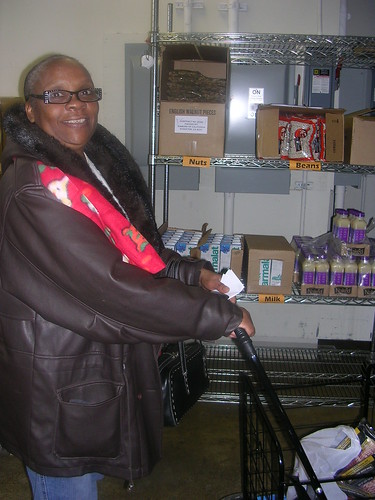
So on January 28th, we transformed our Southeast Center food pantry into a makeshift grocery store. Armed with a reusable bag, clients selected every component of their groceries. Bread for the City staff engaged directly with clients to help put together food bags. Clients pondered their choices, happily snatching favorites while politely declining other items they might not want or need. Staff laughed with clients and chatted about the choice experiment.

“Choice is much better! I get to pick what I want. This month I have enough cans and dry goods, I just needed meat and fresh veggies.”

Indeed we noticed that, when given options, clients displayed a clear preference to avoid waste, and many even took pride in leaving food behind for others.

We asked each client survey questions after shopping, and 97% of participants rated the experience a 5 out of 5. I asked one beaming client what she thought, and she replied, “I love this because I get to pick out the best options for me. Please keep it going!”

Stay tuned for more results of this exciting new experiment…