Showing posts with label AmeriCorps. Show all posts

April 29, 2011

We Join U.S. Secretary of Agriculture Tom Vilsack in the fight to end hunger

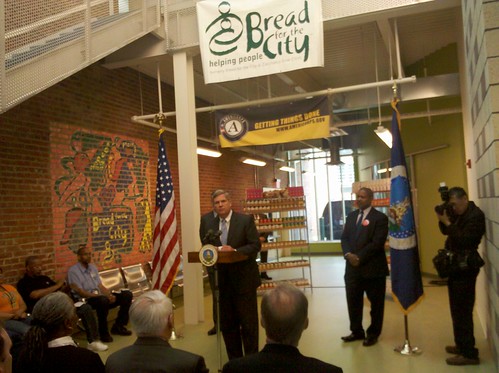
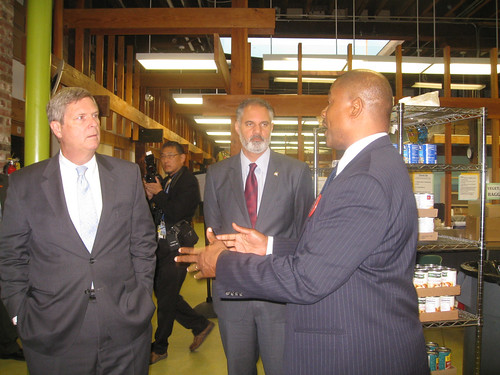
We had an honor of a visit today: U.S. Secretary of Agriculture Tom Vilsack came to Bread for the City.

"It's amazing what's being done here," Secretary Vilsack told us. "You are doing phenomenal work, making a difference in the lives of people every day."

The Secretary was here to announce important new federal anti-hunger initiatives. More than 50 million Americans are "food insecure" (in other words, they struggle daily to acquire nutritionally adequate food). Here in DC, one in eight people are food insecure, including two out of every five children.


"These are friends and neighbors, folks we know," said Secretary Vilsack.

It's an outrage. And it's a complex problem with no easy solutions. However, Secretary Vilsack and I both agree: the solutions are there. It's just up to us to make them work.

So let's get started. Will you stand with us?

Today, Secretary Vilsack unveiled new USDA resources like an anti-hunger tool kit for community leaders like us, and an online commitment drive for pledges of anti-hunger action. "It's necessary for the community to get engaged to ensure that these youngsters are not left alone," said the Secretary.

See more about these USDA initiatives at their new website: Endhunger.USDA.gov

We've been working long and hard to end hunger. Bread for the City now offers food assistance to more than 23,000 people in a year, making us the largest food pantry in DC. With the hard work of Americorps members and volunteers like you, we've launched initiatives like Glean for the City to great success, reaping tens of thousands of pounds of surplus produce that now goes to the tables of the hungry instead of to waste.

But providing food to the hungry is just the start.

In recent years, we've helped to successfully lobby the District government to expand eligibility for food stamps in our city. Through cooking classes, we are actively promoting change at home. And our rooftop garden project is creating a vision of a healthy, green community right above us.

We know we can't do it alone. It's up to all of us. As Secretary Vilsack said today, "It’s not just the responsibility of the volunteers of the country, or the non-profits of the country, or the Department of Agriculture. It’s our individual responsibility to be engaged." That's why our clients and staff have joined 35 organizations, coalitions, and passionate individuals around the city to call for the creation of a formal food systems network in DC.

And there are so many ways we can push for a hunger-free community -- and they all start with you. So will you answer Secretary Vilsack's call? Stand with the USDA, Americorps, Bread for the City and your fellow neighbors as we work together to eliminate hunger from our cities.

Make a donation today, as we champion the effort for a hunger-free community.

Stay tuned for more reports from today's exciting event. Meanwhile, join the DC Food For All google group if you'd like to learn about how to work for food justice right here in the District today.

February 17, 2011

Protect Americorps!

There is a bill before congress this week that, if passed, would completely dismantle Americorps, the program that places full-time volunteers in non-profit and government agencies for one or two years while giving them a (very) modest stipend and a grant award to be spent on education. This would eliminate thousands of jobs and destroy a programs that encourage social innovation and social change around the country.

As we’ve written about here before, Bread for the City depends on several of our staff positions to be filled by full-time volunteers, most of whom are in Americorps programs. These positions are mutually beneficial--Bread for the City gets young, bright, enthusiastic, passionate employees at an extremely affordable rate, and young college graduates get exposure to a real working environment and, more importantly, their eyes are opened to the suffering caused by poverty that Bread for the City faces. Many of these full-time volunteers go on to work for justice throughout the rest of their careers.

If the H.R. 1 passes, Bread for the City will suffer, as would every other organization that has hosted an Americorps member, or those that have hired an Americorps alum and benefited from their experience. Sign this petition to let your representative know you value Americorps, or better yet, call your representative and tell them where you stand!

October 21, 2009

Set AmeriCorps Funding Free (From Taxation)!

There’s an opportunity right now to make volunteer service at a place like Bread for the City just a little more feasible.

A good chunk of Bread for the City’s staff comes to us through various Volunteer Corps programs, like the AmeriCorps Health Corps or the Lutheran Volunteer Corps. These are mostly young people, recent college grads, working for Bread for the City under a year-long contract.

Currently, nine of these full time volunteers fill important roles at Bread, like Medical Clinic Coordinators, Social Service Case Workers, and the Volunteer Coordinator (that’s me!). Volunteers receive a stipend that is only designed to meet very basic needs. Jesuit Volunteers, for instance, receive $75/month for personal expenses after rent and food costs.

One benefit of performing this year of service is the Segal AmeriCorps Education Award, a $4725 grant from the government to help pay for tuition or student loans (next year it will be $5350). Like Jo has written here before, "this funding is not a primary motivating factor in driving someone to service. It’s the “youthful idealism,” rather than the funding, that makes these slots so competitive." But for those of us with new student loans, or saving up to attend graduate school, it does make a real difference.

The way policy is currently written, however, this grant is taxed as income by at least 15%. Since the Award isn’t given in cash—you can think of it as a type of credit that is exchanged between the government and a loan agency—paying the tax comes out of pocket, not out of the Award. This means that some former Corpsmembers end up paying upwards of $500 after using their award. That’s as much as the recent increase yielded by the Kennedy Service Act, about which we've already posted. Also, if a Volunteer Corps worker enters into a full-time position after a year of service, the Education Award can easily bump them up into a higher tax bracket than their payroll, resulting in an often unforeseen tax burden.

A bill is currently before the House Ways and Means Committee, H.R. 1596, the Segal AmeriCorps Education Awards Tax Relief Act, which would exempt the Award from taxes and give volunteers more opportunity to use their dollars in pursuit of educating and bettering themselves. You can take a few minutes out of your day to help ensure the passage of this bill by letting your representatives know that you support the tax relief of AmeriCorps volunteers and that such relief will help supply our communities with educated, economically stable service-minded individuals. (Of course, if you don’t happen to live in DC, then you can take additional comfort in the knowledge that your representative happens to have a vote in Congress.)

May 12, 2009

AmeriCorps: Fixing Student Loans Should be Part of the Expansion


Civil service should come with loan deferment.

We’ve posted before about the Serve America Act (which, among other things, will open up AmeriCorps from 75,000 slots to 250,000 slots nationwide), and the potential for improvements to AmeriCorps for the purposes of fostering civil service in our country. Block grants, as I wrote before, would be a smart step to make sure the funding goes to programs that can put it to best use.

But service still isn’t a viable option for many young Americans – and that needs to change in order to develop a culture of broad civic volunteerism.

One of the most crucial would be to change federal guidelines on student loans. AmeriCorps members are typically just out of college and have racked up a great deal of student loans. Federal Stafford loans can, after a very complicated process, be deferred while a person is in AmeriCorps. Many private loans cannot. Considering that AmeriCorps members live on about $800 a month and have to pay for their own housing, debt can quickly become a problem. Moreover, many students from lower income households are unable to participate in AmeriCorps because the financial investment is so prohibitive.

The deferred Federal Stafford loans can be handled with more consideration as well. Most people leave AmeriCorps having saved no money (for the obvious reason that they’re paid so little). Their first payment on their student loans often comes due right as they’re leaving, when they are looking for a job. As a result, service often poses the wrong kind of sacrifice to volunteers: putting them at risk of insolvency.

If Congress is serious about getting more people involved in community service, one way to show it would be to work with private lenders to allow private loans to be deferred. Streamlining and extending the deferment process for Federal Stafford loans would be another big step forward. This is a way to ease volunteers’ transition back into the job market, and it will inevitably mean more people are able to take advantage of the opportunity to greater positive effect. And as opposed to the expenditures of the Serve America Act, these suggestions would cost little to nothing.

May 6, 2009

AmeriCorps & Civil Service: There's More To Be Done


Slight tweaks could go a long way.

Jo posted yesterday about an on-going discussion we’ve been having. Bread for the City has seven stipended volunteers on staff, either through AmeriCorps or a Volunteer Corps, doing work in almost every program we offer. And in the wake of the Serve America Act, we’ve been talking about ways these civil service programs could be improved. Though Jo was writing primarily about education awards, there is another part of the equation—the monthly stipend.

The Edward Kennedy Serve America Act plans, by 2017, to open AmeriCorps from its present 75,000 slots to 250,000 slots. Though allowing more people to join will help AmeriCorps, and will therefore help direct-service non-profits like us, this alone doesn’t take sufficient steps to make these service opportunities more enticing, effective, and rewarding.

Most AmeriCorps members can look forward to a monthly stipend of about $800 dollars a month. Even if a person is able to find some type of housing for $500 a month (I’m assuming this person is living in a group home, lives in a region not near a metro, lives in substandard conditions, or a mix of all three), that means all of the other expenses per month have to equal $300. We’ve heard from a number of partner organizations that AmeriCorps members have had to work second jobs, rack up huge credit card debt, or terminate their service year early because they couldn’t make ends meet. This is obviously bad news for the participant, who walks away with a negative experience; and it’s also bad news for the non-profit, since it prevents the AmeriCorps member from focusing their full attention to the work they have a passion for and signed up to do.

One easy fix I can see is to open up AmeriCorps funding to locally directed block grants that can be used to support Volunteer Corps stipends. AmeriCorps already handles all of the education awards for Volunteer Corps, so directing money to stipends is not a far stretch.

In a Volunteer Corps, participants still live very simply – with low enough incomes, as Jo wrote, to qualify for food stamps. But they are provided with housing and a support structure. These local groups are already active, are highly competitive, and (as Jo points out) offer much more support than a traditional AmeriCorps slot. Instead of expanding AmeriCorps slots while Volunteer Corps organizations have to continue to raise their own funds, why not direct some of that money to the pre-existing structures that are better equipped to provide a meaningful service experience? We could create better civil service opportunities, faster, with the same amount of funding.

May 5, 2009

Making Service Work

Like many volunteer service workers, I came to Bread for the City filled with things like hope and idealism; after eight months here, all that has butted up against endless emails to Social Security administrators, frustrating phone calls with landlords, endless paperwork, and a level of income that happens to qualify me for food stamps. But as a result, I have a more complete appreciation for how difficult it is to climb out of poverty. And that has been as valuable to me as any education.

This work is of immense value to the community. Michelle Obama recently acknowledged it when she wrote in an op-ed that, “the nation needs youthful idealism more than ever.” Her article itself was vindication for the work that my colleagues and I have done all year. She was writing in recognition of the Edward M. Kennedy Serve America Act, which her husband recently signed into law.

The Act has been hailed as a bill that “will change the course of history and civic responsibility in our country." And indeed, it’s a helpful step toward a revival of civic participation in America – but with all due respect, it’s very much a first one.

The Serve America Act vastly increases the number of AmeriCorps “education awards” (which provide debt relief for student loans), but the increase in size of awards is small: from $4,725 to $5,350. Such funding isn’t quite negligible, but even as a recent graduate in thousands of dollars of student debt, I wouldn’t say that an increase of six hundred dollars or so is substantial.

In my experience this funding is not a primary motivating factor in driving someone to service. It’s the “youthful idealism,” rather than the funding, that makes these slots so competitive.

My own service was conducted through the Lutheran Volunteer Corps (which is not technically part of AmeriCorps, though we can receive AmeriCorps education awards). LVC also provides participants with additional financial support, a programmatic structure, and living accommodations within an intentional community. Through this community, I’ve found the support and inspiration to sustain a year of low pay and difficult work. And with the LVC’s support, Bread for the City has provided me the space and trust to try my hand at the work of social justice. As a result, I consider this year of service to have been a privilege.

And yet, that privilege itself is not as widely available and readily exercised by young Americans as it could be. Debt prevents so many from participating, and those who try anyway must struggle to attain loan relief. Even if a year or more of service can be financially feasible, many are daunted without a proper social network or access to a feasible living situation. Opportunities to serve are taken to best advantage when there is sufficient support inside the program.

Supportive living conditions; sustained and sustaining financial support; social engagement – these are the critical components of my successful service. Through improvements designed to foster these conditions, AmeriCorps could become an even more powerful engine of volunteerism and civic participation.

We’ll be discussing these issues in greater depth in the coming week. It’s an exciting time for those committed to service and social justice, and we hope to see more great progress made in the years to come.

April 28, 2009

National Poverty News Roundup for 28 April

Here in the week following the signing of the Edward M. Kennedy Serve America Act -- a piece of national legislation that, among other things, sets in motion a dramatic expansion of AmeriCorps and inaugurates a new "Summer of Service" program for middle and high school students -- it appears that the need for such service remains as high as ever. Food banks across the country continue to see increased demand and decreased supplies, while tent cities, sometimes populated by long-term residents, continue to be a feature of the contemporary US housing scene. And although we have both successful examples of and expert knowledge about particular policies that can address the problem of homelessness, funding remains a challenge, especially in these economic times.

The economic downturn is not only affecting poverty-reduction efforts in the United States, of course, but is also having an effect globally. US Treasury Secretary Geithner cautioned that international financial institutions needed to alter their practices in order not to give up global gains in fighting poverty, and focus more on "long-term development objectives." The Obama administration is seeking $100 billion in new aid money, and for the first time in its history the IMF has agreed to issue interest-bearing bonds to finance its programs. All this at the very same time that the World Bank has issued a report forecasting that Eastern Europe and Central Asia will see millions of people pushed into poverty over the next few years. In such circumstances, it's inspiring to see rallies and assemblies of concerned groups, raising consciousness and perhaps helping make solutions politically viable.

On another front, things continue to go poorly for the mortgage modification bill that continues to meet with industry opposition as it makes its way through Congress. The relief system at the moment is perverse to the point where, reportedly, some struggling homeowners are purposely skipping mortgage payments in order to qualify for some kind of payment modification from their lenders. This hardly seems like a recipe for a sustainable program of keeping people in their homes. Given other societal and global needs, is a bailout of homeowners with unsustainable mortgages ethically justifiable? Yes, argues Randy Cohen, because "a foolish financial decision need not be a moral failure or even unusual." Agree or disagree, the claim -- and the discussion it provoked -- is worth taking a closer look at.