
Elena A. Alvarez was a translator for the World Bank for decades. She’s now retired, but has continued serving as a translator for Bread for the City. Since 2002, Elena has been a volunteer English-Spanish translator for our Legal Clinic. Ms. Alvarez provides excellent written translations of legal documents, such as settlement agreements and court orders for our housing and family law clients. She has also translated into Spanish many other documents so that the Legal Clinic staff can better communicate with clients, as well as with unrepresented opposing parties who also speak only Spanish. (Elena has translated many documents for our Medical Clinic as well.) Our Legal Clinic, particularly in the NW Center, serves a significant number of Spanish-speaking immigrants. Over the past 8 years, Elena’s pro bono services have saved Bread for the City thousands upon thousands of dollars, money that we have been able to re-direct to other programmatic needs. But, more importantly, thanks to Elena’s expertise and generosity of time, the Legal Clinic has been able to make justice more accessible to our Spanish-speaking clients.
During highly stressful times in our clients’ lives – the threat of losing their housing or custody of a child – Elena’s translations help Bread for the City attorneys make sure that their clients understand what is going on in their case and that their clients are, accordingly, treated with dignity and respect. This is a priceless service to both Bread for the City and our clients, and we cannot thank Elena enough for this gift that she so selflessly keeps giving to us every year.
It is volunteers like Elena that make our work possible. Even after more than 35 years of service, volunteers still remain at the heart of everything we do. And so we gather each fall to honor our volunteers, celebrate the work we've done together, as well as look ahead at accomplishments yet to come. Bread for the City's 5th Annual Good Hope Awards will be held on Thursday, October 7 at the National Press Club. It is a time when we step back and offer a huge "THANK YOU!" to all of our incredible volunteers.
-- Thanks to Su Sie Ju, Esq., our Northwest Legal Clinic Supervisor, for contributing to this post.
September 30, 2010
Volunteer Spotlight: Elena A. Alvarez


September 29, 2010
Free Farmer's Market at Bread for the City Southeast!
 Bread for the City is hosting our very own farmer’s market!
Date: Monday October 4, 2010
Time: 10:00 AM to 12:00 PM
Place: Parking lot of Bread for the City Southeast Center, 1640 Good Hope Rd SE
• Enjoy cooking demonstrations!
• Take home recipes and nutrition tips!
• All participants can receive 1 bag of veggies!
All community members are invited. Tell your friends and families!
September 28, 2010
Volunteer Spotlight: Crooked Run Orchards
 Glean for the City brings back TONS of fresh produce to our food pantries. No, really - TONS. For the NW and SE communities that Bread for the City serves, we are often the only source for fresh produce in the neighborhood. We can boast all day about the successes of Glean for the City. But without our partnering farmers, this project wouldn't exist.
Enter: Crooked Run Orchard.
Crooked Run Orchard is a small, family owned, eco-friendly farm in Purcellville Virginia and has played an integral part shaping Glean for the City. The Orchard provides a beautiful venue for gleanings, with rolling grassy hills and tranquil orchards. On top of donating over 10,000 lbs. of fresh, crisp apples so far this year, the farmers Sam Brown and Ute Ditbreener are mentors and educators for our gleaning coordinators and volunteers. Despite an seemingly unending work load, they are always happy to talk about food security and agriculture.
Although located 50 miles from DC, Sam and Ute didn’t hesitate to allow us onto their land for gleaning. They genuinely care about our clients' health and are grateful to us for giving them the opportunity to serve. As Ute remarked on our last outing, “Nutrition is essential for health and happiness, and you don’t have to be from DC to know there is a shortage of fresh produce. We’ve wanted gleaners for years; we were so thrilled when Bread for the City came to us.”
Sam Brown and Ute Ditbreener will be honored with our Fresh Food Partner award at our 5th Annual Good Hope Awards, coming up next Thursday morning, October 7 at the National Press Club. We look forward to this awards breakfast every year and the opportunity it gives us to thank all of our volunteers for their dedication and service.
-- Thanks to JW for his contributions to this post.
September 24, 2010
10.10.10 Update: Hip Hop Caucus invites you to our Sustainable Food Block Party!

September 23, 2010
Growing for the City
 This summer, we’ve laughed a lot in the sunshine as we’ve propped up sunflowers, made whole-wheat pasta salad with fresh herbs, seen how mint grows, and pulled carrots from the ground (read more here). It’s all part of our effort to better connect to where and how our food is grown. We’re thankful to the Marion Street Garden and Common Good City Farm for partnering with us on this effort; they’ve opened up their doors to Bread for the City staff and clients and shared their bounty.
And we’re starting our own little corner of fruits and vegetables right here, as well. Both the NW and SE sites are currently developing rooftop gardens. Our vision is for them to serve as hubs for cooking and nutrition workshops, opportunities to connect with nature, venues for interested clients to volunteer for Bread for the City (doing watering and plant maintenance work), and just inspiring places to have meetings and lunch.
Check out some of the first pictures of our Southeast garden under construction here, and pictures of our upcoming NW green roof here.
By providing opportunities to sow seeds, maintain plants, harvest produce, cook food, and then, of course, enjoy each bite, we aim to create an experience through which clients feel invested in choosing fruits and vegetables at the market, And recent research supports this approach:
In this month’s Journal of Nutrition & Dietetics, lead researcher Chutima Sirikulchayanonta,of Mahidol University in Bangkok, described a program through which children planted vegetable seeds, had tasting parties, watched Popeye cartoons, sent parents letters with tips on healthful eating, and also had teachers sit with children during lunchtime. This combination of adult involvement and hands-on experience translated to significant results. Vegetable consumption doubled, as did the types of vegetables the children ater.
Perhaps I can best summarize our intentions with a summary of an interaction I had with a regular cooking workshop participant at a recent visit to Common Good City farm.
Client, turning around to me with a fistful of mint: “Is this mint?”The seeds are newly planted, but we imagine a bright harvest as we deepen our involvement with local gardens -- including our own.
Me: “Yes.”
Client, smelling the mint: “I never tasted mint before the fish stew we made at the cooking workshop last month. I loved that stew and have been intending to make it. And now I get to pick the mint myself. I’m going to make it tonight! Just beautiful.”
If you are interested in helping with these new endeavors, we are looking to take on a new (unpaid) intern to assist with the Southeast Herb Garden. This Rooftop Garden Intern will help grow and maintain the garden, reach out to donors and organizations for continued support through in-kind donations, water and care for the plants currently growing on the roof, and work with our Nutrition Consultant to plan for programming events to take place in the garden.
The intern will need to work on the garden daily or at least every other day, excluding weekends, in order to keep the plants healthy, for a total of 10-15 hours per week. If you have a passion for broadening access to healthy foods in the District, have a knack for or interest in gardening and growing potted vegetables, and are responsible, dependable and consistent, please send a cover letter and resume to Erin Garnaas-Holmes at eholmes@breadforthecity.org.
September 22, 2010
Volunteer Spotlight: Anna Melton
2010 Social Services Volunteer Award - Anna Melton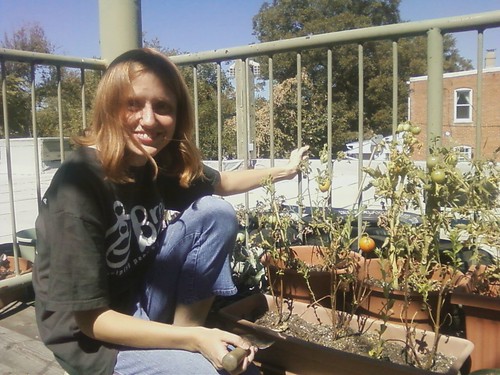
Anna Melton has been working her way up the volunteer ladder at Bread for the City since this past February, starting as a helper in the Southeast Food Pantry and now (practically single-handedly) creating and maintaining the Potted Vegetable And Herb Garden on the roof of the Southeast Center. (Check out the Flickr set of our roof-top garden here.)
Anna organized a campaign to solicit donations for the patio garden, personally inquiring at local garden and hardware stores and coordinating pick-up's, drop-off's, and thank-you's for numerous donations. She planted every single pot of fresh herbs a vegetables currently on our roof, and still comes to Bread almost daily -- not only to keep the garden watered and healthy, but also to assist Bread for the City staff with Social Service intakes and Food Pantry shifts. She's been an invaluable addition to the Southeast team. And we can't thank her enough!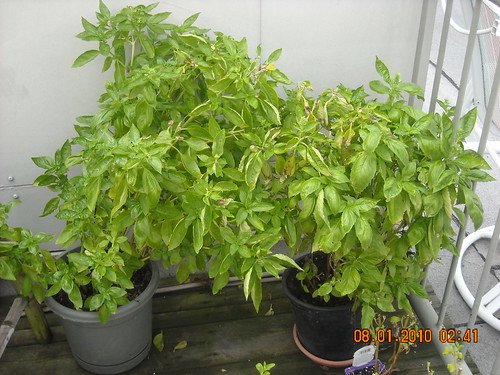
Anna will be recognized for her work at the 5th Annual Good Hope Awards, held this year on October 7, 2010 at The National Press Club. As we mentioned in Tuesday's post, even though Bread for the City has grown tremendously since we began in '74, we still could not do what we do without the incredible support and dedication of our volunteers. The Good Hope Awards is our yearly opportunity to gather together as a community and honor the tremendous work of our volunteers, folks like Anna Melton who make our work possible. For more information on the Good Hope Awards (or any of our events), contact Nathan LaBorie at nlaborie@breadforthecity.org.
-- Portions of this post were contributed by BFC's Volunteer Coordinator Extraordinaire, Erin Garnaas-Holmes. (And by portions, I mean most of this post. And the pictures.)
September 21, 2010
Volunteer Spotlight: DC Bar Pro Bono Program
Bread for the City certainly has grown since its inception in 1974. But even after all those years, volunteers are still at the heart of everything we do. The Good Hope Awards is our chance to thank all of our volunteers for their tireless support of our good work. This awards breakfast is also a chance for us to especially honor those volunteers who have gone above and beyond in transforming the Bread for the City community.
The 5th Annual Good Hope Awards will be held this year on October 7, 2010 at The National Press Club. The series of posts over the coming days leading up to the event will highlight this year's GHA recipients. Please join all of us at Bread for the City in extending an especially warm "thank you" to these organizations and individuals -- without whom, our work would simply not be possible.
2010 Community Partner Award - DC Bar Pro Bono Program
Bread for the City has grown tremendously over the last decade. Heck, we’ve basically doubled our budget in the last four years. Yet the need for legal services has increased at such a rate that we simply cannot address all of this need on our own -- even with our growth. If anything, having more attorneys has increased our reputation and has brought even more people coming through our doors asking for help. That’s where the DC Bar Pro Bono Program comes in. Whenever we have too many cases to handle -- be they landlord/tenant, or disability, or family, or cases outside of our practice areas, or some weird issue that we just just can’t fathom -- the first place we turn is the DC Bar Pro Bono Program. And they always come through. Their vast network of firms and lawyers is essential to Bread for the City being able to function. We refer scores of cases to them for full representation every year.
The Pro Bono Program also runs the Landlord/Tenant Resource Center and is our close partner in the Attorney of the Day Project. Let’s face it, I, Vytas, used to BE the Landlord/Tenant Resource Center, fielding dozens of calls a month, trying to talk tenants through the maze of landlord/tenant court. Now we just tell all our clients to go to the Resource Center, where the Pro Bono Program has assembled a fantastic stable of volunteer attorneys, all supervised by incredibly competent Pro Bono Program staffers…or Dan. (Kidding, Dan! Just kidding!) The Program helps hundreds of clients get through their court dates and/or find representation. They also screen almost every case the Attorney of the Day office handles, saving us time, and assuring that tenants are provided the best chance of saving their homes and experiencing actual justice in that Branch of the Court. Finally, the Pro Bono Program continues to run the Advice and Referral Clinic at both of BFC’s Centers on the second Saturday of the month. This clinic continues to help more and more people with every kind of issue imaginable, efficiently, compassionately, and without cost. This is also where we send all the clients we don’t know what to do with. It’s the perfect catch-all, and we love it.
On a personal note, the people I work with the most -- Mark, Dan, Maureen, Leah, and Kristi -- are all wonderful to work with. Well, maybe not Mark so much, but 4 out 5 is pretty good. (Kidding again!) In short, the DC Bar Pro Bono Program is a fantastic and necessary component of not only DC’s legal services community, but Bread for the City Legal Clinic’s functionality and sanity as well.
In all sincerity, THANK YOU for all of your contributions to our work.
-- Portions of this post (the good parts) contributed by our Lord High Legal Clinic Director, Vytas V. Vergeer.
-- ed. note. The DC Bar Program Program was also really, really important in getting 2009 Good Hope Award Recipient, DLA Piper to secure nearly $2 million (MILLION) for our expanding Northwest Center. Read more about that here.
September 20, 2010
Bread for the City hosting city-wide sustainability party on 10.10.10
On October 10th, Bread for the City will proudly join with 350.org and organizations and communities across the world, in a "Global Work Party" -- a coordinated set of actions to make our communities more sustainable and carbon-neutral.
In the past few years, we’ve taken several steps to make our own community more sustainable. We’ve rescued tons and tons of food that would otherwise have gone to waste. We’ve begun to collect and distribute tens of thousands of reusable grocery bags through our food pantry. And we’ve even begun gardening on the roof!
Now our Northwest Center will be kind of a home-base for actions happening across the city.
Along with dozens of other local and national organizations, we’ll use 10.10.10 as an opportunity to celebrate these steps, share ideas and visions for a more sustainable and just future, pressure the government to follow our lead.
Come join us. The Hip Hop Caucus, with the Green the Block campaign and Roadside Organics, are throwing down a big Local Food Block Party on site at our Northwest Center. From noon to 4pm on Sunday October 10th, come enjoy free food prepared by local chefs using local ingredients -- and stay to enjoy local hip hop performances, plus demonstrations of cooking, gardening, weatherization and more. We’ll even be giving a sneak preview of something very exciting: a rooftop garden on top of our new facility!
RSVP on Facebook here.
Lots of things are happening in the city on 10.10.10 -- see the full list here. Head out to explore and then meet us back here!
September 14, 2010
Give it away, give it away, give it away now
 Last month,
Now in its second year, Glean for the City has become an essential part of our food pantry -- enabling us to provide free, fresh produce to nearly 5,000 households each month. In fact, it’s been packing our pantry pretty much to the brim -- and yet there’s still acres of food left untouched out there. (See our recent photos here.)
So we’re trying to figure out how to rescue even more. That starts by just giving it away more quickly. So now our NW food pantry is putting out a variety of freshly picked produce for anyone to take home--even if they don’t participate in our food program. Seriously, these bins are just set out there, and people can come and pick their fill. All we ask is that they promise to eat what they take -- and enjoy.
Since the Northwest Current is only in PDF form, we’re sharing the full text of the article with you below. Gleaning Crews Aim to Feed the Hungry
By Teke Wiggin, NW Current, August 11 2010
“Go deep!” yells a girl in a white tank top as she chucks three ears of corn in rapid succession toward a man stooped over a crate behind a row of stalks. The man springs upright, deftly grabbing each ear as it hurtles through the air. Laughing to himself, he snaps off the stalk butts and peels the thick outer husks. He begins to drop the ears into a crate lying at his feet but pauses and turns his head toward the girl. “You’re not checking these, Ashley!” he shouts. Ashley shakes her head and prepares to launch another salvo, scooping up ears from the tilled soil and snapping off others from trimmed stalks. On a sweltering Saturday, the two volunteers, along with about 30 others, are scouring Parker Farms cornfields in Oak Grove, Va., to harvest leftover crops for the food-salvaging program known as Glean for the City.
Now in its second year, the program gleans crops from local farms in order to add large quantities of produce to the 5,000 food bags its Northwest-based parent organization, Bread for the City, provides to D.C.’s poor and needy each month.
Though Bread for the City collects canned goods and other nonperishable food items year-round, from July to November it focuses on the gleaning program, gathering different crops ranging from broccoli to apples at area farms. The program organizes gleaning sessions on farm acreage that has just undergone harvest, furnishing vans and coordinators to guide participants through crop fields. Last year, the program salvaged more than 50,000 pounds of fresh produce, according to Bread for the City spokesperson Greg Bloom, who said that figure should increase this year by at least 50 percent.
Since its inception, Glean for the City has been a hit, attracting hundreds of volunteers eager to sample a days work in the fields. “It’s hard to imagine exhausting the interest in this kind of volunteer work,” Bloom said. “The prospect of heading out to the country to pick up food ... that’s something a lot of people are ready to get behind.”
Chevy Chase father-and-son team Larry and Kevin Carlson labored in the fields Saturday, trudging through the dirt ditches that cleave crop rows and foraging with their hands for forgotten ears. Both said they enjoyed the experience of scrounging up sweet corn that otherwise would have gone to waste. “It’s gratifying,” Kevin said. “It feels like you’ve accomplished something. I like filling bins.” Aforementioned corn-tossing enthusiast Ashley Lawson, who is also the coordinator of the D.C. food kitchen Miriam's Kitchen, said she likes that gleaning allows her to be part of the giving process from start to finish.
“It’s nice when we can come out here and assess the quality of food were serving ... it really shows that we care about them,” she said. Miriam's Kitchen is one of several service organizations and projects that regularly partners with Glean for the City. Coordinator Vince Hill explained that gleaning is not uncommon for food pantries and kitchens, but usually is very ad hoc. “Glean for the City,” Hill said, “is one of the only programs he knows of that has the wherewithal vans, crates, staff to operate on a large scale.” Hard work and feel-good generosity aside, gleaning can also be quite the eye-opener for some volunteers.
Sarah Ngueyem, who is pursuing an associates degree at Montgomery College, said she was no stranger to this work. Back in Cameroon, she and her family regularly handpicked crops together. But Ngueyem saw something Saturday shed never witnessed on her family’s farm: enormous volumes of produce left to rot. “Back home we don’t use machines, so we do it all by ourselves. My grandma used to come behind us to check,” she said, puzzled by the leftover ears that smattered the ground or still poked up out of post-harvest stalks.
Bread for the City Project Manager Jeffrey Wankel, who started the gleaning program last year along with the organizations nutrition consultant, Sharon Gruber, said he was also surprised to find out about the excess. When researching how the organization could acquire more fresh produce, he learned that factors like consumer size standards, blemishes and human error cause up to half of crop yields to go to waste. That frustration was what led Wankel to engineer Glean for the City in the first place. Last year, Wankel and Gruber drew up a list of 100 farms within a 60-mile radius of Breads headquarters at 1525 7th St. NW. Then they started putting out cold calls.
Bread for the City spokesperson Bloom recalled the process: “What we found along the way...was farmers [saying], We have tons of food here, but we just don’t have the resources. But if you send volunteers out here, were happy to let you come and take it.” Wankel said many farmers were eager to help, and gave tips on the best ways to scout out leftover produce like visiting farmers markets.
Glean for the City now visits local markets several times a week to scrounge up vendors' excess products, allowing the organization to supply at least five types of produce throughout the harvest season. When it comes to visiting actual farms, Wankel said selecting the right ones depends on yield potential. “You have to find a farm with the capacity; small farms will say, ‘We’d love you to come, but we only have 200 pounds’”, he said. That quantity might sound hefty on paper, but its just a fraction of what Glean for the City can amass with a 30-person crew over only two hours.
After gleaning in the sun for an afternoon on Parker Farms, Hill and Wankel told a sweaty, dirt-spattered crowd they’d rounded up 3,000 pounds of fresh, quality sweet corn. Glean for the City will average this quantity on every one of its weekly trips to local farms. But Hill said all the trips combined will still leave a disturbing amount of the total surplus behind: almost all of it. For this reason, he said, he can count on hearing the following words from Parker Farms owner Rod Parker during every gleaning trip: “You didn’t bring enough bins, and you didn’t bring enough people.”
More information about Glean for the City is available at www.breadforthecity.org/gleanforthecity.
September 8, 2010
Family Food Fun
 The most lasting habits are those learned young, something BFC Nutrition Consultant (and mother of two) Sharon Gruber knows well.
Sharon, who conducts nutrition classes and cooking workshops with Bread for the City's adults clients, featured a Family Fun Party at each of our centers (Northwest in Shaw and Southeast in Anacostia). "I thought it would be great to provide a fun, health-focused outing for families the week before DC public schools start for the year," said Sharon.
About 25 mothers, grandmothers and children of all ages were in attendance. Children and caregivers alike enjoyed bananas rolled in sunflower seeds and whole-grain cereal, "sandwich on a stick" and "stuff your own tacos", just to name a few. By Sharon's count, one of the crowd favorites was "plain, low-fat yogurt that the kids sprinkled with cinnamon themselves. The then dipped apples into it, and for extra fiber and nutrients, the apples still had the skin on. No need for the sweetened stuff!"
For many of Sharon's clients and their families, meat is the central element of each meal-- and sometimes diets can lack the proper balance of vegetables and fruits. These classes were designed to explore the possibilities of fruits and vegetables and they were a hit with both children and parents. One mother remarked, "I'm filled up....Who knew it was possible? You really don't need meat."
Recent research suggests that activities like these may be an effective tool to change childhood eating habits permanently. "Previous research has shown that food habits and eating patterns learned in early childhood continue into later childhood and adulthood," according to a study published in the current issue of Nutrition and Dietetics. "This means that emphasizing  healthy food choices at an early age can have a major impact on a person's future health...Kindergarteners may be more likely to eat vegetables if they're enticed with things such as tasting parties, cooking classes, gardening and even Popeye cartoons." After a six-week nutrition education program geared towards children, the study found that "vegetable intake doubled and the types of vegetables they ate increased from two to four. In addition, parents said their children talked about vegetables more often and were proud they had eaten them in their school lunch."
"Being a mom has helped me to empathize with parents of those so-called picky kids," explains Sharon. "But it's also taught me that it's important to keep at it until you find something that works. Somewhere, that winning formula exists."
One of our pickiest party-goers, the reluctant brother of two vegetable loving sisters, bravely tried every dish at the event, much to the surprise of his shocked siblings. "He normally only eats French Fries," his younger sister declared. Still, nothing was to his liking until the 11-year-old found carrots and hummus. "This is great!" he said, eyes wide.
Although hummus is common in upscale grocery stores, it is out of reach for many budget conscious shoppers; Sharon encourage participants to try the dishes at home by providing alternative recipes that taste just as good but cost far less. One of our youngest participants munch happily on each and every vegetable around but declared yogurt to be her favorite fruit. Perhaps not quite the answer we were looking for, but for Sharon this is nonetheless a sign of progress.
"The point of this is to get kids touching food, making food, interacting with food. My hope was that children (and possibly their parents and guardians) would try something new and healthful and enjoy themselves in the process-- to take the pressure out of eating a healthful diet, and to add some laughter and adventure instead."
And that might be the most important lesson learned here: food can be fun!
September 7, 2010
Proposed legislation targets wage theft
 Jorge was hired by a contractor to install drywall at a private residence. The contractor, “Sebastian,” picked him up one day at a gathering spot for day laborers, offered him the job, and drove him to the house each day, promising to pay him $1,000 at the end of the two week project. When the two weeks were up, Sebastian never showed up. Jorge wonders if he should have known better: “My buddies warned me not to work with this guy because he doesn’t pay.” You mean he’s known to pay low wages? “No, I mean he doesn’t pay his employees. At all. Ever.”Getting ripped off by shady contractors is a common enough occurrence among day laborers that it is an expected hazard of working in such industries as construction, home repair, and landscaping. Usually there is little to no recourse. Employers are small, fly-by-night operations with no central office. Day laborers working two or three jobs do not have the time or money to seek redress through small claims courts, and it is difficult to interest attorneys in cases involving paltry sums of unpaid wages. Workers may file wage claims through their local government labor offices, such as the DC Office of Wage and Hour, but agencies are understaffed and the process can take months or longer. Often the employer is clever enough not to give the worker correct contact information. A typical wage theft case at the EJC dead ends when the client is asked how the deadbeat employer can be reached. “His name is Dave and he drives a red pickup truck,” says the client. OK, where is the house where you built the deck? “I don’t know, Dave would drive me there.”As the National Employment Law Project, UCLA Labor Center, and UIC Center for Urban Economic Development noted in their recent study Broken Laws, Unprotected Workers, wage theft affects workers in low wage industries across the US, a practice that includes nonpayment of overtime and minimum wage, and misclassification of employees as independent contractors. Growing awareness of this problem has sparked a number of campaigns to strengthen laws to prevent it. Washington, Utah, Colorado, New Mexico, New York, Delaware and Maryland have already enacted legislation against wage theft or employee misclassification. In February, following a campaign by the Interfaith Worker Justice Movement, Miami-Dade County became the first county in the US to outlaw wage theft by authorizing county officials to step in and collect wages should an employer fail to pay or bounce a check. San Francisco enacted a similar bill, and there are active campaigns for wage theft legislation in Los Angeles, Chicago, New Orleans and Fayetteville, Arkansas.
 Building on this momentum at the state and local level, Rep. George Miller has introduced a new bill in Congress, the Wage Theft Prevention Act. This law would lift the statute of limitations on investigations by the Department of Labor into cases of wage theft, which is currently set at two years. (Currently, should a case remain unresolved after two years – a real possibility for understaffed local labor agencies – all charges are dropped.) Two years is a long time to wait for a paycheck. But should enforcement improve, so too might the reliability of work for other drywall installers such as Jorge.
*This is a fictional name, changed to protect the subject’s privacy.
Learn more at the Kalmanovitz Initiative for Labor and the Working Poor.
September 2, 2010
If you don't stand for something, you'll fall for anything.
Sometimes this rodent infestation isn't even the worst thing about her apartment: the broken air conditioning (broken heat, too, in the winter) is outright miserable. And don't get her started on the mold, which wreaks havoc on her asthma.
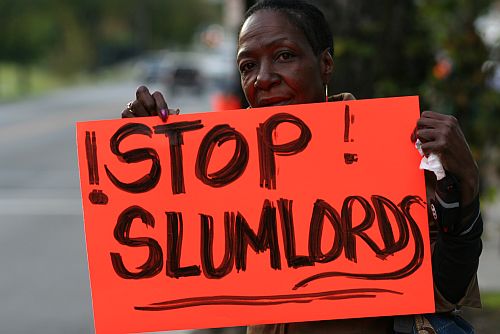
And hers isn't even the worst situation in Marbury. Some apartments have holes in their walls that gape clear through in between each other. Denise says that in one man's unit, the mold got so bad that mushrooms started growing out of the walls.
Marbury Plaza, located just east of the Anacostia River and down the street from our Southeast Center on Good Hope Road, is one of DC's largest housing complexes. Its long period of decay reflects the plight of so many District residents who are struggling to maintain decent, affordable housing.
Fortunately, thanks to the efforts of Denise, the Marbury Plaza Concerned Tenants' Association, and Bread for the City's legal team, these conditions are about to improve.
Last week, we brought you the good news: after years of campaigning, including an organized rent strike, the Marbury tenants successfully reached a settlement with the owners that will abate rents and invest millions of dollars into repairs and upgrades. Bread for the City's legal team have helped the tenants craft their strategy, build their power, and bring their demands to the negotiating table.
We're now pleased to announce that the Marbury Concerned Tenants' Association have selected Bread for the City lawyers and advocacy staff to receive their Tenants' Choice Award, in recognition of our service to the community. We are honored to accept their invitation to the 2nd Annual Tenants Choice Award Ceremony, to be held on Friday September 17, 2010 at 7pm at THEARC Theater. (Facebook event page is here.)
Tonight at 6pm, you can hear a full news report on the Marbury Plaza settlement. Tune into WPFW 89.3FM (or streaming online here) to hear the full story, and hear the interview with MCTPA President April Goggans here.
In the meantime, you, too, can support this work. Tickets are available for the Tenants' Association's award ceremony -- purchase yours here. You can also make a donation help their ongoing efforts to build community at Marbury Plaza.
And of course, you can support Bread for the City's legal team -- and the work that we do with tenants across the city -- by making a donation to us today:
"Bread for the City's role was pivotal," explains Denise, who worked as a floor captain for the Tenants Association's campaign. "We certainly didn't have money to retain the services of a legal firm. If it wasn't for them, we'd be up a dark alley."
Instead, this victory points to hope for renewal -- through a community working together towards empowerment and justice.
"I hope this landmark case will resonate across the city, inspiring other tenants to know and fight for their rights," says Denise, "If you don't stand for something, you'll fall for anything. The Tenants' Association stood for community, for working together for a common cause. And Bread for the City stands for under-served, struggling people -- for respect and dignity and caring for other human beings."
Congratulations again to April and the Marbury tenants. You can listen to Pete Tucker's interview with April here.


 Posts
Posts


