
June 28, 2011


June 15, 2011
Beyond Bread is Dead. Long Live BreadfortheCity.org/Blog!
After just over three years of dedicated bloggage, it's time to say goodbye to Beyond Bread. This trusty blog has served us well, but it's time to move on. And the future is bright!
We're pleased to announce the launch of the new BreadfortheCity.org, in which our daily blog will reside.
We're still working out a lot of kinks and settling in to our new digs, so please pardon all the dust. Be sure to send me (Greg at gbloom[at]breadforthecity[dot]org) a heads up if you stumble across something that's really broken.
For those of you who are reading this by RSS or email (or for those of you who would like to read this by RSS or email) please point your feed-reader to: http://feeds.feedburner.com/breadforthecity/BFCBlog
Meanwhile, point your browser here from now on:
June 7, 2011
Conference Reportback: Planting Seeds for Economic Justice
Angie Stackhouse is Bread for the City client and a local advocate for social justice issues, particularly for the homeless community. Angie has been helping Bread for the City with the food policy council planning process with the Health Affordable Food for All Coalition, and recently traveled attended a food policy conference with others from Bread for the City. Angie has blogged with us in the past about homelessness in DC. I came to the Community Food Security Coalition’s local policy conference to find out how we can better serve the homeless community in terms of getting fresh vegetables in shelters. Once there, I met a lot of people who talked about how that’s just one important way among many that we can improve our communities’ food systems, improving our health while also developing economic opportunity.
And I realized that what we all want is healthy affordable food for all - so let’s do it!
How do we make that happen? First, you need to think about who needs to be brought to the table. You need to do the groundwork - going into the communities and asking people how they feel about their food choices and how they feel about not having fresh food in their neighborhood.
You also need to have people who know about things like zoning, people who are affiliated with the Health department (to highlight the importance of sickness & disease happening in the neighborhoods), and folks who have data linking lack of fresh vegetables to sickness and obesity (that’ll help convince City Council how important it is). Then, you start thinking about how to work together to make it happen.
I learned that having something like a food policy council can help make sure the City Council recognizes that people need fresh & healthy food. And I learned that successful food policy councils have participation and leadership from residents who themselves are struggling with these problems and searching for solutions.
But we also learned that you’ve got to be strategic. You have to know how to use the tools that you have with limited resources. Being strategic means being able to clearly define what you’re trying to do, which also makes people more likely to want to sign on.
So let’s get to work! Here are some of my favorite ideas from the conference:
- Gardening in a way that creates jobs, and supporting healthy foods in shelters will also encourage homeless people to participate in becoming healthy themselves, and feeling more empowered over their own lives. The Gateway Greening Project in St. Louis is one example.
- Food trucks is an awesome way to get food across the city while also creating jobs. Green carts in New York are an example of that.
- Transportation matters more for low-income residents. To engage in garden projects, markets, and so on, they may need additional support for travel to and from.
- Everything Cleveland is doing.
- Food justice can and should also mean economic justice. Bringing in healthy retail can support local job creation, for example.
- Check out the websites of all the organizations I learned about, including a business that specifically caters to the homeless community.
- Dig deeper into the mobile market and mobile garden idea and who’s working on it in DC.
- Start doing more outreach and organizing. We know everyone who needs to be at the table – let’s make sure they’re there.
June 3, 2011
Sisters Helping Sisters to Thrive: Report-Back from the Women’s Collective Training
 Recently, Liz Nafziger and Ri Turner, two of Bread’s Medical Clinic Coordinators, attended a day-long training run by Abby Charles, former Advocacy and Policy Coordinator of the Women’s Collective, DC’s premier organization for women affected by and at-risk for HIV/AIDS infection.
Once we had successfully navigated the twisty corridors of Northeast DC’s Greater Mount Calvary Church, the first thing we noticed upon walking into the training room was the amazing collection of attendees. Primarily black women, the attendees ranged from Women’s Collective outreach workers (HIV-positive women who do peer outreach to promote HIV testing and prevention, including the use of the female condom) to managers of a residential shelter for women, from OB/Gyn nurses to community organizers who run a monthly meeting for African immigrant women in Maryland. We felt incredibly fortunate to share the day with such a dynamic group of women.
During the first half of the training, we learned about the problem – the impact of HIV/AIDS on women (especially in DC, where the overall HIV infection rate is over 3.2%, one of the highest rates in the country). Although HIV is sometimes thought of as a disease that primarily affects men, we learned that women are also affected by HIV at an increasing rate. Additionally, some factors make women especially vulnerable to the impact of HIV. For example, women are more likely than men to be economically dependent on others, which makes it more difficult for them to insist on safer sex practices, and also makes them more vulnerable to intimate partner violence and rape.
Once we had begun to grasp the impact of HIV/AIDS on women, we learned about the unique needs of women affected by HIV/AIDS. For example, more often than men, women bear the burden of dependents, such as children or aging or disabled relatives. Financial or material benefits (such as monthly supplemental food) are generally issued on an individual basis, designed to alleviate the economic impact of HIV on a single woman. However, those benefits often end up spread thinly among that woman’s dependents, leaving little or nothing for her own support. Similarly, women who are already overwhelmed with taking care of the needs of family members have a greater tendency to neglect their own health – they may prefer not to know about their own health status rather than add another problem to an already overwhelming plate of responsibilities. As a result, women may end up being “late testers,” which means they are not diagnosed until less than a year before their disease progresses to full-blown AIDS.
Finally, we learned about the Women’s Collective’s model for serving the needs of women and girls affected by HIV and AIDS. What makes the Women’s Collective a truly unique organization is the fact that it is run by and for a peer network of women affected by HIV/AIDS (and mostly black women, which is especially important in the District, where 90% of women newly diagnosed with HIV between 2001 and 2006 were black women, even though only 58% of women in DC are black). Additionally, the Women’s Collective emphasizes the importance of addressing the impact of HIV/AIDS by integrating four different programmatic thrusts:
•Treatment – Healthcare services tailored toward women with HIV/AIDS
•Prevention – Outreach, education, and referral services
•Advocacy – Coordinated efforts to change the institutional structures that perpetuate the prevalence of HIV infection and create barriers to access to treatment and resources
•Administration – The resources necessary to maintain a stable and sustainable organization to oversee the other three program areas
We enjoyed learning about the Women’s Collective model and reflecting on its similarities and differences from our model here at Bread for the City. Stay tuned for an upcoming post which will give more detail, specifically about the amazing advocacy work that the Women’s Collective is doing in the District, and how that work relates to our advocacy efforts here at Bread for the City.
June 2, 2011
DC: A Community of Gardeners
Bread for the City's Northwest Rooftop Garden “vine-cutting” ceremony officially marked the opening of the DC area’s largest rooftop agricultural site.
The goal of the rooftop gardens in both Northwest and Southeast is to provide a space for community members to engage with the production of fresh produce, and also to foster community among neighbors and allies.
One of the ways we can do that is by using the space itself as a site for growing dialogues.
So the week following the vine-cutting, we hosted a screening and discussion of the film A Community of Gardeners, which depicts how community gardens in seven DC neighborhoods have, in distinct ways, empowered individuals and groups. The standing-room only crowd included community activists, teachers, avid gardeners, BFC staff and clients, City officials, and other residents interested in BFC’s rooftop garden efforts.
Cintia Cabib, the filmmaker, introduced the film and answered questions. In addition, Dennis Chestnut of Groundwork Anacostia, and Bea Trickett of the Neighborhood Farm Initiative were part of the panel discussion following the film.
 Filmmaker Cintia Cabib discusses her work
with the standing room only crowd.
A desire to give young people a direct connection to the land and food production resonated in all seven community gardens featured in the film, as well as throughout the discussion. One young woman interviewed at Fort Stevens Garden remarked that she “hated golf courses and lawns now” because these spaces did not allow her to dig into the dirt and produce food that she could take home.
During the discussion, Erika Moses -- a BFC client who was also recently interviewed on WAMU in a piece on the rooftop garden project -- commented that while her daughter was initially reluctant to take part in the Rooftop Garden building days at the NW Center, she ended up enjoying planting seeds so much that she wanted to keep coming back. Community gardens present an opportunity for youth to develop confidence since they can see the literal growth of their work and have the ability to harvest what they grow.
An educator in attendance from the National Youth Garden confirmed the satisfaction that students get from growing their own nutritious, fresh food, and learning about garden wildlife, all while interacting with their peers in the outdoors. The film emphasized the rapid increase in demand for community gardens as concerns about access to fresh, organic, and healthy foods have grown. Community gardens in DC can instill the concepts of food security and fresh produce among young residents who have never encountered agricultural sites before. These gardens can help youth to reject their perception that, as one BFC client put it, “vegetables must come from a can at the grocery store.”
Cintia Cabib framed the discussion by explaining that community gardens can sprout up anywhere in the city- but that they work best when they reflect the particular needs of their neighborhood. Already, DC Schoolyard Greening offers curricular resources for teachers so that they can match a student gardening program to specific conditions on school sites, with hopes of an entry into the official DCPS curriculum in the near future. Groundwork Anacostia has been partnering with community groups and housing projects in SE to create gardens as vehicles for community development. Also,the Neighborhood Farm Initiative has published a guide to assist individuals and groups who are interested in starting their own community gardens. Encouraging young people to take part in transforming familiar, but inaccessible spaces in their neighborhoods into productive food growth sites teaches new skills, fosters interaction between peers, and also increases local food security.
How can Bread for the City best engage young people who live in the neighborhoods surrounding the NW and SE centers in its Rooftop Garden projects? How can BFC make its gardens a desirable place for all community members?
To join in this conversation about creating more gardens for food production in DC, please join the DC Food for All Google Group or contact Allison Burket at aburket@breadforthecity.org
To volunteer at one of our rooftop gardens, please contact Erin Garnaas-Holmes at eholmes@breadforthecity.org
BFC’s food production initiatives, such as the rooftop gardens, would not be possible without the generous support of donors, so please give today.
June 1, 2011
Want it fresh? You got it.
 Big news from our pantry: starting today, and running through the rest of the harvest season, clients of Bread for the City’s food pantry will enjoy a new level of choice: all fresh produce, for any who want it!
This is a true milestone in our Nutrition Initiative, which is now heading into its fourth year of great progress in advancing the health of our community. In 2008, we overhauled our menu to feature all healthful items; in 2009, we committed to provide at least one item of fresh produce in every bag; last year, we adapted a “choice” system that enabled clients to decide what items they wanted (strategically promoting fruits and vegetables in the process). As a result, our clients are reporting increased satisfaction and increased preferences for healthier, greener offerings.
Now, thanks to the tremendous success of our Glean for the City program, we’re pleased to offer clients the option to skip canned goods entirely. If clients want to receive all fresh produce, we’re now happy to provide it! It’s a great step for the health of our community. Says our nutrition maven Sharon Gruber: “Health-wise, our menu of canned goods is already pretty good -- with minimal additives, low sugar and sodium, and so on. But fresh veggies just taste better, which encourages people to have more of them. And if eaten raw, they have enzymes and other healthy things that are missing from many canned foods.”
“Plus,” Sharon adds, “the diversity of our fresh produce will far outshine the canned goods we offer. People can try new things, get things that are otherwise cost-prohibitive, and get more of an array of vitamins and minerals.”
As our client and garden volunteer Erika Moses explained to WAMU’s Sabri Ben-Achour last week in our rooftop garden, this kind of exposure even in small amounts can have substantial impacts on people’s diets. (Listen to that story in Real Audio here, Windows media here.)
As great as all this is, we can’t help but also note that this all-fresh step will actually save us money! The gleaned produce is obtained for free from regional farms and local markets. The only costs are staff time, transportation, and some equipment like bins and gloves; that works out to about 20 cents per pound, by far the cheapest of all our food items. This will greatly help our pantry’s budget for the winter months. (Which is especially important, since food prices are on the rise again.) That said, we do expect a need to increase our capacity for storing all this produce. During the harvest months, our pantry staff pack their fridges literally to the max. In fact, last year, we lost some produce to rotting and had to cut the harvest season short due to lack of storage.
To fulfill this pledge to our clients throughout the year, we very well may need to expand our fridge capacity! That may cost us as much as $15,000! Can you help us maximize our freshness? Donate today to help us upgrade our fridge capacity.
This great step forward is made possible by two essential sources of support. The first is farms and farmers markets -- so a huge thank you to the West End Farmers Market of Alexandria and the Bloomingdale Farmers Market here in Northwest. And the second is people like you -- so please support our efforts today.
May 31, 2011
Our Garden: Grandly Opened!
On May 20th, we officially opened the new Rooftop Garden at our Northwest Center. The weather was perfect, the garden was blooming, and we had a great turnout -- our heartfelt thanks to everyone who made it possible!
Check out this great slideshow of photos from the event below (or browse the full set on Flickr).
(Thanks to Michelle Lindsay for her fantastic pro bono photography!)
Among our guests was WAMU’s Sabri Ben-Achour, who produced this report that aired last Friday on Metro Connection -- check it out online. (Real Audio here, Windows media here)
As Mr. Ben-Achour notes in his report, our rooftop garden project is all about bringing people closer to our food -- and to each other. On those fronts, it’s already a great success! The space is not just beautiful; it also fosters opportunity for us to work together and learn from each other about how to work for healthier lifestyles and stronger communities.
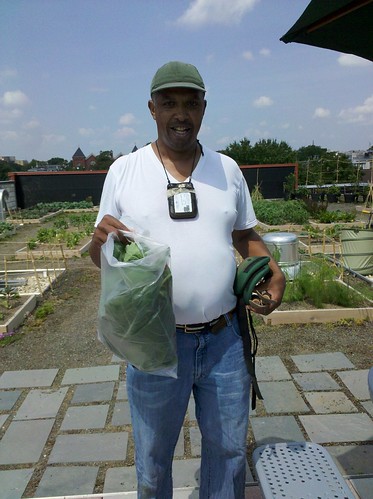
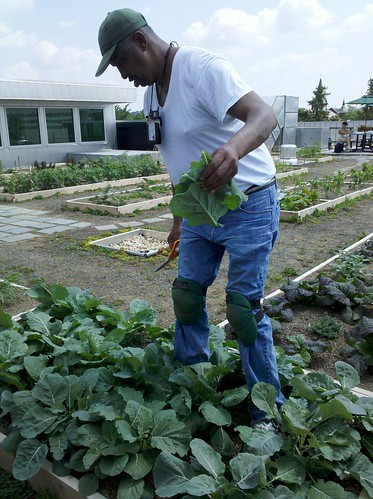 Indeed, just days after our big buzzy Grand Opening, we quietly conducted the very first harvest from our garden. Longtime Bread for the City client George joined us during "open garden" hours (Mondays and Wednesdays, 9am-noon, by the way), and he clipped bags of leaves from our collard greens which are already overflowing their bed. George took some for home, and brought the rest down to the pantry to share with folks there.
"I can't have a garden at home," George tells us, "and I’ve wanted a chance to do this work for so long.” We’ve known George for a while, and we can say that we’ve never seen him so happy and excited.
So we want to say a huge Thank You to all those who attended the ribbon-cutting event and have donated in support of the program so far. This has all been made possible by your support.
Of course, this is just the beginning. We’re also building our Southeast Center garden, and we've just begun to develop programming for each site. We need your help to keep this going. And the best way to help is to give:
For $25, we can purchase and maintain five plants for an entire season.
For $50, we can organize a complete gardening-and-nutrition workshop.
Gifts of $100 or more will be honored with a name or phrase of your choosing to be painted by members of our community onto ceramic pots.
Gifts of $1,000 will be honored with the dedication of an entire bed!
Help us make this community strong and green. Give to the green roof gardens today.
May 25, 2011
Prep For Success: from the shelter to the job
We recently heard from Bread for the City’s new job developer, Malton Edwards. Malton has been working in our Pre-Employment Program, working entirely with residents of Wards 7 and 8, where the unemployment rates are some of the highest in the nation.
We’re pleased to report great results!
Out of eight students in our last PEP program, we’ve already helped six find jobs. (That may not seem like a big number, but given how challenging our job market is here -- and how many challenges our clients face along the way -- it’s no small feat.) And under Malton's leadership, this program is already doubled in size, with an all-time high of 16 students in its newest class.
Let’s take a look at one of PEP’s recent success stories: Eric Dyer.
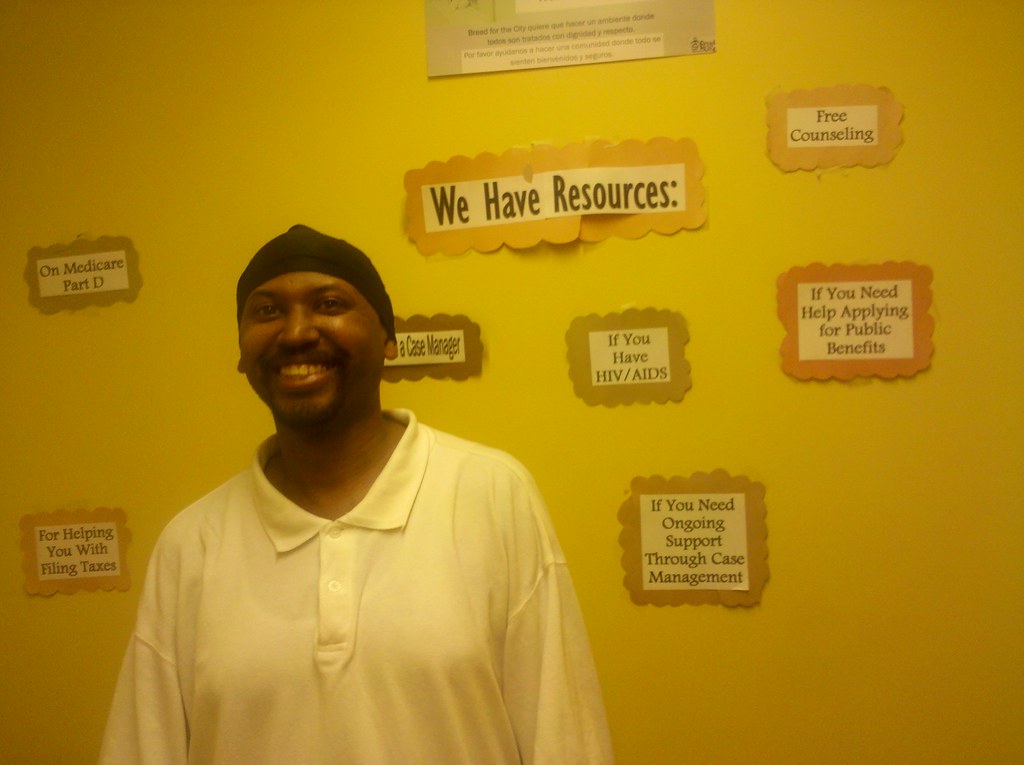 Eric is a 46-year-old native Washingtonian. He used to work in utilities, and also has experience as a mechanic. But he lost his job years ago, and eventually his home. He kept trying to get his life back on track -- with little to show for it.
“I took a few job training programs,” Eric says. “But they just give you the classes and once you’re done, that’s that. It’s over.” And that wasn’t enough.
Eric didn’t even have proper shoes, for instance. And that’s what brought him to Bread for the City.
“I came here in search of clothes,” Eric recalls. “I saw a flyer for the Pre-Employment Program and was initially a little skeptical, because I’d just completed the computer training course and it didn’t get me anywhere. But Stacey [Smith, a Bread for the City social worker] came to talk to me and I decided to do the program.”
“At first,” Eric says, “PEP seemed to be about real basic stuff. Eventually I realized that these were, you know, big questions. Not just ‘how do you go walking down the street looking for jobs?’ but ‘what do you need to get it done?’ ‘How do you feel about yourself?’ ‘What will it take to get you where you want to be?’”
PEP classes are two days a week, with a group of about 10 or 15 people who are learning the life skills that they need to be ready for employment. This personal development is incorporated with our comprehensive services, as we make sure that our participants can address their myriad challenges at once.
“It was a really different experience for me,” says Eric. “For one, there were small things like bus tokens. That makes a huge difference in me being able to stick with it all the way through, every time. Otherwise, how would I be able to get there? Other programs, maybe you get one farecard and that’s it. If you’re not able to take every step along their certain path on your own, you can slip through their cracks. You’ll get something like ‘I’m sorry, we can’t help you with that.’”
“But you need all kinds of means to get up from the bottom,” says Eric. “And Bread can help you get it covered.”
In the course of PEP, Eric acquired the clothes, customs, and even simple confidence that he’d need to get a job.
“It’s been awesome to see Eric’s success,” says Stacey Smith. “It’s a transformation. He comes in here from the homeless shelter, he shaves and puts on a suit and tie and heads out with a Blackberry like a professional. It’s like Clark Kent to Superman.”
Even with this transformation, however, getting a job can still require a lot of support. Among other places, Eric applied for a cook position at the Hard Rock Cafe; when he called back to inquire about it, however, they told him that that they couldn’t find his application.
“In the past, that would have been it - end of story. But Malton followed up with me and then followed up with them and made sure that I was right where I needed to be.”
And surely enough, Eric now has a job at the Hard Rock Cafe.
“It’s long and hard and my feet are sore. It’s hard to work such long hours into the night when you’re staying in a shelter, especially because come 7am you have to leave the shelter. So that’s hard. But Melissa Mitchell is now helping me search for housing, and she’s helping me find educational resources.”
We’re excited to see all the progress yet to come from Eric, our other PEP participants, and our job development program as a whole. And we need your support to help this program thrive! PEP is looking for mentors to work closely with PEP participants in their job readiness training -- contact Stacey Smith (ssmith [at] breadforthecity [dot] org) to learn more.
And PEP is still not a fully-funded Bread for the City program! Your donation will make a huge difference as we engage in this transformative work -- so give today.
May 24, 2011
City Council votes tomorrow. Ask them to save our safety net today.
The City Council votes tomorrow on the budget for Fiscal Year 2012. Chairman Kwame Brown, responding to public pressure, showed leadership to restore a portion of the cuts.
Save Our Safety Net reports that his budget will include $24 million to partially fund Interim Disability Assistance, homeless services, and Temporary Assistance for Needy Families. But there are still $32 million in cuts on the table, and instead of using all progressive revenue to fund the safety net, the Chairman and others are planning to use a portion of the money to reverse the marginal income tax increase proposed by the Mayor.
Please take a minute today to email your Councilmembers to ask them to fully fund safety net programs. They need to hear from you. If you have time, call their offices as well. The numbers are below.
Take a look at this amazing video from Save Our Safety Net. It will inspire you as you talk to your elected officials:
Here's what Save Our Safety Net reports is still being cut:
-- $2m from childcare subsidies
-- $2m from Local Rent Supplement Program, eliminating the vouchers
-- $18m from the Housing Production Trust Fund
-- $900k from Children's Mental Health Services
-- $1.3m from Domestic Violence Services
-- $600k from the Low-income Heating and Energy Assistance Program
-- $3.3m from Interim Disability Assistance, leaving 1000 on the waiting list and 600 removed from the program
-- $3.5m million from homeless services, for transportation to shelters, feeding, and supportive services
And here are the numbers to call the City Council as well as email:
Kwame Brown (Chairman) 724-8032
Vincent Orange (at-large) 724-8174
David Catania (at-large) 724-7772
Phil Mendelson (at-large) 724-8064
Michael Brown (at-large) 724-8105
Jim Graham (Ward 1) 724-8181
Jack Evans (Ward 2) 724-8058
Mary Cheh (Ward 3) 724-8062
Muriel Bowser (Ward 4) 724-8052
Harry Thomas, Jr. (Ward 5) 724-8028
Tommy Wells (Ward 6) 724-8072
Yvette Alexander (Ward 7) 724-8068
Marion Barry (Ward 8) 724-8045
Jen Budoff, Council Budget Director 724-8139
May 23, 2011
Save IDA: Save Dollars and Save Lives
We’ve blogged a lot about Interim Disability Assistance (IDA), a program that provides low-income District residents with $270 a month while they wait for Social Security to approve them for disability benefits. We’ve even advocated for a similar program for TANF recipients, to help them get on SSI and pay TANF costs back to the District. We are pleased to note that such a program appears in the Mayor’s proposed TANF budget for Fiscal Year 2012, but we vigorously oppose another line in the budget—one that would completely eliminate the IDA program, putting more than 900 lives in turmoil. Watch this video from SOME and the DC Fiscal Policy Institute to learn about the support IDA provided to three men who are too disabled to work:
I work in the legal clinic, and represented a client with a similar story. Ms. C has several serious mental illnesses, along with orthopedic problems that have left her with pins and screws in several joints. She had worked for many years in the construction and food service industries, but she became sicker and was no longer able to work. She applied for benefits in September 2008; it took two denials and 31 months for her to have a hearing before one of Social Security’s administrative law judges. Ms. C was homeless, and IDA helped her afford some important items, like soap and socks and bus passes. Bread for the City represented Ms. C at her hearing and won.
Ms. C is now entering Bread for the City’s representative payee program and is excited to have an income she can use to apply for apartments. In addition, Ms. C won back benefits for all the months she was awaiting Social Security’s decision. She will be able to pay the District back for all the IDA she received, and can use the remaining lump-sum payment for expenses such as a security deposit -- and even potentially an apartment of her own, though even on a budget with Social Security benefits, this is no easy task (and still more budget cuts threaten to make it even harder). But it’s clear that Social Security benefits will dramatically increase Ms. C’s stability, and IDA was the bridge that helped her get there.
As we blogged about on Tuesday, our social services program helps people apply for these benefits. Our cases have a very high approval rate, as we gather medical evidence, write supportive reports, and advocate with the disability examiners. If social service clients or other low-income DC residents have their initial application for benefits denied, and are then denied at the reconsideration stage, Bread for the City’s legal clinic evaluates their cases for representation at a hearing before an Administrative Law Judge. Staff attorneys, volunteer attorney Bruce Mayor (who has been representing Bread clients in Social Security matters for nearly a decade!), and non-attorney interns and volunteers gather medical records, write briefs, and attend hearings for the clients we accept. We also refer cases to attorneys through the DC Bar Pro Bono Program.
And we’ve been remarkably successful. Our social services program has helped 43 people apply for benefits so far this year and already 23 have been approved. Meanwhile, our legal clinic just won our 27th hearing of 2011. All 27 of those victories are for people who have been denied benefits at earlier stages in the process! That’s a lot of federal dollars coming to low-income DC residents: to spend in local businesses, to reduce the need for emergency assistance, to keep up with rent and avoid eviction. The cases our legal clinic alone has won so far in 2011 will bring over $220,000 in federal dollars into the District each year, and provide much-needed stability to dozens of disabled people who are unable to work.
We are eager to continue to make money for the District, but we need help. It’s much easier to represent a client that can afford a phone, transportation, and sometimes even a stable address. These basics for communication and peace of mind enable faster determinations and ultimately more money in back payments for DC. We hope the City Council will find the money to keep this program.
You can tell them to do so yourself. Contact Chairman Kwame Brown at 724-8032 or kbrown@dccouncil.us, and tell him something along the lines of this:
The Interim Disability Assistance Program is an essential part of the safety net for District residents with disabilities. It’s also a mechanism for drawing down federal revenue to serve extremely low-income District residents and for transitioning those disabled individuals to a federal income source that will better allow them to sustain themselves. Please do not allow IDA to be eliminated and ensure that it has the funds necessary to serve those who need it.
May 18, 2011
Cuts to Housing Programs, No New Investment
Anyone who thinks that the affordable housing crisis in the District of Columbia is over is wrong.
One only has to spend a day chatting with Bread for the City clients to realize that the crisis is real. The vast majority of clients identify housing as an issue in their lives. Take for example the woman I recently encountered during an intake. She is disabled, and is living on monthly disability benefits of $674 from SSI. She pays $555 of that income in rent. She is not alone.
Nearly 1 in 5 DC residents are spending more than 50% of their incomes on housing. (The standard for “affordability” is 30%.) Perhaps this explains why there are approximately 38,500 households on the waiting lists for subsidized housing through the D.C. Housing Authority.
There are a variety of tools the DC government uses to assist in providing affordable housing options to residents. They include a wide spectrum from homeless shelters to home ownership programs. Three of these vital programs are at risk in the proposed city budget (as per DCFPI’s analysis).
- The Housing Production Trust Fund finances the construction and renovation of affordable housing, and also provides financial support to tenants who want to purchase their buildings.
- The Local Rent Supplement Program (LRSP) provides a rental subsidy to help low-income residents -- those making less than $30,000 a year — afford their rent. Since 2006, it’s funded housing for 1,700 families.
- The Permanent Supportive Housing Program (PSH) provides supportive housing for chronically homeless individuals and families, in the Housing First model.
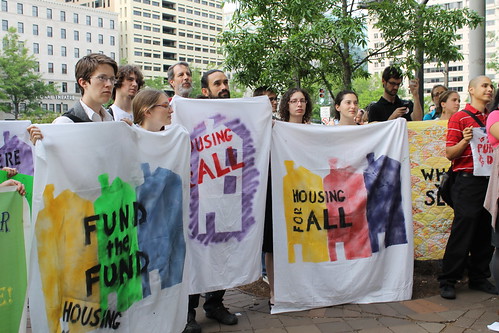
While Mayor Vince Gray declares that they are not cutting funding for any of these programs, the budget put forth essentially does just that. First, the budget raids $18 million from the Housing Production Trust Fund by using money intended for the creation of new affordable housing to pay existing LRSP rental subsidy costs. Without the Housing Production Trust Fund, the disparity between creation of affordable housing and luxury housing will continue. Since 2000 the number of low cost rental housing units has shrunk by more than ⅓ while production of luxury units has nearly doubled. We need the trust fund to continue at full funding levels in order to have any chance at reducing the number of tenants who need affordable housing.
Second, the budget ends the LRSP voucher program through attrition, both in policy language and through reduced funding. Phasing out the LRSP tenant based vouchers will result in the loss of an important affordable housing tool. We cannot abandon this program. In the last several years it is the only program that has resulted in households moving off of the DCHA waiting list. In addition, it is the only program that serves the lowest income residents – folks at or below 30% of area median income.
The need for additional vouchers is clear. It is evidenced by the wait list. It is evidenced by the large number of tenants paying more than 50% of their income toward their housing costs. It is evidenced by the number of people coming through the doors of Bread for the City each day.
Finally, the budget moves PSH participants (and their funding) in two ways that may or may not even be possible -- by transferring them to federal vouchers and commandeering newly available units opening at project-based sites. The Housing First model is an innovative way to serve chronically homeless individuals. PSH serves those most difficult to house, including individuals with drug addiction, mental illness, criminal records, poor credit history, poor rental history and a host of other issues. However, transitioning these individuals to federal vouchers or project-based local programs may prove impossible. Criminal records, poor credit history, substance abuse, family size, and poor rental history are all considered in the screening process for the federal voucher program. Many folks, if not the majority, will simply not qualify.
We cannot afford to reduce the number of people served through these very important housing programs. We need to make progress in serving the 38,500 families on the waiting list. Reducing this funding only adds to the wait list.
May 17, 2011
Don’t cut IDA, but do make it better
Interim Disability Assistance (IDA) is a vital program to our clients here at Bread for the City. It can take years for some clients to get approved for Social Security disability benefits and with our clients unable to work during that time period, this cash assistance program gives these clients $270 dollars per month to make ends meet. When clients are approved, Social Security pays back IDA for payments to the client. IDA in the District of Columbia has a recoupment rate of 40% of the funds it gives out – roughly equal to rates in other states. In the upcoming budget vote on May 25, IDA is in danger of being completely eliminated.
This program should not be cut. The people who receive IDA have no other options for income and this monthly assistance makes a huge difference for being able to ultimately get approved for SSI. One client, Ms. J, makes a compelling case for IDA. She worked for many years, but suffers from serious and worsening physical and mental illnesses and had to leave her job. She received IDA for the two years it took for the Social Security Administration to find her disabled. Ms. J put almost all of the $270 a month she received each month towards rent; although she was almost evicted on several occasions, those funds, with the help of relatives and non-profits, kept her from homelessness. IDA also paid for things that food stamps and other programs do not: bus rides to her doctor, over-the-counter medication, toothpaste. Our attorneys were more effective representatives for Ms. J because she had a phone where they could call her, a stable address where Social Security could send her notices, and funds to travel to medical appointments or her Social Security hearing. As a result, Ms. J qualified for disability benefits and recovered a large back award, of which part was sent to the District.
Instead of using costly emergency services, the money she got from IDA – and the SSI she receives now – is generated additional economic activity.
Instead of cutting the program, I have some ideas for making it more efficient, based on the SSI application assistance we provide here at Bread. Here in our social services program at Bread for the City, we help clients apply for disability benefits. During the Initial and Reconsideration level applications, we request medical records and have regular contact with the client’s Disability Determination Services examiner to make sure they have everything needed to make a decision on their disability. We help streamline the process and make each submission as effective as possible. This helps the DDS examiner not to have to wait months for records and hopefully means our clients receive a fast, favorable decision.
DC’s IDA program could include applications assistance. The District is already working with SOAR (SSI/SSDI Outreach, Access, and Recovery) to improve access to application assistance for homeless and recently incarcerated residents. Bread for the City has been involved with this organization for years. We believe they have developed a great model in which case workers help disabled clients submit complete and detailed applications that clearly present any medical evidence of the claimant’s disability. This allows for the applications to be processed quickly and efficiently and increases the number of first-time approvals, thus saving the time and expense involved in lengthy appeals. We have incorporated many of the SOAR best practices into our own applications assistance work.
By improving the process to get applicants approved for SSI, more money would ultimately be recouped from Social Security. Elements from Washington state’s IDA program, called Disability Lifeline, could also be used to assist with the SSI application process, such as having an initial assessment by a member of a trained assistance team to help determine the level and duration of the disability. This worker can assist with the initial application and improve the quality of the application submitted, in turn increasing the likelihood of approval in the early stages.
When clients fail to get approved for SSI in the initial or reconsideration stage, they advance to the hearing stage. It can take over a year for a hearing to be scheduled, during which time they continue to receive IDA even though no progress is being made on their application. Helping clients get approved before the hearing stage would allow others off the waitlist to receive IDA benefits, thus needing less money overall to run the program and helping more people.
If the District is not satisfied with the recoupment rate, it should modify the program, not eliminate it. Recipients of IDA truly have no other means of support; taking this program out from under them will result in homelessness and more costly emergency services. Especially considering the possible closure of homeless shelters due to budget pressures, our neighbors are likely to experience increased rates of mental illness, substance use, domestic violence, and even death. Please take a few minutes to call your Councilmembers now to ask them to fully fund safety net programs:
Kwame Brown (Chairman) 724-8032 or kbrown@dccouncil.us
Vincent Orange (at-large) 724-8174 or vorange@dccouncil.us
David Catania (at-large) 724-7772 or dcatania@dccouncil.us
Phil Mendelson (at-large) 724-8064 or pmendelson@dccouncil.us
Michael Brown (at-large) 724-8105 or mbrown@dccouncil.us
Jim Graham (Ward 1) 724-8181 or jgraham@dccouncil.us
Jack Evans (Ward 2) 724-8058 or Jackevans@dccouncil.us
Mary Cheh (Ward 3) 724-8062 or mcheh@dccouncil.us
Muriel Bowser (Ward 4) 724-8052 or mbowser@dccouncil.us
Harry Thomas, Jr. (Ward 5) 724-8028 or hthomas@dccouncil.us
Tommy Wells (Ward 6) 724-8072 or twells@dccouncil.us
Yvette Alexander (Ward 7) 724-8068 or yalexander@dccouncil.us
Marion Barry (Ward 8) 724-8045 or mbarry@dccouncil.us
Jen Budoff, Council Budget Director 724-8139 or jbudoff@dccouncil.us
You can also email them all at once here.
May 16, 2011
Tattered TANF
One in three children in DC is in a household in the Temporary Assistance for Needy Families (TANF) program. That shocking statistic points to serious systemic problems, but it also demonstrates the great potential of TANF as a poverty-fighting program. Unfortunately, that potential may soon be squandered.
One of the budget cuts before the DC City Council right now is a reduction of $8 million in local funding for the TANF program. This represents two changes. First, it would reduce benefits by another 20% for nearly all families in the program more than 5 years. Benefits for a mom and two children would go from $428 at the start of the year to $257. Second, it would remove entire households from the TANF program if the parent doesn’t comply with the work requirement, rather than just sanction the adult and continue to provide benefits to the children.
We are in favor of transitioning more TANF recipients off the caseload, but we believe the approach chosen by Mayor Vince Gray would result in lasting harm to parents and children, rather than supporting TANF recipients in meeting their goals for education, stable employment at a living wage, and safe housing.
Currently, TANF recipients are not offered the support services or training they need to transition successfully off the program. The Income Maintenance Administration (IMA), the agency in charge of implementing TANF, is working to better assess the needs of TANF applicants so they can be matched to appropriate supports and to expand job readiness, training, and education to offer a spectrum of services. The Department of Human Services estimates it will take 18 months to do assessments of those who are already in the program for over 60 months. By this time, the TANF recipients most in need of help will have seen their checks whittled away to $107 a month, if they are even still in the caseload.

Again, 1 in 3 children is in the TANF program. Other states have small programs relative to the need because they have punitive policies that leave families disconnected and unsupported. DC’s TANF recipients may feel unsupported, but at the moment they are at least connected to the program. Every six months, they walk through the door to recertify. If the services were improved, that could be the perfect time for an intervention that connects TANF recipients to an array of services tailored to their needs.
Instead of investing in our economic future by focusing on the long-term potential of TANF recipients, the administration wants to cut roughly half the caseload from the program, starting with those who have been on TANF the longest and have the most barriers to work. It is an enormous missed opportunity to lose touch with these families. And it will end up costing the District more money in the long run, for expensive emergency services and remedial assistance for children growing up in poverty.
Why not give the intervention of assessments and better services a try and see what impact it has on the caseload? What if instead we use the opportunity of unemployment and the recession to invest in families that want good jobs but aren’t equipped for them right now?
If you oppose this budget cut, we need you to tell the Council. Join us Wednesday from 11:00 am - 1:00 pm at the Wilson Building, 1350 Pennsylvania Ave NW. We'll learn more about the cuts and their impact from the people who are using these programs to survive, and we'll engage the Council to ask them to make better choices. If you can’t come, please send an email to the Council now. Contact me for more information: 202-587-0524 or jpodschun@breadforthecity.org.
May 13, 2011
"Everyday…pasta and beans, pasta and beans. I would like to add some vegetables and fruit."
By Kate Sims, Bread for the City volunteer. This is cross-posted from the DC Food For All.
What would a more food-just D.C. look like for you?
One community member recently shared her experience living on food assistance programs and her hopes for her family’s diet to expand beyond the pasta and beans offered by many local food pantries. To her, a more food-just D.C. includes vegetables and fruit in her grocery bags.  A community brainstorm was held this past weekend at the New Community Church Sanctuary for local advocates and members of the Shaw community to share their ideas for a more food-just D.C. Hosted by ONE DC, Bread for the City, and Common Good City Farm, a round-table discussion enabled individuals from a variety of groups and backgrounds to answer the following questions: What does a healthier, more just food system look like? What are examples of programs that are moving the city toward a more food-just system? How could city-wide support and policy change help facilitate a more food-just D.C.? And finally, who and/or what would need to be included to actually establish such a system?
As previously posted in Community Brainstorm: Building a Healthy, Hunger-Free DC, the food system impacts the environment, the economy and people, yet there is no centralized agency responsible for it; in DC, 13 different city agencies play a role in shaping our local food system. What is now being proposed is the formation of a food policy council, which has the potential to improve DC’s fragmented food system. Food policy councils in other cities and states engage with government policy, grassroots projects, businesses and food workers. They serve as forums for the discussion of food issues and coordination between the various sectors of the food system, and can influence government policies.
Visions for the ideal food-just system include expanding supermarkets across the city, specifying food vouchers for fruits and vegetables, and developing urban agriculture, especially in the expansion of community gardens, and to increase the presence of farm animals and fruit trees in the city.
Examples of initiatives that were presented as already working towards a more food-just D.C. included rooftop gardens, such as the newly established one a top Bread for the City, community and school gardens, gleaning programs, the donation of fresh produce to local shelters and food pantries, and “re-skilling” programs, such as the one offered by Ecolocity DC.
Also, specifically present in the Shaw neighborhood are the ONE DC wellness initiative and Common Good City Farm’s Green Tomorrows program, offering low-income adults or families fresh food from the farm and educational programs.
Overall, the community brainstorm confirmed the passion and determination among local advocates and community members alike to support greater organization and collaboration to create a more food-just D.C., one that better serves all D.C. residents. As one local advocate concluded, “We’ve got to get out of this beg mode and move to a power mode,” which I believe embodies the driving force behind the rapidly developing food justice movement here in D.C.
There are many ways to get involved, such as attending or hosting an upcoming discussion. For more information, contact Allison Burket at aburket@breadforthecity.org.
May 10, 2011
Making the Case for New Taxes
by George A. Jones
Yesterday I reached out to the DC’s City Council and asked them to protect the public services that provide critical aid to families and individuals living in DC.
These are difficult economic times and the DC Government, like many state governments across the country, is trying to address huge budget pressures. We already blogged that $2 out of every $3 in cuts in Mayor Vince Gray’s proposed budget come from safety net programs, even though they make up only one quarter of the total budget. As it stands, the proposed budget would make unprecedented cuts to affordable housing, TANF, homeless services, and Interim Disability Assistance.
While Bread for the City remains more committed than ever to providing high-quality, comprehensive services, we also recognize that the income disparity we have in DC – which has widened over the course of the recession – is a systemic problem that requires a comprehensive solution. It is the role of government to provide fair and just policies and services to all community members. Cutting services for low-income DC residents is a kind of double whammy – asking those with the lowest incomes and hurt most by the recession to bear the brunt of balancing the budget.
Roger Kuhn, a long-time volunteer and former board member at Bread for the City, is one of the DC residents who wants our city leaders to generate more revenue through progressive tax structures, rather than simply cutting vital programs. In fact, he would be willing to pay more in taxes himself!
As Roger mentions during his testimony, a Hart survey released late last week found that, “An overwhelming majority of those who are most likely to be impacted by the tax increases also voice support. Among voters with incomes of more than $100,000, 90% of District residents say that they find the tax increase on voters earning more than $200,000 to be acceptable.” (Full memo here.)
Instead cuts to vital services, a progressive tax structure would allow our city to make strategic investments that keep families out of costly emergency and remedial services, and bring dollars into the local economy.
I applaud Mayor Gray’s leadership in including a new income bracket for DC residents earning $200,000 and above. In my testimony yesterday, I asked the City Council to go a step farther, and make our tax system even more progressive. Please join me and email the Council to voice your support.
What’s the 211? The Social Service Directory Problem.
Bread for the City provides a lot of services -- but we can’t do everything. People often come to us in search of services that we don’t actually provide. Sometimes, they were sent our way with incorrect information transmitted not just by word of mouth but other non-profits and even government agencies.
Our community does have many resources to offer people in need. But it’s often hard to know where to look.
So, at considerable cost of staff time and energy, Bread for the City has developed our own internal directory of the many resources available to DC residents in need. It demands continual upkeep, and we devote substantial staff time to it. The amount of external requests that we receive for this resource guide suggests that we’ve done a good job in its development. Yet there have almost certainly been instances in which we’ve sent our own clients off with incorrect information. The problem is simply too big for us to solve alone.
The problem, of course, is age-old. But we believe that, what with modern information technology, a better solution is due. Indeed, some comprehensive directory initiatives have popped up in jurisdictions where the government has tried to gather all of the information about available resources into one repository. The DC government itself has made some attempts to solve the problem before, by way of the Answers, Please! / 211 initiatives. But our impression of that program -- which seems to be shared by other service providers -- is that there was little effort made to update and expand the information. Furthermore, this government initiative didn’t meaningfully engage with the community of service providers. As a result, the Answers, Please! directory was not especially useful -- and it quickly became outdated.
There was some movement during the previous administration to reignite this effort. But though a prototype was developed, we’re told that the Fenty administration didn’t manage to bring the project to fruition. We believe that the Gray administration could revive this project, in what could be a quick and effective "win.” (We’ll even offer them, pro bono, a tagline: "Many Resources, One City.”)
That said, though this initially seems like it could best be spearheaded by the government, we’ve also seen quite a few attempts from the private sector. In fact, Bread for the City has been actively involved in the development of two of the more notable recent initiatives -- both the DC Food Finder (a free-and-low-cost food resource locator that we helped build as part of the Healthy and Affordable Food for All Coalition) and the BRIDGE Project (an initiative of of students and faculty of The George Washington University's Human Services Program, whom Bread for the City advised throughout the course of the project’s development).

Each of these platforms, however, face serious challenges of sustainability and scalability. It’s simply difficult to manage so much information, so much of which changes often.
We believe that we can find better solutions. We’ve even dreamt here on this blog before about such wild ideas as a "Yelp for Social Services.” Let’s strive for such solutions by fostering an open dialogue involving the public sector, the non-profit sector, and dedicated technologists. There is no better time to try than now, as government and nonprofit resources are stretched to the breaking point even while demand for services is increasing. We are unlikely to make it work all in one fell swoop, but a spirit of openness and collaboration could put us all on a path to a future in which all the information about the resources in our city is readily available and accountable.
So tell us: what would you want in such a community resource portal?
Next, we’ll gather in person to talk about these challenges and opportunities. Join us, Susie Cambria, the BRIDGE Project, and others for a conversation here at Bread for the City (1525 7th St NW, 20001) on Monday May 23rd from 4:00-5:30pm. RSVP with me at gbloom [at] breadforthecity [dot] org.
May 9, 2011
What’s happening to the DC Healthcare Alliance?
 The DC Health Care Alliance has long been one of the one of the best programs available anywhere in the country for low-income people with no other means to acquire health insurance. Even before national healthcare reform appeared on the horizon, the DC Health Care Alliance was our ‘public option’ for low-income residents who don’t qualify for Medicaid -- and we have the Alliance to thank for the fact that nearly 95% of DC residents have health insurance.
So we’re concerned at the health care news coming out of the District’s budget crisis. Mayor Vince Gray has proposed changes to the DC Health Care Alliance that could have far-reaching effects. Though they’re not technically budget cuts, they do seem to us to be a misguided attempt to scrape some fiscal savings right out of the safety net that supports the most vulnerable DC residents.
Legal Aid has the news:
Currently, Alliance enrollees must recertify (demonstrate that they are still eligible for the program based on their residency and income) once per year by filling out and sending in a form. The Mayor is proposing that Alliance enrollees recertify twice a year by having a face-to-face interview with an Income Maintenance Administration [IMA] employee.The primary reason for this change that we’ve heard from government officials is to ensure that the DC Health Care Alliance is only being accessed by DC residents. But it’s not clear to us how many Maryland or Virginia residents are actually receiving Alliance now, or of those, how many would be “caught” by the new rules. And it is clear that this intensified recertification process will make it much more difficult for many actual District residents to remain in the Alliance.
 For many Alliance members, two in-person recertification appointments in a year would pose a significant challenge (especially since the wait for such appointments can often run the course of a day or longer, as reported here and in the Washington Post). Many Alliance members have multiple jobs (without health benefits) and lack the kind of leeway to take time off that most white-collar workers enjoy. Others have severely limited mobility. And some are simply likely to miss the memo. (For instance, we’ve recently reported on this blog that IMA has a well-documented history of sending English-language notices to non-English speakers; many Alliance patients are non-English speakers).
We’re also concerned about the effect that this intensified recertification will have on IMA’s already-overburdened administrative capacity. Indeed, DHS is planning to hire 15 additional IMA staffers just to handle the additional administrative burden of these recertifications. There’s talk of leasing entirely new office space to accommodate this new workload, or conducting these recertifications during evening hours that would be out of sync with the administration of other public benefits like TANF.
So that’s where all this really starts to get confounding. Surely we can find better solutions to our fiscal crisis than hiring a whole new fleet of government workers whose primary function just makes it harder for low-income DC residents to keep their health insurance!
We believe the city has other options. For instance, many Alliance members live in households with other people receiving TANF and/or food stamps -- both programs that already require annual in-person recertification, which could exempt Alliance members from having to recertify again. Likewise, community health clinics like Bread for the City already confirm that our patients live in the District; we could take an extra step to process their Alliance recertification here at the point of care. Sure, this would involve a lot more faxing and general paperwork headaches for us. But if it makes it easier for our clients to keep their insurance, we are willing to do it!
 Consider what will happen if this policy change goes into effect. First, many Alliance members will simply fall out of the program one way or another. It’s more costly to the city to process the paperwork to re-enroll a resident once they’ve already been terminated. And when people who lose their insurance fall ill, they’ll end up in the emergency room. There, they’re likely to be re-enrolled in the Alliance -- at a far greater cost to both the individual (for their health) and the city (for the higher cost of emergency care).
We hear a lot of anxiety from city government about the supposed Alliance freeloaders from Maryland and Virginia, but we don’t see how it makes sense of any kind to effectively penalize DC residents for the potential fraud of others.
In the past decade, the District’s health care system has become one of the nation’s best, in large part because the Alliance provided a public option long before health care reform reappeared on the horizon. There’s much more work to be done, of course. Let’s not fall backwards.
Save the Date for our Rooftop Garden Party!
Mark your calendars!
 Our first Grow for the City garden party:
May 20, 2011
3-3:30pm: Ribbon Cutting
3:30-6pm: Open House and Reception
1525 7th St NW, 20001
Join us for this Open House Fundraiser as we celebrate the official opening of our Northwest Center's rooftop garden. With your support, we'll create a welcoming, green, fun space that can transform our community.
Entrance to the event is free (though we will be asking all attendees to support the project)!
Please note that the garden is, unfortunately, not wheelchair accessible. (The reception will be, however.)
Space on the rooftop is limited, so please RSVP by May 16, 2011 to RSVP@breadforthecity.org.
Last thing: gifts to the garden of $100 or more will be dedicated with a name of your choosing on a decorated pot, and gifts of $1,000 or more will be dedicated on one of our garden beds! Please support this project today.
May 6, 2011
How these gardens grow
 This past weekend, Bread for the City’s rooftops completed their transformation into gardens.
We’ve already been hard at work over the last several weeks; building garden boxes, weeding, transplanting sedum (hardy plants that will grow into lush groundcover in between the beds and walkways). Our Southwest Center has been collecting growing containers like tires and even old barbecue grills. See this video of Community Resources Coordinator Sherita Evans giving us a tour:
Meanwhile, in Northwest, the rooftop was full of empty beds as of Sunday Morning. Now, thanks to dozens of clients and volunteers and dc greenworks and a giant crane, our roof is full of lush vegetation -- everything from strawberries to kale and heirloom tomatoes.

“Our missions are really aligned in this project,” says Frank. “Bringing people and plants together. And it truly is a community building project, so I’m excited to be a part of this.”
Old City Green has already donated seeds and planters and their expertise -- and now they’re opening up to you by creating a garden gift registry for our Grow for the City garden initiatives!
Now you can support our rooftop garden while shopping for your own gardening supplies. When you swing by Old City Green, ask for our registry list -- and you’ll be able to directly purchase donations from a list of seeds, flowers, and planters. All donations will go on our NW and SE roof gardens; and we’ll use surplus donations to supply our clients with home garden-starter kits.
Here’s what we have on our registry:
Registry Items
1. Organic potting soil
2. Hanging pots for growing herbs on our walls
3. Large, free-standing pots for berry bushes and tomatoes.
4. Client-approved seeds
5. Flowers for our bees
1. Organic potting soil
2. Hanging pots for growing herbs on our walls
3. Large, free-standing pots for berry bushes and tomatoes.
4. Client-approved seeds
5. Flowers for our bees
Our first wave of planting is done but we are still working on the garden! We’ll gather again this Saturday and next Saturday to build trellises, label beds, hang pots, construct stools and benches, and other fun projects. We’re in need of handy people who want to get to work! Email Erin at eholmes@breadforthecity.org to sign up.
Let’s make this garden grow!
May 5, 2011
Too Little, Too Late: DC's Rental Assistance Paradox

The 2010 census confirmed what many DC residents already know all too well – that soaring housing prices are pricing low-income and working families out of the District. This change disproportionately affects DC’s low-income African American population. In fact, Ward 8 - a community which Bread for the City’s Southeast Center serves - was the only Ward in the District to see a population decline between 2000 and 2010.
A person with a disability receiving Supplemental Security Income (SSI) in DC receives $674 per month. A person working 40 hours per week at a minimum wage job makes $1320 per month. But the Fair Market Rent for a one-bedroom apartment in Washington, DC is $1289-- a figure completely out of reach for many DC residents. Meanwhile, the waiting lists for subsidized housing are tens of thousands of households long, with over 300 new applications submitted monthly.
Many low-income residents who are lucky enough to actually have affordable housing are just barely able to keep it -- we often hear from clients that any unforeseen expense could potentially result in the loss of their home.
Given this crisis in our community, our Social Services team has ratcheted up their housing case management support so that we can help clients address the issues that might cause them to fall behind on rent and face eviction and homelessness.
There are resources available to people in need. The DC Emergency Assistance Fund (DCEAF), the Emergency Rental Assistance Program (ERAP) and the Housing Prevention and Rapid Re-housing Program (HPRP) are all government-funded programs that help pay back rent, late fees, and court fees to prevent eviction, and the latter two programs will sometimes cover the first month’s rent for new apartments. However, these funds are difficult to access, have restrictive eligibility requirements, and often times they’re simply not even available to a person in need until it’s too late.
And the funds all have their own limitations. Some cover utility assistance, while others do not. Some cover security deposits, some don’t. Beyond this web of restrictions, families often face a Catch-22 with emergency housing assistance funding: households aren’t eligible for assistance until the disconnect notice has already been sent and the eviction proceedings have begun. By that point, the window of opportunity for a family to get back on track is often closed.
Households also have to prove that they only need the assistance because of a temporary emergency, like a death in the family or an unforeseen medical expense. A household that falls behind on rent simply because of the high cost of living in D.C. is not considered eligible.
In the past year, Bread for the City has been able to assist dozens of families get back on their feet by obtaining funds through these programs while simultaneously providing them with comprehensive case management support to help them advance towards stability. For instance, Mr. J was putting himself through college and raising a son while also holding down a job. When he lost his job, he fell behind on rent while waiting for unemployment to kick in.We were able to help him secure DCEAF funding to make ends meet for the short period of time that he was without income. Weeks later, not only was he caught up on rent, but he got a new job.
However, Mr. J.’s case is rare. Stories like his are the exception – not the rule.
Thousands more households are struggling to pay their rent, and by the time they are eligible for emergency assistance, they may be in over their heads. With the District facing even more cuts to affordable housing and rental assistance programs in this budget season, more and more DC residents will be forced out of their homes – and perhaps even out of the city.
Contributed by Emily Cadik, Bread for the City Policy Fellow.
Subscribe to:
Posts (Atom)


 Posts


