Showing posts sorted by date for query parker farms. Sort by relevance Show all posts

March 18, 2011

Sneak Peak at Glean for the City 3.0

The Daily Beast covered our Glean for the City program this week! Reporter Kathleen Maloney writes:

During warmer months, groups from Bread for the City's program called Glean for the City travel to Parker Farms with their volunteers to gather that discarded or overlooked produce, sometimes collecting up to 2,000 pounds in a single trip. Sharon Gruber, a nutrition consultant with Bread for the City, began Glean for the City when she was hired and realized that their clients needed not only food, but healthy food. "I quickly realized we couldn't buy all the produce I wanted us to buy."

So she began cold-calling farms—150—to ask them what they did with their unwanted or unmarketable produce. That is how she found out about gleaning. Bread for the City now organizes trips to participating farms where produce like apples, sweet corn, squash, and broccoli are collected directly from the fields....

The organization receives about half its produce directly from the farm, Gruber said, and half from farmers' markets in the area that participate in gleaning by donating food left over at the close of the markets. Many of the Washington, D.C.-area farmers' markets that participate in gleaning are the FreshFarm Markets, one of which is just a block from the White House and was visited on its opening day last year by Michelle Obama, champion of the national Let's Move! campaign. The government's community service website, serve.gov, also features a USDA "Let's Glean!" tool kit, with information and facts about the process.
The whole piece is worth a read.

I do want to elaborate on a point made briefly in the article, which is that this year’s Glean for the City will make more of an effort to involved clients of Bread for the City. We had a pilot “client gleaning” last year that went so well that we hope to have several more this year.

We also are developing a greater educational component to Glean for the City. Each gleaning trip will include a comprehensive discussion on nutrition, hunger, and food waste -- so that people aren’t just working, but thinking!

Also, this year, our new gleaning coordinator (Tonya Hamilton-- you’ll meet her soon) will be placing a special emphasis on her outreach efforts toward schools. For any school-driven Glean for the City events, we will have materials to send to the teachers before and after the farm visits; we hope that this will help the message of sustainability and service carry beyond the actual trip itself.

There’s lots of opportunity to improve our food system -- reducing waste and addressing hunger -- and it will take both learning and work. Let’s get started!

Glean for the City will begin booking fall gleaning volunteer shifts on April 1st. Volunteering fills up fast - so start organizing your group now!

September 14, 2010

Give it away, give it away, give it away now

Last month, Northwest Current correspondent Teke Wiggen followed Vince Hill, Jeffery Wankel and 30 volunteers into the heat of the fields of Parker Farms in Colonial Beach, Virginia to learn about our Glean for the City program.

Now in its second year, Glean for the City has become an essential part of our food pantry -- enabling us to provide free, fresh produce to nearly 5,000 households each month. In fact, it’s been packing our pantry pretty much to the brim -- and yet there’s still acres of food left untouched out there. (See our recent photos here.)

So we’re trying to figure out how to rescue even more. That starts by just giving it away more quickly. So now our NW food pantry is putting out a variety of freshly picked produce for anyone to take home--even if they don’t participate in our food program. Seriously, these bins are just set out there, and people can come and pick their fill. All we ask is that they promise to eat what they take -- and enjoy.

Since the Northwest Current is only in PDF form, we’re sharing the full text of the article with you below.


Gleaning Crews Aim to Feed the Hungry
By Teke Wiggin, NW Current, August 11 2010

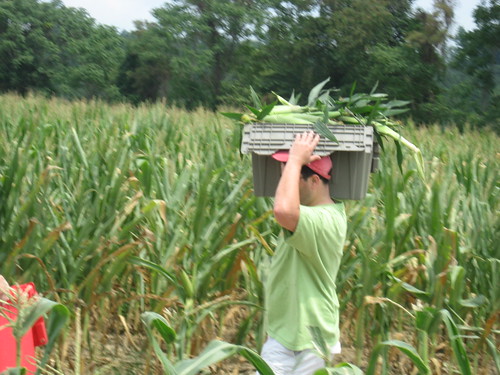
“Go deep!” yells a girl in a white tank top as she chucks three ears of corn in rapid succession toward a man stooped over a crate behind a row of stalks. The man springs upright, deftly grabbing each ear as it hurtles through the air. Laughing to himself, he snaps off the stalk butts and peels the thick outer husks. He begins to drop the ears into a crate lying at his feet but pauses and turns his head toward the girl. “You’re not checking these, Ashley!” he shouts. Ashley shakes her head and prepares to launch another salvo, scooping up ears from the tilled soil and snapping off others from trimmed stalks. On a sweltering Saturday, the two volunteers, along with about 30 others, are scouring Parker Farms cornfields in Oak Grove, Va., to harvest leftover crops for the food-salvaging program known as Glean for the City.

Now in its second year, the program gleans crops from local farms in order to add large quantities of produce to the 5,000 food bags its Northwest-based parent organization, Bread for the City, provides to D.C.’s poor and needy each month.

Though Bread for the City collects canned goods and other nonperishable food items year-round, from July to November it focuses on the gleaning program, gathering different crops ranging from broccoli to apples at area farms. The program organizes gleaning sessions on farm acreage that has just undergone harvest, furnishing vans and coordinators to guide participants through crop fields. Last year, the program salvaged more than 50,000 pounds of fresh produce, according to Bread for the City spokesperson Greg Bloom, who said that figure should increase this year by at least 50 percent.

Since its inception, Glean for the City has been a hit, attracting hundreds of volunteers eager to sample a days work in the fields. “It’s hard to imagine exhausting the interest in this kind of volunteer work,” Bloom said. “The prospect of heading out to the country to pick up food ... that’s something a lot of people are ready to get behind.”

Chevy Chase father-and-son team Larry and Kevin Carlson labored in the fields Saturday, trudging through the dirt ditches that cleave crop rows and foraging with their hands for forgotten ears. Both said they enjoyed the experience of scrounging up sweet corn that otherwise would have gone to waste. “It’s gratifying,” Kevin said. “It feels like you’ve accomplished something. I like filling bins.” Aforementioned corn-tossing enthusiast Ashley Lawson, who is also the coordinator of the D.C. food kitchen Miriam's Kitchen, said she likes that gleaning allows her to be part of the giving process from start to finish.

“It’s nice when we can come out here and assess the quality of food were serving ... it really shows that we care about them,” she said. Miriam's Kitchen is one of several service organizations and projects that regularly partners with Glean for the City. Coordinator Vince Hill explained that gleaning is not uncommon for food pantries and kitchens, but usually is very ad hoc. “Glean for the City,” Hill said, “is one of the only programs he knows of that has the wherewithal vans, crates, staff to operate on a large scale.” Hard work and feel-good generosity aside, gleaning can also be quite the eye-opener for some volunteers.

Sarah Ngueyem, who is pursuing an associates degree at Montgomery College, said she was no stranger to this work. Back in Cameroon, she and her family regularly handpicked crops together. But Ngueyem saw something Saturday shed never witnessed on her family’s farm: enormous volumes of produce left to rot. “Back home we don’t use machines, so we do it all by ourselves. My grandma used to come behind us to check,” she said, puzzled by the leftover ears that smattered the ground or still poked up out of post-harvest stalks.

Bread for the City Project Manager Jeffrey Wankel, who started the gleaning program last year along with the organizations nutrition consultant, Sharon Gruber, said he was also surprised to find out about the excess. When researching how the organization could acquire more fresh produce, he learned that factors like consumer size standards, blemishes and human error cause up to half of crop yields to go to waste. That frustration was what led Wankel to engineer Glean for the City in the first place. Last year, Wankel and Gruber drew up a list of 100 farms within a 60-mile radius of Breads headquarters at 1525 7th St. NW. Then they started putting out cold calls.

Bread for the City spokesperson Bloom recalled the process: “What we found along the way...was farmers [saying], We have tons of food here, but we just don’t have the resources. But if you send volunteers out here, were happy to let you come and take it.” Wankel said many farmers were eager to help, and gave tips on the best ways to scout out leftover produce like visiting farmers markets.

Glean for the City now visits local markets several times a week to scrounge up vendors' excess products, allowing the organization to supply at least five types of produce throughout the harvest season. When it comes to visiting actual farms, Wankel said selecting the right ones depends on yield potential. “You have to find a farm with the capacity; small farms will say, ‘We’d love you to come, but we only have 200 pounds’”, he said. That quantity might sound hefty on paper, but its just a fraction of what Glean for the City can amass with a 30-person crew over only two hours.

After gleaning in the sun for an afternoon on Parker Farms, Hill and Wankel told a sweaty, dirt-spattered crowd they’d rounded up 3,000 pounds of fresh, quality sweet corn. Glean for the City will average this quantity on every one of its weekly trips to local farms. But Hill said all the trips combined will still leave a disturbing amount of the total surplus behind: almost all of it. For this reason, he said, he can count on hearing the following words from Parker Farms owner Rod Parker during every gleaning trip: “You didn’t bring enough bins, and you didn’t bring enough people.”

More information about Glean for the City is available at www.breadforthecity.org/gleanforthecity.

August 17, 2010

Gleaners Rescue Corn

This past Saturday, Parker Farms and Bread for the City hosted yet another Glean for the City adventure. Our mission this time around was especially critical - rescuing yellow corn.

"I've never seen it this bad," said Rod Parker, shaking his head. "1% infestation is bad. 5% and you might break even. We're at 8% right now." Rod is referring to a pest known as corn earworm. (They're pretty gross.) This season, the infestation is so bad that Rod has been forced to abandon over 80 acres of corn. Eighty. Acres. Rod says it's just not cost effective to fight them anymore.

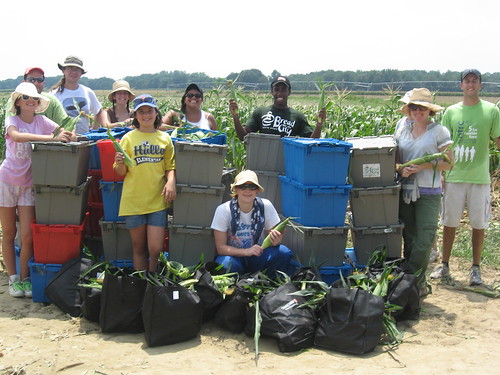
That's where our gleaning heroes came in. We made the 90 minute trek down to Parker Farms in Colonial Beach, VA to rescue the corn and bring it back to our clients at Bread for the City-- the worm free corn, that is. While a high percentage of corn is infested with the corn earworm, an even higher percentage of corn is perfectly edible. (And really delicious! Ever eat corn right off the stalk? Can't get much fresher than that...) After a couple hours' work, our 12 volunteers gleaned over 2,000 pounds of fresh, free, delicious yellow corn. Check out the August 14 photo gallery on our Flickr page.

Without our volunteers and Glean for the City, 80 acres of corn would become 80 acres of compost. (Really expensive compost.) Although devastated with the loss of so much corn, Rod says that the blow is softened by knowing that Bread for the City can make use of what is left of his corn crop.

While we won't be able to rescue all of the corn, we can do our part to salvage what we can; 2,000 pounds at a time. And you can help! Contact Vince Hill at VHill@BreadfortheCity.org to sign up for a gleaning trip. With the harvest season about to kick into high gear, there are plenty of gleaning trips left. Don't miss out!

August 5, 2010

The Mega-Glean!

Post by BFC intern Vicky Gan.


This Saturday, August 7th, Bread for the City will send out our largest Glean for the City expedition yet. This time, we will be partnering with Miriam’s Kitchen, which provides hot meals and case management services to homeless men and women. 35 dedicated Bread for the City volunteers will be joined by 15 Miriam’s Kitchen volunteers. We’ll drive to Parker Farms with a fleet of vehicles that will bring back almost 4,000 pounds of sweet corn.

This is our second season of Glean for the City, and our first collaborative glean. We expect to pack both of our pantries pretty much to capacity. Miriam’s Kitchen, which has recently begun serving dinner in addition to breakfast, will be using the sweet corn to make corn salad, corn soup, and good ol’ corn on the cob.

The organization’s development and volunteer manager, Ashley Lawson, has this to say about the upcoming event:
We very rarely have full ears of corn to serve our guests, so we are very excited to spend the day picking enough corn so each Miriam’s guest can get their fill of corn for dinner next week. Our volunteers are looking forward to this unique afternoon, and we are grateful to Parker Farms for being so generous with their crop. Even more so, we are appreciative to Bread for the City for the invitation to collaborate. We hope this is the start of many gleaning days!
We’ll also be sharing some of our glean with the DCPCA’s Ward 8 ‘Family Fun Day’ on August 14, 2010. The event will be from 11AM to 3PM at Ketcham Elementary School (1919 15th Street SE), and will offer food (corn and more!), exercise and fun activities with live music and local vendors providing tips and information on healthy living. (Contact Emily Roberts at (202) 638‐0252, x220.)

If you’re interested in volunteering, or if your community group or organization might want to partner with us on future mega-gleans, please email Vince Hill. In the meantime, if you'd like to support this work, you can help us cover the cost of transportation and other things like bins, bags, gloves, and so on, by making a donation to Glean for the City today.

July 20, 2010

Let's Glean Again, Like We Did Last Summer

Aaaand we’re gleaning again!

On Saturday, more than a dozen volunteers drove down to Parker Farms in Colonial Beach, VA. Some of our volunteers were BFC donors; others found out about the project from an NPR story about it last year; and still others learned about it from the DC Food For All. All of them were ready to roll up their sleeves and come to the rescue of the farm’s surplus sweet corn.

There was more out there than we’d expected. We gleaned just one acre out of 100s that were available to us, and left at the end with more than 1,700lbs of corn in tow. Farmer Rod Parker met us in the fields, and at the end of the day he told me, “my only complaint is that you didn’t bring enough bins.”

Why is so much corn left in the farm’s field? Here are some reasons:

1) Human error: laborers inevitably miss a certain amount of corn that is market-ready and perfect. Farmers often opt not to pay for a second pass through the fields, but are happy for volunteers to come do it.

2) Undersized/under ripe: corn that is too small to sell is left behind, even if it is edible. Shoppers are so picky that almost every type of produce has size minimums and shape requirements. Under-ripe corn is also left behind. It’s not as tasty or filling, but still edible -- and often ripened by the time we get to it.

3) Damaged: corn that has been eaten or broken. There wasn’t actually that much corn that was actually damaged, and we left it all behind too. There was way more of the good stuff to be had.

This successful trip marks the launch of the second year of Glean for the City, a project that already feels like a cherished tradition around here. Last year, we rescued 50,000 lbs. of fresh, surplus produce from farms and farmers markets, including apples, bell peppers, broccoli, and a plethora of other fruits and veggies -- an average of 2,000 lbs. of fresh produce every week! All for free, all food that otherwise would have gone to waste, but instead went to the kitchen table of the DC residents who need it the most.

The farmers love it, our volunteers love it, our clients love it, and our community was so enthusiastic about it that you all helped us win a contest on the internet, ensuring that we had enough funding to cover the cost of a full-time coordinator to manage the program. (Speaking as this year’s new coordinator, I want to say thank you!)

You’ll be really excited by what we have in store this year. First of all, we’ve extended the gleaning season by one month, and connected with new farm partners to bring in more quantity and a healthier variety. We aim to bring in 3,000 lbs per week this time. And we’re even partnering with other local food pantries to run coordinated gleanings and share the bounty!

In fact, I hope to someday honor our Food Pantry Director Ted Pringle’s goal of ultimately replacing all canned vegetables in our pantry with farm-fresh produce.

If you’re interested in volunteering, or if your community group or organization might want to partner with us, please email me. In the meantime, if you'd like to support this work, you can help us cover the cost of transportation and other things like bins, bags, gloves, and so on, by making a donation to Glean for the City today.

July 12, 2010

Our First Client Gleaning!

Common Good City Farm
Over the past year, BFC has worked to expand our gleaning program to provide fresh, local produce to our clients. We are kicking off this season with a Glean for the City event on Saturday, July 17th and we need your help! We will travel to Parker Farms in Colonial Beach, VA. Join us in the fields, and help collect more than a ton of delicious sweet corn for our food pantry. The event will last from 9am to 2pm, including driving time. For more information, please contact Vince Hill.
------------------------------------------------------------------------

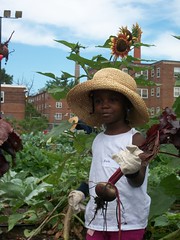
After weeks of unforgettable heat, the day dawned fresh and inviting, just the type of weather we needed for our first ever client gleaning project at Common Good City Farm. Sure enough, the day turned out to be educational, delicious, and fun.


Common Good City Farm, located about a half a mile from BFC’s NW center, is a neighborhood farm dedicated to raising awareness about food and food justice in DC. In addition to selling some of their produce to local restaurants, CGCF runs programs and workshops for low-income volunteers and school-aged children, as well as the curious, casual gardener. Several clients expressed interest in Common Good's "Green Tomorrows" program, which provides a bag of fresh produce to low-income residents in exchange for two or more hours per week of instructional, hands-on work on the farm.


Spencer Ellsworth and the other staff at Common Good City Farm generously took time to share their knowledge of urban gardening, basic plant care and food preparation.
Spencer Ellsworth, our CGCF guide for the day


They weren't the only ones ready to teach. Antoinette Jones, a grandmother born and raised in North Carolina, was one of the stars of the day. A long time client, Ms. Jones embodied the excitement and enthusiasm of our volunteers, waxing lyrical about a childhood in the country and the joys of gardening. She helped to make everyone feel at home in the garden, more specifically the cabbage patch. She taught everyone, even Spencer, a thing or two about how to keep your cabbages healthy and how to get the most out of your plants.


“It’s too late in the year for another [cabbage] head to grow, so you pop them out like collard greens...cut ‘em, clean ‘em, throw ‘em in the pot with a piece of meat, whatever you got and it taste just like collard greens!” Even if down home cooking isn’t your thing, Ms. Jones had some money-saving advice we could all use. “How many know how to make spices from the tops of your vegetables?” She asked the group as we rested in the shade. She patiently explained how to dry and prepare the tops of vegetables to make the spices normally sold for $7 or $8 dollars at the supermarket; chive from spring onions and a parsley substitute from carrot tops. “And now, what you’d buy in the store for $8 somethin’ dollars, you made it for free!”
Ms. Jones shows another client how to pull cabbage


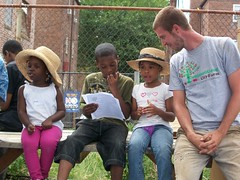
But wisdom doesn’t always come from the most experienced among us. One of our clients, India, brought along her son and daughter at their expressed wish. “I told them about the trip and they were so excited...we love fruits and vegetables so anything they can dig up out of the ground, that’s good for them.” Antonio, 10, and Ania, 4, were a testament to their mother’s pride, ducking excitedly from patch to patch, pleading to be allowed to cut, pull, or dig something. “What can I do next?!” was a near constant chorus from the siblings and Ms. Jone’s young granddaughter Kayla.


Ania, 4, was our youngest gleaner of the day
These kids defy stereotypes; not only do they love healthy foods, but Antonio proclaimed his favorite vegetable to be broccoli! Kayla couldn’t contain her enthusiasm. “Whatever is green is good and I am going to eat it!" she declared amidst the still-tender squash beds. Ania’s enchantment was enough to capture the hearts of the entire group, as she pulled out a few my-size-beets and laid them gently in the bins to be brought back to Bread for the City with an ecstatic “Yeah!”.

The joy was palpable as our clients cut kale, pulled carrots and and clipped cucumbers to replace the canned goods that ordinarily adorn our food bags in the NW center.

Many of our clients were especially touched when they brought the gleaned produce back to our NW food pantry and saw how their hard work would translate into better food for them and their fellow clients. “This is so wonderful,” remarked one client. “”I’ve been [wanting] to volunteer for BFC for a long time! It’s great to pick produce for the pantry! We need to do this again!”

We ended the day tasting just-ripe peaches and discussing the meals people would make with the food they had picked with their own hands. BFC’s nutrition consultant Sharon Gruber spoke about the importance of “eating with the seasons,” using all the parts of the fruit and vegetables, and how to maximize your spending potential at farmer’s markets.

Many clients expressed an interest in returning to CGCF. None had heard of the urban farm before this trip, and all were impressed at the scale, scope, and mission of the organization’s work. Despite the convenient location of the community garden, few clients were aware of the possibilities that lay in this once-fallow field. Upon seeing the farm for the first time, one client remarked, “I never knew this garden was here! This is so cool to have right in our backyard!”

As we gathered for a picture to commemorate what we hope will be the first of many opportunities for our clients to be an active part of Bread, Kayla summed up our feelings in a way only a child can. “What a perfect picture for a perfect day!”
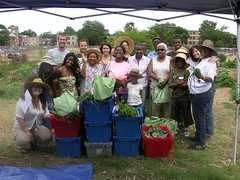
Our first ever client gleaners!


November 24, 2009

Gettin' Dirty: The Final Glean

The forecast was ominous for Glean for the City's final Gleaning (on Saturday, November 14th). Rain had been pounding Parker Farms for days. It stopped only hours before we planned to hit the fields.

According to procedure, I emailed our volunteers (from law firms Booz Allen, Dickstein Shapiro, and Coviello and Associates), and informed them of the high likelihood that we'd be gleaning in a swamp. I expected people to want to reschedule. Instead, I received a unanimous “Bring it on!”

A swamp it was. Volunteers leaped puddles, walked down dry rows like a tightrope, and trudged through the mud in search of perfect heads of broccoli. As I wrote last time, gleaning broccoli isn't easy -- you have to really get down to the ground and slash it out.

One of our volunteers got a little too far down to the ground. Her foot sunk 2 feet into the mud, and even with Vince's help she was struggling to get up. After considerable tugging (and laughing), she eventually pulled her foot out -- but without a shoe! It seemed to get eaten by the muck. But rather than take it easy after that, she kicked off her other shoe (which just looked like a chunk of mud anyway) and proceeding to glean barefoot for over an hour.

By the end, despite the mud, we'd hauled up 35 bins bulging with broccoli. We took the time to admire our work, and then the volunteers began to depart in their respective vehicles. But nature had one last attempt to spoil our fun.

Vince and I heard the spinning wheels first. We looked over at a volunteer's sedan, which was now stuck in a newly formed river, and simultaneously said, “UH OH”. We tried to help push--to no avail.

Predictably, Rod Parker came to the rescue. Using the front end of his 4x4, he gently nudged the vehicle to solid ground. Our volunteer drove away, waiving out of the car with a loud, “Thank youuuu!” It was the perfect exclamation point on an improbably perfect day.

A special thanks to Barrett Jones for taking video of the event. Of course, also a very special thanks to Rod Parker for taking the time to spend the day with us. Rod has been an essential component of our first year at Glean for the City.

Last but not least, a HUGE thanks to everyone who voted for us (especially those of you who voted every day!) in the Tom's of Maine '50 States for Good' contest. I am pleased to report that Bread for the City won!

We'll have more thoughts here soon about what that means for the future of Glean for the City. In the meantime, thousands of thank yous from us to those of you who made it happen. This one's for you:

November 9, 2009

Chopping Broccoli


On a gorgeous fall morning, Glean for the City made our long anticipated return to Parker Farms. Two previously scheduled trips had been rained out, but now we finally got our first crack at broccoli gleaning.

It was worth the wait. 20 volunteers -- from the Historic Anacostia Block Association (HABA), a local neighborhood association, the ANC 8A (03), and White and Case -- armed with knives and enthusiasm, stormed the vast broccoli patches. Rod Parker himself generously gave our volunteers a tour of his facility, then took us into the fields and showed us the ropes of chopping broccoli.

“Just look for a good head of broccoli, it shouldn’t be hard to find. You won’t even be able to put a dent into this field, even if you fill the van to capacity.”

Rod was right. In just 1 hour and 15 minutes, our volunteers had stuffed every single produce bin. They refused to quit, and filled every picking bag to capacity as well. As folks began to stack the days take, two intrepid volunteers remained in the fields, stubbornly forcing broccoli into the final two bags.

“I don’t want to leave. There is so much fantastic broccoli left, it breaks my heart to just leave it out here!” Another volunteer carrying an arm full of broccoli remarked, “How is this possible? There are thousands of starving families in DC, and all of this produce is just rotting in the fields!”


Volunteers loved gleaning this crop. Unlike apple gleaning, broccoli needs to be cut and cleaned, and feels more like true harvesting. We had to scrape together knives from the BFC kitchen for this event. Thanks to the generosity of Andrea Messina and the Georgetown MBA Volunteers, we won’t have to worry about knives again. Even though Andrea's gleaning event was rained out she still set up a donation of 32 knives to Glean for the City. This gives us the tools to tackle any crop we please; and should be a big help as we expand the variety next season.


A special thanks to Mana Rabiee of WAMU(NPR) for joining us to cover Glean for the City. She interviewed Rod Parker, spoke with volunteers, and even helped us load the broccoli after gleaning! Check out the podcast here.

Since the WAMU report, we've been flooded with offers to volunteer for gleaning. We're thrilled to have so much support from the community -- and strangely sorry to announce that we're already booked through the remainder of the gleaning season. But we are already filling slots for next season, when we'll be gleaning strawberries as early as May! Email me to sign up.

October 23, 2009


Stalking Broccoli


As the harvest season winds down, Bread for the City's Glean for the City program is reaching its final stretch, and it's been a great success. Altogether, with the help of hundreds of volunteers, we've brought in roughly 35,000 pounds of fresh produce. And now we're in the lead for a major grant from Tom's of Maine in their 50 States for Good contest! Please vote for us now (shortcut: click Ctrl-F and type 'bread' to find us) and make yourself a note to vote each day between now and October 31st!

During this last stretch, we will be gleaning broccoli from Parker Farms. We started off the season gleaning 5,000 lbs. of sweet corn there, and Rod Parker is generously allowing us to return for the brocc. Over the coming months, we expect to harvest several tons of broccoli for our pantry -- all from just this one farm.

(We were going to do a big glean in tandem with the launch of the DC Food For All, but we got rained out! There will be more opportunities for Glean for the City to collaborate with the DC Food For All, I'm sure.)

Broccoli will be a new and challenging harvest for us. Apple picking, for instance, is as easy as it is fun. When we picked up cucumbers, they'd already been harvested and sorted and were just waiting for our truck. Broccoli, on the other hand, will have to be removed from its stalk, right out of the ground.


This is a relatively labor intensive harvest. You need a knife to strip the leaves and cut the stalk. Large leaves protrude from the sides of the stalk and cover the edible heads of broccoli -- which means it's easy to miss.


There's also a lot that deliberately gets left behind: the farmers pay harvesters to make just one pass through the field. In that pass, they look for the best pieces. Variations in soil and sunlight cause some plants to reach maturity later, and a lot of broccoli gets left behind because it's insufficiently ripe.

It's a sad reality of today's market that stores will only accept broccoli of a certain size, because they cater to shoppers' picky demand for full crops. In the meantime, farms can’t afford to take another pass when the broccoli reaches maturity. Most of these plants reach the perfect size days later -- but they are left to rot in the field. Unless of course Glean for the City is on the scene.

Thanks to all the volunteers, farmers and market managers who've made Glean for the City such a success so far. Check out this great recent New York Times article about a sophisticated gleaning network in California - I think we could get to that level very soon!

And last but not least, please vote for us in the Tom's of Maine contest. With your help, we'll ensure that all the food that's fit to eat gets to the people who need it.

September 24, 2009

Volunteer Spotlight: Parker Farms


Parker Farms started as a family owned "Pick Your Own" operation with two acres of vegetables and berries in 1974. Rod Parker still runs the family business as the General Manager, with his son working as the Field Manager. With headquarters in Oak Grove, Virginia, Parker Farms now handles over 3,200 acres of farmland in Maine, Maryland, Virginia, North Carolina, South Carolina, Georgia and Florida.

Rod was a huge help in the planning process for Glean for the City, and gave us valuable information that allowed the program to really take off. He took time out of his hectic schedule to sit down and talk with Bread for the City about food waste and the gleaning process. (That's Rod talking to BFC Nutritionist Sharon Gruber.) He took a lot of guesswork out of running the program, and helped to prepare us to hit the ground running.

This year, with the help of Parker Farms, volunteers working with Glean for the City have collected nearly 30,000 total pounds of fresh produce. We will be back at Parker Farms in October to glean broccoli, and any interested volunteers should visit www.BreadfortheCity.org/gleanforthecity.

Thank you Rod Parker and Parker Farms for all that you do. We are proud to have you as our 2009 Fresh Food Partner.

July 29, 2009

Gleaning Provides Opportunities for Education


Two days ago I made my third trip to Parker Farms in Virginia to gather fresh crops for our pantry.

I was met by volunteers from Setauket Presbyterian Church. Rev. Jeff Geary, the group leader, brought a group of 8 volunteers to hit the fields with Glean for the City. After two successful gleanings, I am expanding our trips to include education and dialogue regarding food security (similar to the discussions we've been posting on this blog).

I took the opportunity to speak with our young volunteers about food waste, gleaning, and the role that Bread for the City takes in addressing poverty. It turns out Rev. Geary had education on his agenda as well. His church works to educate their youth about commercial agriculture and its exploitative use of underpaid farm workers. He hoped that Glean for the City would provide hands-on example of the arduous task of handpicking crops.

After gleaning 1,000 lbs. of corn, we loaded up the van and took a step back to admire our work. Rev. Geary remarked that a day laborer picking tomatoes in Florida would have made only $10-25 for gathering the entire quantity on his/her own. As we looked out at the endless acres of corn we couldn’t glean, we discussed the utility of this fresh food for our clients.

Glean for the City provided a rare opportunity for education in agriculture. Most of our volunteers had never been to a farm, and none had ever worked in a field. Picking produce is a strenuous activity, and I'm glad we're able to provide this type of exposure to our volunteers while being able to help our clients access nutritional foods.

July 23, 2009

Glean for the City: Corn and More

Monday was our second Glean for the City event, again at Parker Farms.

I was accompanied by 20 volunteers from the Washington Quaker Workcamps. With this large volunteer group we picked literally tons of corn -- and fast. We filled every produce bin, and decided to stuff every picking bag full for good measure. On the drive home, I was accompanied by the sweet scent of nearly 2,000 lbs of corn in the van.

Our volunteers wanted more. "I wish we could keep going! We’ve barely put a dent in this field, and I can't believe the rest will go to waste."

Another volunteer remarked to me that, "The government should create a volunteer corps to organize gleanings with farms and food pantries. But I am happy that Bread for the City is doing their part."

The corn will be split up between our SE and NW centers. This will provide a fresh produce staple for our food bags for the rest of the week.

As a side note: We typically offer canned corn in our pantry, which is very popular with our clients - but also high in sodium! Fresh corn is very high in fiber and generally healthy. Just as important, it is easy to prepare: boil for 15 minutes, grill for 10 minutes, cut it off the cob and put it in salsa or salad. Our volunteers were eating it right off the cob, and so was I. We even brought some back for the Bread for the City parking lot barbecue, where it was a big hit.

In trying to bring in more fresh produce to the pantry, we're also working toward variety. Sharon, our in-house nutritionist, likes to say " people should eat a variety of colors.” The more colors, the more variety of vitamins and minerals. A large array of nutrients supports and protects the body from illness and chronic conditions.

So on Sunday, I picked up over 800 lbs. of fresh fruits and veggies from our friends at the West End Farmer's Market. Our fridge is now stocked with a rainbow variety, including squash, eggplants, peppers, greens, cucumbers, tomatoes, and fresh bread.

The quantity has increased with every trip to the West End Market, and I will go every Sunday until they close for the season. Combined with our gleanings, this will enable us to bring both variety and quantity to our food pantry for months.

We’re deeply grateful to Parker Farms, FreshFarms Markets, and all of our community partners for helping us make sure that this surplus food will go to those who need it most, instead of going to waste.

July 13, 2009

Corn for the City


Our gleaning initiative begins!

Early Saturday morning I took a beautiful country drive to Parker Farms in Colonial Beach, Virginia. I was on my way to Glean for the City’s inaugural event. As the event coordinator, I must admit, I was a little nervous. But that quickly turned to excitement as enthusiastic volunteers began to arrive. After a quick rundown of the gleaning process our group of 10 headed to the fields to meet Rod Parker. As we looked out across hundreds of acres of corn fields, comments by owner Rod Parker hammered home the scope of food waste; and the amazing opportunity this was for the food pantry.

“We have already gone through the fields and picked everything we can sell,” Rod said, “but most of what is left is perfectly good to eat. As you can see, there are 3 or 4 ears of edible corn left on every stalk.”
“How do we know if it’s good to eat?” one of the volunteers asked.
“Just give a good squeeze,” Rod responded. “If it’s fat and juicy, then pick it. You can even eat it raw off the cob. It’s like candy.”

A few volunteers took Rod’s suggestion and quickly discovered that the corn was delicious, even uncooked. Then it was time for us to hit the fields. Each volunteer took a couple of picking bags and a row of corn and got to work. And oh how the corn rolled in. I patrolled the edges of the fields, filling produce bins with bags from the volunteers. At times, it was tough to keep up with everybody! Most of the group were clearly amazed as they grabbed corn at a constant pace. “This is great!” one of them told me, “I cannot believe that all of this would have gone to waste. It’s so easy to glean corn, and you see the results of your work right away. I want to do this again!”

Before we knew it we had filled half of our containers in the first hour. After a short water break we stuffed the remaining containers in only 45 minutes. In total, we picked 1,500 lbs. of corn in two short hours.

With one last look at the BFC van, bulging full of corn, we left satisfied with a hard day’s work. This will feed over 1,000 hungry clients at Bread for the City over the next week. Thanks to the volunteers who made it possible!

July 7, 2009

Announcing Our Latest Initiative: Glean for the City!

Time to bring fresh produce to everybody.

This week, Bread for the City is proud to announce our latest and most ambitious volunteer initiative—Glean for the City!

We’ve posted before on this blog about how much perfectly good food gets wasted, for a variety of reasons, between the farms that grow it and the stores that sell it. There are estimates that up to 50% of all food produced in the United States ultimately goes to waste. We plan to tap into some of this abundant produce supply so we can bring it to the District and give it to the people who would otherwise have to go without.

This weekend our first group will go to Parker Farm, about an hour away from DC, to pick corn. Every Saturday between July 11th and the middle of November, we will be asking other groups of 20-25 people to go to other farms in Virginia and Maryland to pick or “glean” the excess produce the machines leave behind so that we can offer fresh, free, local produce to neglected neighborhoods in our city. We estimate that one group can bring back enough produce to feed 1750 hungry people!

If you are interested in learning more, organizing a volunteer group, or donating to support this new effort, we’ve got specifics on our website for you. We’ll also be putting updates here on the blog as Glean for the City gets underway. Finally, many thanks to all of you in the community who have made this new initiative possible!

July 1, 2009

Food Waste Up Close: Sorting Cucumbers

Why waste something so good?

This past week, we made a trip out to Parker Farms in Oak Grove, VA. The goal of our visit was to get a glimpse at how our new program, Glean for the City, will work to bring fresh produce into our pantry. (We’ll be gleaning corn from Parker Farms in July -- see here for information about this new project.)

Besides growing corn, Parker Farms also runs a sorting and distribution operation for crops from local farms. We were fortunate enough to visit the farm on a cucumber-sorting day, and General Manager Rod Parker took the time to show us the entire process.

To be sorted, every cucumber is loaded onto a long conveyer belt. The cucumbers are then power-washed with water to remove any residual dirt or pesticides. After being sorted by hand, the “imperfect” cucumbers are placed on a separate conveyer belt headed towards a large dump truck.

Cucumbers are rejected for several reasons:

A. They are too curvy for efficient packaging.
B. They have a small white spot at one end, usually only one square inch in size. This is caused by the tip being buried and missing out on photosynthesis. 97% of the cuke is green and edible, but grocery stores still won’t take them.
C. They have small cracks that keep them from the market. Rod notes that, while cucumbers do have a short shelf life, the cracks don’t affect taste or ripeness.

Farmers need shoppers to buy the cucumbers they’re selling, and the market demands aesthetically pleasing produce. Looking at the truck of rejected produce, Rod told us that, “90% of the cucumbers in that dump truck taste perfectly fine and have the same nutrition. They just don’t look good enough to be sold.”

The rejected cucumbers are driven back into the fields and deposited on the ground to become fertilizer. Mr. Parker estimates that, “we dump thousands upon thousands of them every time we sort.” From our experience, it seems that many farmers would like to donate unsellable food to pantries, but they are already strapped for time and resources and don’t have the capacity to take on that additional burden.

There is sometimes a tax break for donated farm produce, but most often they are capped at 10% of market value. Given the difficulty of trucking produce to yet another destination, it’s not enough of an incentive. So the produce goes to waste. But this summer, we’ll be rescuing at least some of it so we can bring it to the people who need it most.