March 31, 2011

Tomorrow: A Dark Day for Low-Income Families

On April 1, thousands of DC families will wake up to a 20% reduction in their cash assistance. Benefits will be cut for Temporary Assistance for Needy Families (TANF) recipients that have been in the program more than five years and do not meet one of three very narrow exemptions. For a parent and two children, monthly benefits will be reduced from $428 to $342.

Regardless of their different timelines, needs, and goals, families need enough cash assistance to stay stable. Despite moves from the TANF agency to reform the program, DC still lacks strong support services and job training. These shortfalls combined with the lack of jobs due to the recession make this a terrible time to further cut life-saving assistance.

As these harsh cuts go into affect, we wanted to take an opportunity to share a story about the daily realities of TANF recipients.

Bread client Patty Anne has worked to overcome homelessness, health issues, an abusive partner, and lots of housing drama, all while trying to find a job and navigate the system to get help for her and her daughter. She shared her story on Beyond Bread and with the Mayor when the decision to reduce TANF benefits was made as part of the budget gap-closing last December. Her words are worth repeating:


It’s hard to make ends meet on a fixed income, even though I’m careful with my budget. My daughter hasn't had a new coat for three years, and right now we’re wearing our coats in the house because I can't turn the heat on. I don't want to run the bills up and then have my utilities cut off. That's grounds to lose my housing voucher, and I can’t take that chance.

It’s clear that they give you the help that they want to give you, not what you need to pick yourself up. It’s not like I’ve been asking for a million dollars, or for people to move mountains or part seas. I just want a stable home for me and my daughter. I want somebody to step up and help me do better for myself, so I can do better for her. I don't want her to live in a constant state of trial and tribulation. If I had the tools that I needed, I would be able to make it.


Read Patty Anne's complete post now or watch her speak advocate directly with the Mayor in this video from Empower DC:

March 30, 2011

DC should fully fund housing inspections

Several years ago, a multi-part Washington Post investigation looked at the conditions of DC's housing stock and discovered a set of "serious breakdowns" in the enforcement of housing codes by the Department of Consumer and Regulatory Affairs (DCRA). The series quoted Bread for the City's Housing Practice Supervisor, Rebecca Lindhurst, among other affordable housing advocates, in explaining the negative ramifications of lapses in oversight activities. For instance, without enough inspectors to actively assess the state of rental properties, the city was allowing many landlords to neglect the maintenance of their buildings. In the wake of the Post investigation, the DCRA made considerable progress towards more robust oversight. But in recent months, momentum has stalled in the face of staffing cutbacks and hiring freezes, which have once again left the city's housing inspection program with minimal capacity.


On March 9th, Rebecca testified at the D.C. City Council’s oversight hearing. What follows are portions of Rebecca’s testimony.


I come before the council today to testify about the importance of a robust housing code inspection system in the District of Columbia. Advocates have been working on this issue for several years and we’d like to applaud DCRA in implementing many of the suggestions made by the tenant advocacy community. Through our ongoing meetings with the Director of DCRA we have worked to improve the inspection system so that all District of Columbia renters live in housing free of health and safety violations.

The last time I testified before this committee I was testifying in support of the implementation of a pro-active inspection program. Since that testimony, DCRA has implemented such a system and continues to work toward a goal of inspecting every rental building in the district by 2013. Traditionally, inspections in the district were only done at the request of a tenant who called in a complaint against his/her landlord. We believe that a tenant initiated inspection system, while necessary, is insufficient and contend that a pro-active inspection system is the most efficient and effective way to ensure that the Housing Code is enforced.

In order to make a pro-active inspection system work the district must increase the number of inspectors. If done properly the long-term results of a pro-active inspection system will be significant. During the initial phase the city will be able to assess the entire housing stock and establish the baseline for each rental building in the District.

In 2008 the city brought suit against several slumlords. However, the suit brought against these negligent owners was filed way too late to save several of the buildings. In fact, in 3 of the buildings the city had to take the drastic measure of closing the building because of the severe health and safety conditions. The owners of these 3 buildings had been allowed to operate rental housing with significant housing code violations for many years. By the time the District stepped in the buildings were too far gone. The landlords refused or were unable to repair the buildings and the District was unwilling to use city funds to make the repairs. In the end, the buildings were closed and the tenants were displaced. The displacement resulted in the city spending thousands of dollars to put the tenants up in hotels and eventually relocate them to permanent housing.

A robust inspection system will ensure that buildings like these do not slip through the cracks. The system is designed to catch buildings before they fall into such significant disrepair that the only option is to displace residents. Not only is it a tool to identify buildings in jeopardy it can also be used as a tool to reclaim neighborhoods. In some jurisdictions the inspection system has resulted in reinvestment by private landlords thereby improving the overall housing stock.

In reality, the proactive inspection system is a mandatory minimum maintenance program. Instead of focusing on catching bad landlords the program focuses on getting to a point where each landlord in the District is maintaining a minimum standard of maintenance. When we get there landlords will no longer take the risk of not fixing their properties because they know that with the periodic inspection they will be caught. There is no longer any reason to take the risk that the District won’t find out and won’t pay attention to buildings in disrepair.

In November 2010 DCRA reduced its inspection staffing by 10 inspectors. Soon after this, a hiring freeze was instituted. DCRA has not been able to replace the inspectors lost. As a result, the scheduling of complaint-based inspections has been effected causing tenants longer wait times for inspections. Currently there are only 25 inspectors employed by DCRA. These inspectors are not only responsible for enforcing the housing code but they also perform permit inspections, inspect elevators in residential and commercial buildings, perform plumbing, electrical and HVAC inspections and monitor vacant properties and illegal construction. There simply are not enough inspectors.

For example, if a landlord is found to not be in compliance with the housing code and fails to abate the violation DCRA has the ability to fine the landlord. In FY10 DCRA issued fines in the amount of $3,502,601. However, only $1,377,745 of this amount has been collected. DCRA needs to do a better job of collecting fines so that it can support its inspection program. Without a fully operational inspection system landlords will not be held accountable for housing code violations and district residents could be forced to live in hazardous conditions. It is DCRA’s responsibility to ensure that all tenants live in housing free of health and safety violations. However, without the proper staffing the district will fall short in protecting its residents.

March 29, 2011

Food Justice: Upcoming Author Event and Discussion

Join us for next week for a discussion and author event at Bread for the City’s Northwest Center on the topic of Food Justice - featuring Food Justice co-author Robert Gottlieb, local food justice advocate Louise Thundercloud, and many others involved in food, nutrition, and justice in the District.

Wednesday, April 6th 6:00 to 8:00 p.m. Bread for the City 1525 7th Street Northwest

We’ll be talking a bit about issues and inequities in today's food system – from the farm workers’ hazardous conditions, to the fact that low-income neighborhoods lack supermarkets, to the emphasis on convenience rather than quality and nutrition in food marketing today. Robert Gottlieb will share perspectives on a nation-wide movement that seeks to transform this food system into one that is more just. Then we’ll look more locally – what does food justice mean for D.C. residents? What opportunities and challenges exist in our city? How does Bread for the City’s programs and our rooftop garden fit into all this? What can you do to help?

Join us! Event is free but space is limited. Please RSVP to aburket@breadforthecity.org. This event is co-hosted by D.C. Farm to School Network, Slow Food D.C., Centro Ashé, and the National Family Farm Coalition.


March 28, 2011

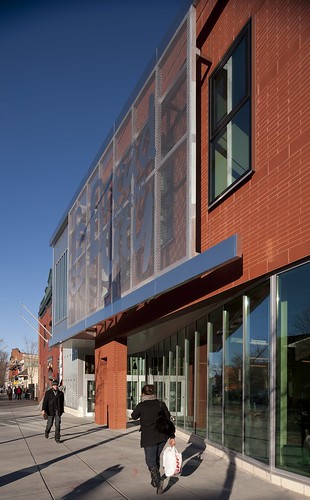
We're in Architecture DC magazine

You should check out the newest edition of Architecture DC magazine, because Bread for the City is totally in it! (It's only available in PDF format, so you'll have to go to page 32 of this file.)


Congratulations to our longtime partner-in-building, architect Kendall Dorman, who designed our Northwest center expansion; Kendall also worked with us to redesign the original facilities of both our Southeast and Northwest Centers, so we believe that his firm Wiebenson & Dorman deserves all this attention and more.

The theme of this issue of Architecture DC is "non-profit architecture," and indeed this article explores the ways in which the design of our new building reflects the character and structure of Bread for the City itself. See this excerpt:
The double-height atrium houses the main front and rear entrances, reception, and vertical circulation (an elevator and open stair), with direct entrances to the medical/dental clinic, the legal clinic, the food bank, board room, social services, and administration.... [T]he interiors are in a “loft” style, in which the necessities of structure, ducts, piping, cable conduits, and the like are exposed and painted white. They become the “ornament” of the space. The entire former exterior brick wall ofthe lumber warehouse building is exposed as the north wall of the atrium. Its solidity is offset by the glassiness of the end walls of the atrium, and balanced by the exposed concrete block elevator tower....
Color is important throughout the project, but used sparingly both for reasons of economy and effect. This starts with the streetfront windows, which have alternating green and blue tints. It continues with the surprisingly bold green linoleum flooring and carpet tiles, and accent walls painted green, blue, or gold, including one wall of each medical exam room. Doors and simple pieces of custom millwork, such as bookshelves, are natural, warm wood tones. Because most of the interiors are white, the colors add “pop” and distinction to the spaces.

The article also discusses our "LEED-like" energy efficiency, our innovative green roof (you'll hear even more about that soon...), and the strange but true fact that all this was made possible by the 1998 Tobacco Master Settlement Agreement. Take a read, page 32.


Photos courtesy of John Cole.

March 25, 2011

Art with a Heart 2011: WOW!


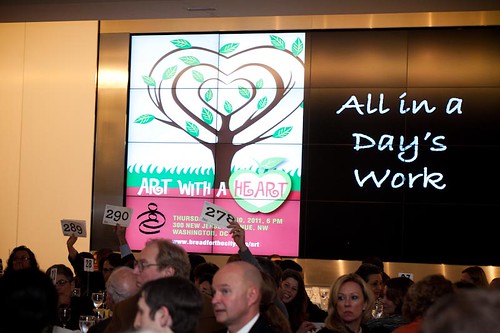
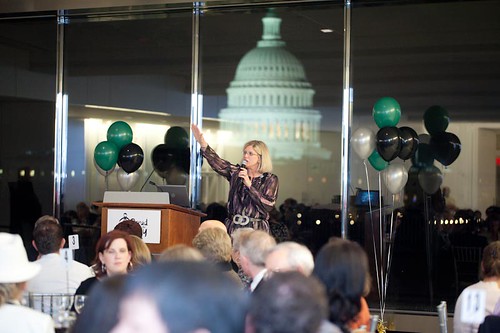
Wow. This year we hosted our 21st Art with a Heart fundraising gala – and it was, quite literally, the best one ever. Indeed, Art with a Heart 2011 didn’t just surpass all of our goals for its silent and live auctions – it raised $326,440 in total, our all-time record!!


For me, the most touching moment of the evening was the outpouring of donations we received for “All in a Day’s Work” – in which we raise funds to cover the daily operating costs of our centers (totaling $25,157 for each day). Our goal was to raise $50,000, but the generosity of our guests surpassed our wildest expectations and we reached over $66,000!!


We also took time during the auction to pay special tribute to some of our longstanding supporters. Three of our board members retired this year, and we wanted to honor them on this occasion. A special thank you to Board members Mark Aron, Roz Cohen, and Laura Parcher for the years of support you’ve given us! Even though you’re retiring from the board, we know we’ll still be able to count on your continued collaboration and I’m sure we’ll see plenty of you in the years to come.


See this slideshow of selected photos from the event -- and click here to see the whole set. Thanks to Jessica Del Vecchio for such great photos!


A big thanks to our AWH Committee, including event chair Cynthia Krus. You all sure know how to plan a party. Thank you also to the many sponsors, volunteers, staff, clients, and supporters for all that you’ve done for us and for the amazing success of our 21st Annual Art with a Heart. See you all again next year!

March 24, 2011

One week left before we open our pantry to Northeast -- can you help?

Today's post is brought to us by my new executive assistant, Christina Queen. Thanks, Christina!

This is so exciting: in just about a week, Bread for the City will open up our food pantries to Northeast DC residents for the first time ever!

I worked as Bread for the City's Southeast Center front desk coordinator for more than five years. During that time, I welcomed a lot of people who were so downtrodden that they could barely find the words to ask for help. I loved my job because I was able to connect these men and women to so many resources. I could show them that there are still good people in this world. I could help them feel human again.


But there was one really hard part of my job: we weren't able to accommodate residents of Northeast DC in our pantry. We didn't have enough resources.

We were able to write referrals to other food pantries in their community -- and I'd even call those pantries up to make sure they knew we were sending folks their way, how many and at what time. I did what I could, but it still was far less effective than serving people here at Bread for the City. Other pantries require ongoing referrals; some only allow people to come every three months; sometimes they might not even have food at all. And none of them have all the comprehensive resources that Bread for the City offers alongside our pantry.

So I can't stress enough to you how much of a step forward it will be when we extend our pantry services to them officially. And it's your support that makes this all possible.

As much as I loved my job at the front desk, I'm pleased to say that I've recently moved on to be George Jones' executive assistant. Where I used to be seeing one individual after another, now i see the big picture of all the people Bread for the City helps, and all the people who help us. It is so inspiring to know how each individual donation makes a difference -- to a person in need and to our whole community at the same time.

We expect to see at least 500 new families from Northeast turn to us in just the first few months -- and our pantry's provisions cost about $10 per person per month. If you haven't yet stepped up to rally support for our big step forward into Northeast, please make a donation today. And if you have already donated, then spread the word to your friends and family! That's how we'll keep growing into a truly city-wide community.

Job Announcement: Family Law Attorney

Bread for the City is seeking a full-time attorney with 0-3 years’ experience for our Family Law practice. Specifically, we seek an attorney to work in our Child Support Community Legal Services Project -- a new, innovative joint endeavor of Bread for the City and the Legal Aid Society of the District of Columbia.

Approximately one or two days per week, the attorney will staff a community legal services office based at the Paternity and Support Branch of D.C. Superior Court, providing immediate, same-day representation to custodial and noncustodial parents in child support cases. The attorney will then retain many of those child support cases for continued representation and will be based the rest of the work week at our Northwest Center. The attorney may also handle a small caseload of other family law cases. In addition, the attorney will conduct advocacy, education and other outreach activities.

Background: The Legal Clinic is one of five programs of Bread for the City, a non-profit organization providing free services to vulnerable residents of Washington, D.C. Bread for the City takes a comprehensive approach to addressing the needs of low-income individuals and families, providing a range of services including supplemental food, clothing, medical care, legal assistance, and social services. The Bread for the City Legal Clinic seeks to ensure better access to justice for low-income individuals in our nation’s capital. The Legal Clinic provides front-line civil legal services primarily in three areas of law: housing, family, and public benefits. Our Family Law practice includes representation in divorce, custody and child support cases, as well as assistance to survivors of domestic violence in obtaining civil protection orders.

Qualifications:

· Member of the D.C. Bar or eligible to waive in;

· Strong organizational, research, and oral and written communication skills;

· Ability to work collaboratively with other staff and interact with a wide variety of people;

· Comfortable working in an open work environment, with no private offices for staff;

· High degree of flexibility;

· Sense of humor;

· Demonstrated commitment to social and economic justice;

· Prior experience in a legal services or other public interest setting highly desirable;

· Some knowledge or experience in child support law a plus;

· Bilingual (Spanish/English) skills preferred but not required.


Compensation: Bread for the City offers competitive non-profit salaries based on experience and a generous benefits package.

To Apply: Bread for the City encourages all interested persons regardless of race, gender, sexual orientation, religion, or disability to apply. Please submit a letter of interest and resume to familyattorneysearch@breadforthecity.org.

Interested persons are encouraged to apply immediately. Job available as of May 1, 2011. Applications will be reviewed as they are submitted. The position remains open until filled. No telephone inquiries please.

March 23, 2011

Save Interim Disability Assistance

We’ve written before about the District’s Interim Disability Assistance (IDA) program. IDA gives $270 per month to low-income District residents who have severe medical conditions and are waiting for a decision on their application for Social Security disability benefits. The District then gets the money back from the federal government if the Social Security Administration approves the disability benefits application.

The program has already undergone cuts in the number of people it serves, and the DC Fiscal Policy Institute fears it will be slashed further in the Mayor’s proposed 2012 budget, which will be released on April 1. They've produced a video with So Others Might Eat that explains the program and shares some stories:


Indeed, we encourage you to contact Mayor Gray and express your support for IDA. And I'd like to share another story of a Bread for the City client who’s been critically helped by this program.

I represent a client named Ms. B, who has several severe mental illnesses and faces physical challenges as well. Ms. B first applied for Supplemental Security Income in September 2008, and her application has been pending for over two years. Her hearing was in January 2011. While we are still waiting for a decision, we are very optimistic that she will be found disabled, and the District will recover all the IDA Ms. B received.

In the meantime, IDA is Ms. B's lifeline. She did not qualify for any cash assistance program but IDA. She has used her IDA benefits to attend meetings with and make phone calls to her social worker and me. $270 a month doesn’t go far, and Ms. B lives in a homeless shelter, but it covers her toiletries and other important items. Among the most vital are transportation to doctors’ appointments and her pharmacy, since Ms. B takes over 10 different prescription medications, and they frequently change as her doctors attempt to control her symptoms while minimizing side effects.

IDA is just about the most effective $270 per person that the District can spend. It can keep some recipients in their homes or with relatives instead of in homeless shelters. It gives people easier access to their doctors and medications, so they need fewer emergency services. It enables recipients to keep in touch with attorneys who can provide a better chance of winning their Social Security cases, in which case the District recovers the IDA it paid out. And when disabled people get Social Security benefits, the District wins too: recipients spend their federal benefits in our local economy, and they become eligible for federally-funded Medicare.

So what can you do? Contact by email or phone the folks in charge of the Mayor’s budget (as soon as possible — the budget will be released on April 1). Mayor Vincent Gray’s email address is eom@dc.gov, and his telephone number is (202) 727-6300. The budget director, Eric Goulet, can be contacted at eric.goulet@dc.gov or at (202) 727-3380. Kenneth Evans, the budget office official responsible for the IDA budget, can be reached at kenneth.evans@dc.gov or (202) 727-5282. And read our most recent post to learn more about the budget cycle and what else we can do.

IDA makes a difference in Ms. B’s life, and in the lives of more than 1,400 other disabled, low-income District residents. Let’s make sure Mayor Gray knows that.

March 22, 2011

Budget Basics, Briefly

Budget season is well underway, and in the run-up to the April 1st release of the Mayor’s proposed FY2012 budget, there are plenty of opportunities this week to get involved.

But what is the budget anyway and why should we care about it? The budget itself is a massive document that lays out in detail the amount of money required to implement all DC government policies, programs, and strategies over the course of the next fiscal year. (A fiscal year for DC government, by the way, is Oct 1st - Sept 30th.) It outlines how DC government plans on getting the money to pay for those programs (eg. income, sales, or property taxes, as well as federal funds) and determines funding levels accordingly.

As budget blogger extraordinaire Susie Cambria puts it, the budget is arguably “the most important of all legislation considered by the City Council and mayor each year.” It determines funding levels for all DC-government activities, shaping everything from school food to TANF to legal services to public works, and everything in between. (See past testimonies from Bread for the City staff and clients about the importance of programs funded by the city budget.)

Currently, the Mayor’s office is working on its proposed budget for the 2012 fiscal year (and is seeking input on their website – check it out). Starting in April, City Council works within agency committees to make additions, subtractions, and revisions to the budget before they vote on it in May. During this time, the different committees host a series of budget hearings – the public’s chance to give input directly to the council. The schedule of budget hearings is available online in PDF form and anyone can testify. See this how-to guide from So Others Might Eat for more, or call Kristi Matthews at the Fair Budget Coalition (202-328-1262) for help preparing your testimony.

Another round of projected shortfalls in revenue means that more than ever, all of our voices are needed to protect the programs that serve our city’s families. Thankfully many of Bread for the City’s allies have useful guides and resources that make it easier for all of us to get involved. Here are a few that I’ve found helpful:

Ready to start taking action today? Here are three ways:
Contact Joni Podschun (jpodschun@breadforthecity.org), Bread for the City’s advocacy coordinator, for more information about what Bread for the City is doing and how you can get involved in the future!

March 21, 2011

Taking Action for Language Access

When I met Mr. M, he was a medical patient and social services client at Bread for the City. Mr. M grew up speaking Amharic and is learning English, and he was referred to the legal clinic because he was having difficulty applying for food stamps from the Department of Human Services (DHS)—a sometimes-difficult process made more complicated by language barriers.

Snapshot of the Amharic-language "Know Your Rights" card, via the Office of Human Rights.
I successfully worked with DHS to get Mr. M approved for food stamp benefits. But DHS continued to send him recertification notices and other vital documents only in English, which he was not able to understand. Mr. M was not just frustrated with his own situation; he was also concerned that other Amharic speakers might face the same barriers he experienced. So we filed a complaint against DHS, alleging that it violated the District’s Language Access Act.

The Language Access Act (PDF of the legislation here) is incredibly valuable legislation that sets the District far ahead of most other jurisdictions with regard to accessibility of government services. The Act requires DC agencies and programs to provide oral interpretation to all their limited- or non-English proficient clients, and to provide written translation of vital documents in languages spoken by 500 people or 3% of the people (whichever is lower) who are served, encountered, or likely to be served or encountered by the agency. The District’s Office of Human Rights (OHR) is tasked with providing oversight about language access and handling language access complaints.

I’m pleased to report that my client’s complaint received a favorable determination from OHR. As a result, OHR gave DHS until the end of May to complete the corrective actions it ordered.

Mr. M. was so excited when he learned about his victory at OHR—not just because changes at DHS would make it easier for him to keep his food stamps and medical assistance, but because this finding will have an impact on the lives of other Amharic-speaking District residents.

But even though Mr. M’s language access complaint had a positive outcome, the process gave me real concerns that people are being deterred from filing complaints because of OHR’s complicated procedures for investigation and enforcement. Consider this: there have been only 17 language access complaints since the Act was passed in 2004, and my client’s complaint was the only instance last year in which OHR found an agency out of compliance with the Language Access Act (another case filed in 2010 was just decided, and it too had a decision of noncompliance).

My case was one of only six findings of noncompliance, but through our involvement in the DC Language Access Coalition and our visits to DC agencies, we know that limited- or non-English proficient people frequently encounter language difficulties when trying to obtain services.

On March 3rd, I testified before the D.C. Council’s Committee on Aging and Community Affairs, which oversees OHR, to share these concerns:

Good morning. My name is Stacy Braverman and I am an attorney at Bread for the City, a non-profit organization serving thousands of low-income District residents each year. Many of those individuals have limited or no English proficiency, and I am here to testify about my experience helping one such client with a language access complaint at the Office of Human Rights.

My client speaks Amharic and is learning English. He had a very difficult time applying for food stamps because of a language barrier. I helped him receive the benefits, but he continued to be sent recertification notices and other vital documents only in English. We filed a language access complaint against the Department of Human Services and received a favorable determination from OHR. Of the three language access complaints filed in 2010, this was the only one in which OHR found an agency out of compliance with the Language Access Act. It was just the fifth finding of noncompliance since the Act was passed in 2004. I am concerned that OHR’s procedures for investigating language access complaints and enforcing its determinations deter people from filing them.

The complaint process was complicated and took eight months—many language access complaints, though, take even longer. My client’s complaint was filed in April 2010. He attended an “intake interview” after which an OHR investigator wrote a complaint, sent it to my client for him to sign and get notarized, and then submitted it to DHS. Over two months passed as I attempted to contact the investigator assigned to the case; eventually I learned that DHS refused to answer the complaint because they believed the matter was resolved when my client received benefits. I had to encourage OHR to continue investigating. Although DHS was given months to formulate an answer, my client and I received just five days to rebut it. We received OHR’s decision over four months later, and were glad to see that DHS was ordered to undertake a variety of corrective actions.

The complaint process was made more difficult by OHR’s unclear procedures. Unlike discrimination complaints, OHR does not publish rules or timelines for investigating language access complaints. Last summer, OHR supplied advocates with an unofficial copy of its language complaint procedures, but these varied significantly from what actually occurred in my case. Complainants are dissuaded when they don’t know what to expect or when to expect it. I hope the Council will provide oversight to OHR and encourage them to publish and follow clear rules for adjudicating language access complaints.

Prospective complainants are also dissuaded because decisions are not enforced. In my case, DHS has until the end of May to undertake corrective actions. While I realize that OHR has limited enforcement powers, and I am in full support of the previous witnesses’ recommendation for appeal rights and a private right of action for language access violations, I am concerned that OHR is not even encouraging DHS to comply with its decision. OHR has a role defined by the Language Access Act: to “provide oversight, central coordination, and technical assistance to covered entities in their implementation” of the law and “ensure that the provision of services by covered entities meets acceptable standards.” My interactions with OHR staff leave me concerned that the language access program there is not providing sufficient agency-level services so that official procedures comply with the Language Access Act. Instead, the program seems focused more on resolving individual issues, and doing so in such a way that they are often not formally docketed as complaints. These informally resolved matters are not required to be reported by agencies, and do not lead to the systemic change the Act was designed to accomplish.

The Language Access Act is remarkable; it makes the lives of countless District residents easier every day. The Council should be commended for passing it. I hope you will continue to work with OHR to make sure that it is properly enforced.

Thank you.

Postscript: We have had good feedback from OHR after the hearing and I hope they will work with DHS to make sure these corrective actions are completed, so that Mr. M’s victory will be even more meaningful.

March 18, 2011

Sneak Peak at Glean for the City 3.0

The Daily Beast covered our Glean for the City program this week! Reporter Kathleen Maloney writes:

During warmer months, groups from Bread for the City's program called Glean for the City travel to Parker Farms with their volunteers to gather that discarded or overlooked produce, sometimes collecting up to 2,000 pounds in a single trip. Sharon Gruber, a nutrition consultant with Bread for the City, began Glean for the City when she was hired and realized that their clients needed not only food, but healthy food. "I quickly realized we couldn't buy all the produce I wanted us to buy."

So she began cold-calling farms—150—to ask them what they did with their unwanted or unmarketable produce. That is how she found out about gleaning. Bread for the City now organizes trips to participating farms where produce like apples, sweet corn, squash, and broccoli are collected directly from the fields....

The organization receives about half its produce directly from the farm, Gruber said, and half from farmers' markets in the area that participate in gleaning by donating food left over at the close of the markets. Many of the Washington, D.C.-area farmers' markets that participate in gleaning are the FreshFarm Markets, one of which is just a block from the White House and was visited on its opening day last year by Michelle Obama, champion of the national Let's Move! campaign. The government's community service website, serve.gov, also features a USDA "Let's Glean!" tool kit, with information and facts about the process.
The whole piece is worth a read.

I do want to elaborate on a point made briefly in the article, which is that this year’s Glean for the City will make more of an effort to involved clients of Bread for the City. We had a pilot “client gleaning” last year that went so well that we hope to have several more this year.

We also are developing a greater educational component to Glean for the City. Each gleaning trip will include a comprehensive discussion on nutrition, hunger, and food waste -- so that people aren’t just working, but thinking!

Also, this year, our new gleaning coordinator (Tonya Hamilton-- you’ll meet her soon) will be placing a special emphasis on her outreach efforts toward schools. For any school-driven Glean for the City events, we will have materials to send to the teachers before and after the farm visits; we hope that this will help the message of sustainability and service carry beyond the actual trip itself.

There’s lots of opportunity to improve our food system -- reducing waste and addressing hunger -- and it will take both learning and work. Let’s get started!

Glean for the City will begin booking fall gleaning volunteer shifts on April 1st. Volunteering fills up fast - so start organizing your group now!

March 17, 2011

No more saying 'no' at Bread for the City

Today's post is by our Northwest Food Pantry Coordinator, Jenette Chance. Thanks, Miss Jenette!


As one of Bread for the City's food pantry coordinators, I greet our clients when they first enter our pantry. When people need food, I'm the one they see.

I love my job. It's not even work for me; it's life. It's not always easy, though. People come to me in very difficult situations, and I am able to help them because of the gifts you make to Bread for the City. For that, I am so grateful -- and I hope that you will continue to give.

When you come to a place like Bread for the City to get help, you're already hurting. You're already feeling bad about the world. To be mistreated in such a situation, I tell you, you can lose the love of life. That is why we all work so hard to treat everyone well, with dignity and respect.

One of the hardest things about my job was when people would come to us from Northeast DC. Northeast was not within our service area, so we could not provide food to Northeast residents who came to us asking for help. I would make sure that they would walk away with a list of food pantries in their community that they could get help from. But it was still miserable. And sometimes, it's true -- I would make exceptions to help people who needed it.

One day, Ted Pringle, the amazing man who used to run our food program, took me aside to sit down with our deputy director, Jeannine. "Jenette, we love your heart," she said. "But you have to learn how to say 'no.' We just can't feed people from Northeast, we don't have enough."

"But we are working on it," Jeannine said. Ted nodded, and he said it to me again afterwards: "We are working on it."

And, even though he passed from us tragically last summer, Ted Pringle is still good for his word: On April 1st, we will finally open up our pantry to Northeast residents. (George announced the news here.) We expect hundreds of new people to turn to us in just the first few months alone.

All of this is possible because of you. So I want to thank you. I love your heart. And I know that you'll stand with us as we open our doors for more people.

It'll be a challenge for us, but it's the right thing to do. It costs Bread for the City just about $10 to provide one client with a three-day supply of food from our pantry. Please give today.

--Jenette Chance, Northwest Food Pantry Coordinator

March 16, 2011

Gearing up for the Budget

It’s crunch time for the Mayor. Mayor Vince Gray’s first budget comes out Friday, April 1. This is the last opportunity for constituents to let the newly elected mayor know what choices we want him to make with the budget.

Gray’s job isn’t easy. The local budget, which totals around $7 billion, has a shortfall of $322 million. In events during the last two weeks, the mayor’s Budget Director, Eric Goulet, has said that the cuts will come from health and human services, even though safety net programs have already been cut by one-third in the last three years. He also said that they won’t cut health and human services if they fill the gap with revenue.

One of the programs that could face cuts is affordable child care. According to the Grassroots Media Project, funding for the District’s Child Care Subsidy Program, which benefits community-based child care providers as well as parents in need of affordable child care, has been cut each of the past five years. We see many families, particularly at our Southeast Center, that are unable to get and keep good jobs without a child care subsidy. (More here)

We think it’s time to share the burden. That’s why we support Save Our Safety Net, Invest in DC, and the Fair Budget Coalition in asking for a more progressive income tax structure.

If you agree, send an email or call the Mayor now at eom@dc.gov or (202)727-6300. Let them know you support progressive taxes to pay for safety net programs.

Come to one of these events to raise your voice with Bread for the City and our partners:

Empower DC Show Us the Green Rally for Child Care
On Facebook
Tomorrow, 10:00 am - 1:00 pm
Wilson Building, 1350 Pennsylvania Ave NW

Take the Safety Net Off the Lunch Table with Save Our Safety Net
On Facebook
Monday March 21 - Friday March 25, 1:00 pm
Wilson Building, 1350 Pennsylvania Ave NW

March 15, 2011

Electronic Health Care: Just Doing It.

--by Julia Eddy, Bread for the City's new medical clinic operations coordinator!


Before Bread for the City started the expansion of our medical clinic, we'd already completed the implementation of an electronic medical records system. And that puts us ahead of the curve! See this article in today’s Washington Post about how few health practices are adopting electronic medical records (EMR), despite considerable financial incentives offered by the federal government and efficiencies to be gained by the technology.

Of course, we're still new to the field -- and always looking for fresh eyes and friendly advice. So we were delighted to recently receive a visit from Dr. Ted Eytan, whose research focuses on the potential for health information technology to empower healthcare providers and patients alike, especially through preventive practice in communities that suffer from great health disparities.

Ted came by Bread for the City the other week for a tour of our new facility and an opportunity to shadow our Medical Clinic Director, Dr. Randi.

Ted wrote about the visit recently on his blog, and we encourage you to read the whole post. Here's an excerpt:
It’s kind of amazing to see what modern, HIT-enabled medical care is like. There’s the community feel of the clinician office, with a laptop garden in the center, and clinicians following each other with electronic charts in hand with more knowledge and information about their patients (and more accountability for it) than ever.

Bread for the City is an early adopter of the eClinicalWorks EMR, as part of a District of Columbia program started in 2007. I think this makes these clinicians both more experienced about what an EHR can do, and more aware of what an EHR should and could do. That puts them in a very good position to recommend improvements to the system and I can tell a lot of innovative ideas will come from this practice. ...

Indeed, we’re more than two years into our work with Electronic Medical Records -- and it still feels like we’ve only just begun to really use this technology. Upon going “live” with our EMR system, we spent the first year grappling with a lot of technical challenges, including performance speed, reporting processes, software bugs, and even the way our small laptops fit physically into our doctors’ practice.

When I shared some of these challenges with Dr. Eytan, during a walking tour of our neighborhood (which he later documented in Flickr), he reassured me in a manner that every doctor knows well: “you’re normal,” he said. During any transition to Electronic Medical Records, there’s a period of challenging development as a clinic adapts to a new way of working. And indeed, now in our third year, we’ve worked through many of the bugs and snags and are starting to see some results -- with reliable software performance and reporting capabilities that we never used to have.

So we’re now starting to seriously explore the potential for this health information technology to transform our practice. For one, it enables our providers to have a total picture of our patients’ current medical history (including visitations with specialists and even trips to the hospital), which helps them deliver more appropriate care. And on a higher level, with our new ability to engage deeply with data from across our practice, we will be able spot health trends that are disproportionately affecting our clients -- and that, in turn, will help us develop the services that our clinic will offer in the future.

It’s all very exciting. But there are other serious challenges between where we are now and the true potential of this technology -- specifically, how can our patients directly benefit from the technology if they are not capable of using it themselves?

For instance, in his post Dr. Eytan references a “Patient Access Portal,” which wouldprovidepatients with online access to their medical records, appointment scheduling, and even electronic communication with doctors. That sounds great -- but we have a major amount of work to do before our client community participate in that kind of technological leap forward. And this is where our Health Resource Room and computer literacy classes come in: teaching the computer literacy skills that people need to engage with information technology. With some help from our community and friends like Dr. Eytan, we’re looking forward to a new world of possibilities.

March 10, 2011

Announcing a big change at Bread for the City

I'm writing today with very exciting news.

On April 1st, for the first time in our history, Bread for the City will open our pantry to qualifying residents of Northeast DC.

We've been working towards this expansion for a long time. You see, even though Bread for the City is already DC's largest food pantry, we just didn't have enough capacity to accommodate the entire city. The need was simply too great for our cramped facilities, so we dedicated our energies to serving people from the communities where those facilities are located, in Northwest and Southeast (plus the few from underpopulated Southwest who occasionally come to us).

But as you know, at the beginning of this year we opened a new building that more than doubled the size of our Northwest Center facility. With this new space comes great opportunity for even more expansion.


So as of next month, when we expand our food pantry's eligibility guidelines to include Northeast residents, we will complete our long evolution into a truly city-wide agency.

Of course, Bread for the City has always been ready to meet with any District resident who walks through our doors, regardless of their address. In the past, Northeast residents who didn't qualify for our food pantry would still walk away with a list of accessible resources in their community.

Needless to say, we have never been satisfied with this limitation on our service. In fact, our staff often used the word "miserable" to describe it.

Thanks to our generous community of donors, those days will soon be behind us. We anticipate that the first few months of expanded food service will see an increase of at least 10% in visits to our pantry. As many as 500 new clients -- families, seniors, and disabled people -- could turn to us for our critical food assistance before the summer has even begun.

This will be a challenge. But it is the right thing to do. And I am confident that, working together, we will rise to meet the great need in our city.

Will you stand with us as we take this great step forward? It costs us just $10.89 per month to provide each person with a three-day supply of food from our pantry. In the coming weeks, we're hoping to raise enough to fund the first few months of increased demand. Please give today -- and spread the word!

Thank you for working with us to meet the great need in our community.

March 9, 2011

Bread for the City to Maryland: pass the bag bill, but do so responsibly.

Bread for the City's food pantry coordinator and reusable bag-fiend Jeffrey Wankel took a trip to Annapolis, Maryland yesterday to deliver testimony at the state legislature's hearings on the proposed bag bill. The text of his testimony is pasted below. Note: If you'd like to participate in our reusable bag drive (more than 25,000 donated so far!), contact Jeffrey at jwankel [at] breadforthecity [dot] org.

Bread for the City is one of Washington DC's primary front-line organizations providing comprehensive assistance to the District's low-income residents. Our food pantry is the city's largest (serving nearly 5,000 families each month), and our food assistance is provided hand in hand with medical care, legal assistance, case management and more. Last year, we saw more than 55,000 people walk through our doors for help.

In 2009, we were paid a visit by Councilmember Tommy Wells, who gave a presentation about his proposed legislation to place a fee on single-use bags. Councilmember Wells explained the environmental benefits of the bill, and also pledged that, if the bill passed, the city would ensure the provision of a large supply of reusable bags to agencies such as Bread for the City, since we serve as major access points for both resources and education to our low income neighbors.

Bread for the City supported the legislation despite a certain amount of ambivalence about the regressive nature of the bag fee. Our clients are struggling so much to sustain themselves day to day that many actually would feel the pinch of 5 cents per bag. But we believe that the principles of environmentalism and conservation should not (indeed, must not) be at odds with a progressive commitment to supporting the underprivileged of our society.

So we gave our support under the condition of the city’s commitment to provide the community with reusable bags. And in the end, we had to work for that commitment to be upheld. Certain grocery stores initially pledged tens of thousands of bags but did not follow through until the media picked up on the fact their pledges had been unfulfilled. Indeed, we are still appealing to the community to follow through on the promises made by the city.

Still, Bread for the City's move towards reusable bags has been very successful. The outpouring of support from our community (and even across the country, as we blogged about our efforts) has enabled us to receive and distribute more than 25,000 reusable bags in the past year. Clients are returning to re-use the bags (we offer additional items of produce as incentive for clients who actually bring back their reusable bags for re-use). This has reduced our single-use bag supply by almost 100,000 bags -- saving us thousands of dollars in the process. And our surveys suggest that clients are increasingly conscious of (and positive about) the environmental impact on their community and the Anacostia River.

So we encourage our neighbors in Maryland to follow our path. Legislators should make this policy smart, and blunt its regressive impact through a concerted effort to supply relief agencies with reusable bag supplies. Advocates, too, should campaign responsibly: work together with the community to ensure that this legislation an opportunity for education and sustainable benefit that can be shared by all. Thank you for your time.


Readers: We need your help to make sure that reusable bags get into the hands of each of our clients. Please contact me at Jwankel [at] breadforthecity [dot] org to learn how to get involved.

March 7, 2011

21 Years of Art with a Heart

Bread for the City has had an amazing year. We saw enormous growth both in our facility and in the services we provide. This Thursday, we’re celebrating our accomplishments at the 21st Annual Art with a Heart.

Twenty one years…can you believe it?

Art with a Heart brings together our donors, volunteers, staff and guests to see all we do here at Bread, and none of this would be possible without the amazing support of our generous sponsors.

For many years, we have continued to get support from such donors as WilmerHale, Covington & Burling, Sutherland, Mark & Cindy Aron, Rosalind & Donald Cohen, and Michael J. Reilly. We are so grateful to them -- and the many others -- who are steadfast in their support of Art with a Heart and Bread for the City year after year. Their kindness is amazing.

This year we are happy to announce that we have many NEW friends! Thank you to all of our NEW sponsors:

Avalere Health
MCN Build LLC
Turner Construction
Wachovia, A Wells Fargo Company
Gensler
Oleen Pinnacle Healthcare Consulting
rand* construction corporation
McKenna Long & Aldridge
Matthew & Marjorie Schneider
Adrienne Wolf Ris
Lois & Bob Merrill

We are looking forward to seeing all of our old and new friends at Art with a Heart on March 10th. Start the bidding!!


March 3, 2011

Things I learned in three years of our Nutrition Initiative: My Top Ten

Somehow three years have gone by (actually flown by) since I started working at Bread for the City. As the go-to person for all things nutrition-related, I’ve been asked to reflect on how far we’ve come in that time and where we’re going next. I figured a Top 10 list might be a fun way to go about it (it could have been a Top 100 list, but...) so here we go, in no particular order:

10. My work day will never be boring. Our clients face many different kinds of problems, and we must always think creatively to support them in addressing them. This means we rely on our co-workers who have expertise in a variety of areas, and it also means that we need to be creative.

9. Building it does not necessarily ensure that they will come--even if they sign up to come. We’ve developed a lot of fun and free opportunities to learn cool things here in nutrition classes, cooking classes, and more. But our clients’ schedules are at the mercy of all kinds of challenging factors: they might not have working phones to receive calls; they might be dependent on unreliable public transportation; they’re often thrust into crises of all kinds; and sometimes are dealing with physical and mental health issues that make it challenging to keep commitments. How does this affect the programming we offer? Well, we try hard and then hope for the best. We make reminder calls, put signs up around the building, and then we cold-call all past participants of related workshops in hope that it might be a good fit for them this time around, as well. And then we divide by 2. If 40 people say they’re coming, we have learned to expect that this means we’ll have 20 people max, which might be the number we were hoping for anyhow.

8. Simply sharing stories can be transformative. This year, we explored struggles relating to food and health in a support-group setting. People share things in a group that they might not in a one-on-one consultation, and peers can learn a lot from listening to each other. We plan to start up the second iteration of our weight loss support group in the spring.

7. It is worth getting your hands dirty. At a client trip to a nearby urban farm this past summer, a regular cooking workshop participant turned to me with a fistful of mint and asked, “Is this mint?” Me: “Yes.” Client, smelling the mint: “I never tasted mint before the fish stew we made at the cooking workshop last month. I loved that stew and have been intending to make it. And now I get to pick the mint myself. I’m going to make it tonight! Just beautiful.” Sometimes it takes getting one’s hands enmeshed with the food to demystify it and motivate to try it at home. We hope to do lots more of this at our own rooftop gardens this summer.

6. Having the education doesn’t mean we have the answers. After getting a complete picture of a medical patient’s diet and exercise habits, I ask: “What do you think about how you’re eating?” and “What have been obstacles in the past that have stopped you from getting where you want to be health-wise?” and also, “What do you need to help you take better care of yourself?”

5. It’s hard to know what will stick and how things travel. For example, a few months ago I was talking with workshop participants about the disproportionate amount of starchy foods at a traditional Thanksgiving meal. When I asked the group if squash counts as a starch, one diabetic client, Ms. Johnson, said, “Is it winter squash or summer squash? You taught us a while ago that winter squash like butternut is full of starch and this matters for diabetes, but summer squash like zucchini is more watery and cleansing.” I knew that she was engaged during the workshops, but this was impressive recollection. Also, sometimes it seems that a client might not be ready to make changes just yet; but seeds can sprout later on, or get transferred to friends and family. You just never know.

4. Food can mask almost anything if someone wants it to. Lots of patients say they overeat because they “love” food, but they also describe eating as a numbing technique, a way to disengage from something deeper going on. When we love something, don’t we want to fully engage in it? When people overeat in this way, it’s often that first bite that they love, but then they love the mask that the eating creates. I’ve had the honor of witnessing some patients do the complex work of addressing what’s happening in that deeper place, and have seen them freed to truly love food, to eat it slowly and savor each bite.

3. Food is more complicated than we might imagine. In fact, there are more reasons than I ever could have imagined as to why people make the decisions they make around food. It never occurred to me that one of my patients would tell me that she can’t cook at home because she is too wide to turn around in her narrow galley kitchen. Or the pervasiveness of the story of those of us who are out of work, no longer on a schedule, and too depressed about it to try to come up with a plan. This is precisely why I don’t prescribe to one specific diet. Every body is different. Not only are we unique on a biochemical level, but our life circumstances also dictate unique approaches that can work for us.

2. Effective leaders initiate progress but are still grounded in their community. Being a leader means BFC needs to stick to its values and lead by example while also staying in close contact with the clients we serve. We have a serious responsibility to our clients and to the community overall, which means, among other things, being firm about not distributing high-sugar and high-sodium items that promote diabetes and heart disease. And it means having a continuous dialog with our clients about the food we provide.

1. There is much more to be done. When I started here three years ago, it was on a three-month contract. Still, I thought a lot could be accomplished in that time. Though I might have accomplished some of it, it was certainly a drop in the bucket. I think of that first year as the year of the low-hanging fruit. I started work in both the medical clinic and the food pantry; among other things, I started seeing patients individually, and the food program stopped purchasing unhealthy snacks, high-sodium soups and other canned goods, and we implemented a no trans-fats policy. With Glean for the City in full swing, as well as other projects in the works, I see years two and three as a time of programmatic innovation. I hope that at the end of this year, my fourth, I can look back on the meshing of some of our new activities into our overall holistic approach. I hope that our messages about food and health in the medical clinic and in the food program will be even more unified and that our complement of programs will offer all BFC clients an opportunity to access and explore healthy, tasty foods in a way that is fun, inspiring, and nourishing.

Thank you for supporting us along this great journey.

March 2, 2011

Health Literacy Computer Class

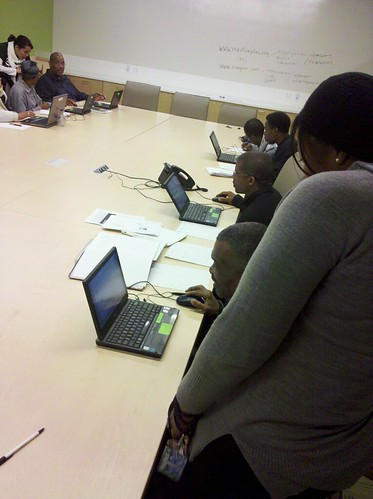
We recently completed our first computer literacy course of the year, and the first one in our new expanded Northwest Center facility!

The most apparent difference was that the class could make use of the new (and very large) Bread for the City conference room, which is much more conducive to these kinds of large gatherings with lots of technology.

More subtly, we continue to change our class format. One year into this experiment, we have a better sense of what our clients’ true needs are, and what will capture their interest. So this iteration of the class focused a lot more on creating email accounts and learning how to use them.


Folks were truly impressed with the instantaneous nature of this medium, and started to get a sense of how fast information travels now.

We’re still learning, of course. Though the expanded space in the conference room is certainly welcome, I’ve noticed that a bigger group of students is not always better. People come with different experience levels, and therefore have different kinds of questions, which threatens to leave those who are less experienced feeling behind and intimidated.


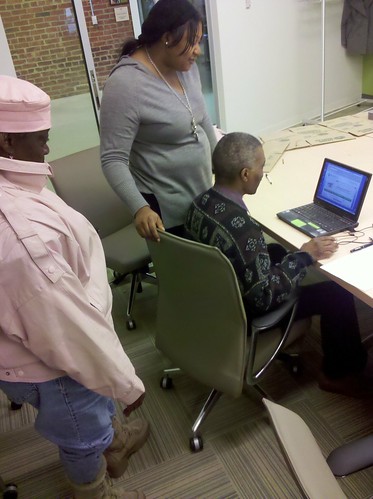
This is really demonstrated by one of my favorite success stories from this class. Ms. B was new to our class, but told us she had already taken a few other computer classes at other places. So we initially paired her up with a partner who had a good amount of experience already. But eventually we noticed that he tended to do all of the work himself. Ms. B didn’t complain about that at all -- in fact, she insisted that she was happy to just watch. But I soon realized that Ms. B was very, very shy -- and she needed to have her own space to be able to learn.

As it turns out, the other computer classes had just moved at a speed that Ms. B wasn’t totally comfortable with, and she also wasn’t one to ask for help. So I set her aside with her own computer and worked with her one-on-one. That’s when she started picking things up! She just needed some hand-holding to get over those first hurdles. By taking time and bringing patience to her education, she was able to learn all kinds of fundamental concepts that we might sometimes take for granted, like double-clicking, and the concept of user names and passwords, ‘@’s and ‘.com’s.

Ms. B even left the class with her own email account, which she says will help her apply for jobs. She’s also excited to be able to keep up with her grandson, who has tried before (without success) to communicate with her by email. And I’m sure we’re going to see her back here at the next class.

Over 12 class participants received certificates for the completion of this 5-week course. We’re expanding our class offerings, too - we’ll have at least three classes happening simultaneously now that we’re in the new space. Stay tuned for more updates!