
 Last month,
Now in its second year, Glean for the City has become an essential part of our food pantry -- enabling us to provide free, fresh produce to nearly 5,000 households each month. In fact, it’s been packing our pantry pretty much to the brim -- and yet there’s still acres of food left untouched out there. (See our recent photos here.)
So we’re trying to figure out how to rescue even more. That starts by just giving it away more quickly. So now our NW food pantry is putting out a variety of freshly picked produce for anyone to take home--even if they don’t participate in our food program. Seriously, these bins are just set out there, and people can come and pick their fill. All we ask is that they promise to eat what they take -- and enjoy.
Since the Northwest Current is only in PDF form, we’re sharing the full text of the article with you below. Gleaning Crews Aim to Feed the Hungry
By Teke Wiggin, NW Current, August 11 2010
“Go deep!” yells a girl in a white tank top as she chucks three ears of corn in rapid succession toward a man stooped over a crate behind a row of stalks. The man springs upright, deftly grabbing each ear as it hurtles through the air. Laughing to himself, he snaps off the stalk butts and peels the thick outer husks. He begins to drop the ears into a crate lying at his feet but pauses and turns his head toward the girl. “You’re not checking these, Ashley!” he shouts. Ashley shakes her head and prepares to launch another salvo, scooping up ears from the tilled soil and snapping off others from trimmed stalks. On a sweltering Saturday, the two volunteers, along with about 30 others, are scouring Parker Farms cornfields in Oak Grove, Va., to harvest leftover crops for the food-salvaging program known as Glean for the City.
Now in its second year, the program gleans crops from local farms in order to add large quantities of produce to the 5,000 food bags its Northwest-based parent organization, Bread for the City, provides to D.C.’s poor and needy each month.
Though Bread for the City collects canned goods and other nonperishable food items year-round, from July to November it focuses on the gleaning program, gathering different crops ranging from broccoli to apples at area farms. The program organizes gleaning sessions on farm acreage that has just undergone harvest, furnishing vans and coordinators to guide participants through crop fields. Last year, the program salvaged more than 50,000 pounds of fresh produce, according to Bread for the City spokesperson Greg Bloom, who said that figure should increase this year by at least 50 percent.
Since its inception, Glean for the City has been a hit, attracting hundreds of volunteers eager to sample a days work in the fields. “It’s hard to imagine exhausting the interest in this kind of volunteer work,” Bloom said. “The prospect of heading out to the country to pick up food ... that’s something a lot of people are ready to get behind.”
Chevy Chase father-and-son team Larry and Kevin Carlson labored in the fields Saturday, trudging through the dirt ditches that cleave crop rows and foraging with their hands for forgotten ears. Both said they enjoyed the experience of scrounging up sweet corn that otherwise would have gone to waste. “It’s gratifying,” Kevin said. “It feels like you’ve accomplished something. I like filling bins.” Aforementioned corn-tossing enthusiast Ashley Lawson, who is also the coordinator of the D.C. food kitchen Miriam's Kitchen, said she likes that gleaning allows her to be part of the giving process from start to finish.
“It’s nice when we can come out here and assess the quality of food were serving ... it really shows that we care about them,” she said. Miriam's Kitchen is one of several service organizations and projects that regularly partners with Glean for the City. Coordinator Vince Hill explained that gleaning is not uncommon for food pantries and kitchens, but usually is very ad hoc. “Glean for the City,” Hill said, “is one of the only programs he knows of that has the wherewithal vans, crates, staff to operate on a large scale.” Hard work and feel-good generosity aside, gleaning can also be quite the eye-opener for some volunteers.
Sarah Ngueyem, who is pursuing an associates degree at Montgomery College, said she was no stranger to this work. Back in Cameroon, she and her family regularly handpicked crops together. But Ngueyem saw something Saturday shed never witnessed on her family’s farm: enormous volumes of produce left to rot. “Back home we don’t use machines, so we do it all by ourselves. My grandma used to come behind us to check,” she said, puzzled by the leftover ears that smattered the ground or still poked up out of post-harvest stalks.
Bread for the City Project Manager Jeffrey Wankel, who started the gleaning program last year along with the organizations nutrition consultant, Sharon Gruber, said he was also surprised to find out about the excess. When researching how the organization could acquire more fresh produce, he learned that factors like consumer size standards, blemishes and human error cause up to half of crop yields to go to waste. That frustration was what led Wankel to engineer Glean for the City in the first place. Last year, Wankel and Gruber drew up a list of 100 farms within a 60-mile radius of Breads headquarters at 1525 7th St. NW. Then they started putting out cold calls.
Bread for the City spokesperson Bloom recalled the process: “What we found along the way...was farmers [saying], We have tons of food here, but we just don’t have the resources. But if you send volunteers out here, were happy to let you come and take it.” Wankel said many farmers were eager to help, and gave tips on the best ways to scout out leftover produce like visiting farmers markets.
Glean for the City now visits local markets several times a week to scrounge up vendors' excess products, allowing the organization to supply at least five types of produce throughout the harvest season. When it comes to visiting actual farms, Wankel said selecting the right ones depends on yield potential. “You have to find a farm with the capacity; small farms will say, ‘We’d love you to come, but we only have 200 pounds’”, he said. That quantity might sound hefty on paper, but its just a fraction of what Glean for the City can amass with a 30-person crew over only two hours.
After gleaning in the sun for an afternoon on Parker Farms, Hill and Wankel told a sweaty, dirt-spattered crowd they’d rounded up 3,000 pounds of fresh, quality sweet corn. Glean for the City will average this quantity on every one of its weekly trips to local farms. But Hill said all the trips combined will still leave a disturbing amount of the total surplus behind: almost all of it. For this reason, he said, he can count on hearing the following words from Parker Farms owner Rod Parker during every gleaning trip: “You didn’t bring enough bins, and you didn’t bring enough people.”
More information about Glean for the City is available at www.breadforthecity.org/gleanforthecity.
September 14, 2010
Give it away, give it away, give it away now


March 18, 2011
Sneak Peak at Glean for the City 3.0
 The Daily Beast covered our Glean for the City program this week! Reporter Kathleen Maloney writes:
During warmer months, groups from Bread for the City's program called Glean for the City travel to Parker Farms with their volunteers to gather that discarded or overlooked produce, sometimes collecting up to 2,000 pounds in a single trip. Sharon Gruber, a nutrition consultant with Bread for the City, began Glean for the City when she was hired and realized that their clients needed not only food, but healthy food. "I quickly realized we couldn't buy all the produce I wanted us to buy."The whole piece is worth a read.
So she began cold-calling farms—150—to ask them what they did with their unwanted or unmarketable produce. That is how she found out about gleaning. Bread for the City now organizes trips to participating farms where produce like apples, sweet corn, squash, and broccoli are collected directly from the fields....
The organization receives about half its produce directly from the farm, Gruber said, and half from farmers' markets in the area that participate in gleaning by donating food left over at the close of the markets. Many of the Washington, D.C.-area farmers' markets that participate in gleaning are the FreshFarm Markets, one of which is just a block from the White House and was visited on its opening day last year by Michelle Obama, champion of the national Let's Move! campaign. The government's community service website, serve.gov, also features a USDA "Let's Glean!" tool kit, with information and facts about the process.

I do want to elaborate on a point made briefly in the article, which is that this year’s Glean for the City will make more of an effort to involved clients of Bread for the City. We had a pilot “client gleaning” last year that went so well that we hope to have several more this year.
We also are developing a greater educational component to Glean for the City. Each gleaning trip will include a comprehensive discussion on nutrition, hunger, and food waste -- so that people aren’t just working, but thinking!
Also, this year, our new gleaning coordinator (Tonya Hamilton-- you’ll meet her soon) will be placing a special emphasis on her outreach efforts toward schools. For any school-driven Glean for the City events, we will have materials to send to the teachers before and after the farm visits; we hope that this will help the message of sustainability and service carry beyond the actual trip itself.
There’s lots of opportunity to improve our food system -- reducing waste and addressing hunger -- and it will take both learning and work. Let’s get started!
Glean for the City will begin booking fall gleaning volunteer shifts on April 1st. Volunteering fills up fast - so start organizing your group now!
June 28, 2010
Glean for the City IN the city
Last year, BFC’s Glean for the City program sought to rescue tons of fresh produce for our food pantry. It all started with countless cold calls to farmers and markets. The end result was 50,000 lbs of free, fresh produce for our clients (not to mention a grant for $20,000). In 2010, Glean for the City is getting bigger and better, with more farms, more volunteers, and new innovations. Over the next harvest season we will expand both the volume and distribution of produce to our clients in both centers. And while we take steps to expand the gleaning project, client involvement remains a constant aspiration.
Common Good City Farm (CGCF), a small urban farm, located less than a mile from Bread for the City's NW center, is providing our first opportunity to glean WITH clients! This Wednesday, June 30th, BFC clients will hit the fields of CGCF to collect produce for our pantry. It will be more than just picking veggies for themselves. These clients are taking an opportunity to give back to BFC. After signing up for the glean, one food client remarked, “This sounds wonderful! I’m going to bring my kids. It’s important to give back. BFC has done so much for us, I want to do what I can for them.”

Education will be the driving force of this gleaning event - we want our clients to see a truly local food source and be a part of the discussion about the food landscape in DC. Bread for the City staff will lead a discussion centered around gleaning, food access, community gardening, and healthy nutrition. After this discussion, we will head to CGCF to get a tour, do some work, and continue the conversation. At CGCF, Spencer, the farm manager, will tell us about the history of CGCF, why and how they help DC residents with access to produce and gardening know-how, and how to get involved. We want clients to walk away with the understanding that this farm is their farm, it is part of their community. As such, they can utilize community gardens (or even their own gardens, if possible) to level the food access playing field, while at the same time contributing to their community.
In my time at BFC, I’ve found most every client is eager to give back to Bread for the City. Gleaning is the perfect opportunity. As the program expands this harvest season, clients will be given several chances, the first being at Common Good City Farm on Wednesday. Beyond this, I am recruiting client volunteers to glean farmers markets over the summer. In the future, I envision a rustic drive to an area farm, with a van full of clients eager to glean produce for our food pantry. We help them. They help us. It's people helping people, helping people.
October 23, 2009

Stalking Broccoli
As the harvest season winds down, Bread for the City's Glean for the City program is reaching its final stretch, and it's been a great success. Altogether, with the help of hundreds of volunteers, we've brought in roughly 35,000 pounds of fresh produce. And now we're in the lead for a major grant from Tom's of Maine in their 50 States for Good contest! Please vote for us now (shortcut: click Ctrl-F and type 'bread' to find us) and make yourself a note to vote each day between now and October 31st!
During this last stretch, we will be gleaning broccoli from Parker Farms. We started off the season gleaning 5,000 lbs. of sweet corn there, and Rod Parker is generously allowing us to return for the brocc. Over the coming months, we expect to harvest several tons of broccoli for our pantry -- all from just this one farm.
(We were going to do a big glean in tandem with the launch of the DC Food For All, but we got rained out! There will be more opportunities for Glean for the City to collaborate with the DC Food For All, I'm sure.)
Broccoli will be a new and challenging harvest for us. Apple picking, for instance, is as easy as it is fun. When we picked up cucumbers, they'd already been harvested and sorted and were just waiting for our truck. Broccoli, on the other hand, will have to be removed from its stalk, right out of the ground.
This is a relatively labor intensive harvest. You need a knife to strip the leaves and cut the stalk. Large leaves protrude from the sides of the stalk and cover the edible heads of broccoli -- which means it's easy to miss.
There's also a lot that deliberately gets left behind: the farmers pay harvesters to make just one pass through the field. In that pass, they look for the best pieces. Variations in soil and sunlight cause some plants to reach maturity later, and a lot of broccoli gets left behind because it's insufficiently ripe.
It's a sad reality of today's market that stores will only accept broccoli of a certain size, because they cater to shoppers' picky demand for full crops. In the meantime, farms can’t afford to take another pass when the broccoli reaches maturity. Most of these plants reach the perfect size days later -- but they are left to rot in the field. Unless of course Glean for the City is on the scene.
Thanks to all the volunteers, farmers and market managers who've made Glean for the City such a success so far. Check out this great recent New York Times article about a sophisticated gleaning network in California - I think we could get to that level very soon!
And last but not least, please vote for us in the Tom's of Maine contest. With your help, we'll ensure that all the food that's fit to eat gets to the people who need it.
August 17, 2009
Glean for the City: Reaping Abundance

[This week's Glean for the City guest post comes from Susan Birchler, Market Manager at the West End Farmer's Market. Thanks, Susan! ~Jeffrey]
Plant one zucchini plant in your garden and all summer you will have an abundance of zucchini. Even an overabundance. Living things at the lower end of the food chain – apple trees, ants, plankton, etc - tend towards a productiveness that makes for an overabundance of food for things living higher up the food chain. Now, consider the difference between anteaters and woodpeckers. Anteaters find an anthill (or termite mound) and with their sticky, quick tongues they consume around 1000 insects a minute. Woodpeckers eat ants too -- but also grubs, beetles, caterpillars, tree sap, seeds and fruits. They are opportunistic and flexible, pecking the bark and wood of trees, consuming whatever they find. Zoologists refer to animals like the woodpecker as "gleaners." This indicates that they scour the environment to find scattered bits of food. They are nature's way of efficiently utilizing her decentralized abundance.
Human food systems have been mainly organized to make people behave more like anteaters: channeling vast amounts of foodstuffs through centralized locations, like farms and supermarkets. But that does not mean this system is perfectly efficient - in fact, it leaves considerable waste. Gleaning is an activity often missing from our modern food system. I'm thrilled to see Bread for the City partially correcting that.
Every Sunday, the vendors bring their abundance to the West End Farmers Market. Their fruits and vegetables have been picked the day before, their breads baked early in the morning. When you walk through the market you can smell the earthiness of onions, tomatoes, peaches, only recently separated from the plant it grew on. The farmers are selling freshness. And despite the fact that our market is thriving, there is always some leftover produce.
Yet when the market is over, many vendors don’t have another market for days. Small farmers are usually not equipped with the refrigeration and chemicals necessary to keep leftover produce fresh for two more days; bakers will not sell stale goods. What to do with leftover produce and breads? Plow it into a compost pile? Throw it away? It is a perennial dilemma. It is not as easy as one might imagine to find a willing nonprofit with the necessary organizational machinery to retrieve our surplus abundance. Smaller agencies, hit with economic slump, have closed their doors or are unable to pick up or distribute the foods. So when I read a piece about Bread for the City's Glean for the City project on the Farmers Market Listserve, I hastily emailed an invitation to glean at our market and received an immediate reply.
The next Sunday Jeffrey Wankel and Heather showed up with a van and bins. Our vendors loaded them down with food. Every week Bread for the City and our vendors engage in a mutually beneficial exchange. The farmers are relieved that their produce will not go to waste; not only that, but it will go to feed those who could not otherwise afford it. The farmers and bakers are so enamored of the process, they sometimes bring extra food specifically to give Jeffrey and Heather.
As market managers, Julie Bryant and I feel like our universe is in harmony. We fulfill our agenda to provide fresh food to the community of consumers. Bread for the City fulfills their agenda to provide nutritious fresh food to a community of people who are not able to access our market. Our collaboration creates a human food system that efficiently utilizes the abundance of grown food by distributing it across a spectrum of the population. We are lucky to have found each other.
[We need an able-bodied volunteer with a large automobile (preferably a truck, SUV, or minivan, but this could be flexible) and about an hour of your time on Tuesday evenings at 6pm. Your work will help us feed dozens of hungry families each week. Please contact me for more details.]
February 15, 2011
Building movement toward a nourishing D.C.
This post is the fourth in a series from Bread for the City intern Allison Burket exploring the basics of food, hunger, and politics in the District.
 Meanwhile, moving beyond the public sector, there are numerous efforts throughout the food system to ensure DC residents can enjoy healthy and affordable food.
And we know of (and work with) many other exciting programs in the community. Healthy Solutions manages a produce buying co-op and runs fresh produce markets in public housing sites East of the River. DC Central Kitchen combines meal preparation for area shelters with innovative job training programs and employment opportunities for its clients, while also supporting local farmers. Common Good City Farm is growing and selling food right in the city, using its farm in LeDroit Park as a community space for sharing food production and preparation skills with neighbors. These and many other groups are improving both the health of our bodies and the health of our communities. (Emphasis on "many": more than 460 food-related entities are mapped in the DC Food Finder.)
A Food Policy Council in DC?
Cities across the country face similar challenges as those in DC – a fractured food policy-making environment, separate organizations addressing different pieces of a broken food system, and lack of transparency and community input in policy decisions. In response, many areas have brought together some combination of non-governmental organizations, citizens, advocates, and government, forming what are often known as food policy councils. (See this DC Food For All post about the Detroit food movement, and the policy council in that city.)
 Food policy councils can serve as a forum for food issues, a network to coordinate community action, and a space to address some of the tangible injustices at work in our food system. They do a wide range of work in other cities, counties, and states -- from gathering and communicating information about a food system, to crafting policy platforms, to developing collaborative projects to address immediate needs.
Bread for the City is interested in seeing something like a food policy council form in DC, but we also recognize that it will need to include more than policy wonks and non-profit providers if it is to be truly reflective of the interests of our diverse communities. A food policy council would ideally be born of a grassroots, city-wide movement for wellness and food sovereignty that includes residents who themselves have the most at stake in radically changing the food system.
That’s why we’re part of a larger conversation with groups like Groundwork Anacostia, the Early Childhood Obesity Prevention Collaborative, Ecolocity, and ONE DC. Together, we’re hosting a series of brainstorming sessions around the city, starting 3:30-4:30 pm this Saturday at Coolidge High School, as part of Rooting DC – an annual, free urban gardening forum. (Register for Rooting DC by calling 202-638-1649, or learn more about the whole conference by visiting the website.)
We'll be discussing and envisioning: What would it look like for all DC residents had access to healthy, affordable, and culturally appropriate food? What is an idea you have for moving the city, your neighborhood, or your self in that direction? The hope is that the discussion generated from this and upcoming sessions can then shape the formation something like a food policy council – or something completely new and different – in DC. We hope to see you there!
August 5, 2010
The Mega-Glean!
Post by BFC intern Vicky Gan.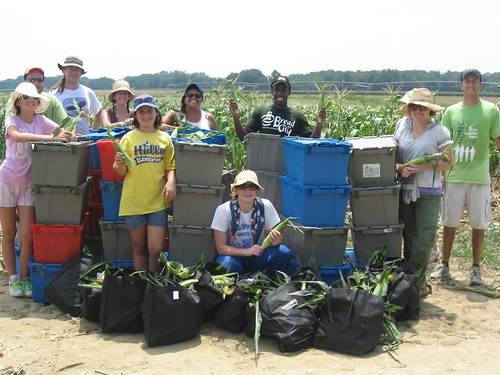
This Saturday, August 7th, Bread for the City will send out our largest Glean for the City expedition yet. This time, we will be partnering with Miriam’s Kitchen, which provides hot meals and case management services to homeless men and women. 35 dedicated Bread for the City volunteers will be joined by 15 Miriam’s Kitchen volunteers. We’ll drive to Parker Farms with a fleet of vehicles that will bring back almost 4,000 pounds of sweet corn.
This is our second season of Glean for the City, and our first collaborative glean. We expect to pack both of our pantries pretty much to capacity. Miriam’s Kitchen, which has recently begun serving dinner in addition to breakfast, will be using the sweet corn to make corn salad, corn soup, and good ol’ corn on the cob.
The organization’s development and volunteer manager, Ashley Lawson, has this to say about the upcoming event:
We very rarely have full ears of corn to serve our guests, so we are very excited to spend the day picking enough corn so each Miriam’s guest can get their fill of corn for dinner next week. Our volunteers are looking forward to this unique afternoon, and we are grateful to Parker Farms for being so generous with their crop. Even more so, we are appreciative to Bread for the City for the invitation to collaborate. We hope this is the start of many gleaning days!
We’ll also be sharing some of our glean with the DCPCA’s Ward 8 ‘Family Fun Day’ on August 14, 2010. The event will be from 11AM to 3PM at Ketcham Elementary School (1919 15th Street SE), and will offer food (corn and more!), exercise and fun activities with live music and local vendors providing tips and information on healthy living. (Contact Emily Roberts at (202) 638‐0252, x220.)
If you’re interested in volunteering, or if your community group or organization might want to partner with us on future mega-gleans, please email Vince Hill. In the meantime, if you'd like to support this work, you can help us cover the cost of transportation and other things like bins, bags, gloves, and so on, by making a donation to Glean for the City today.
November 24, 2009
Gettin' Dirty: The Final Glean
 The forecast was ominous for Glean for the City's final Gleaning (on Saturday, November 14th). Rain had been pounding Parker Farms for days. It stopped only hours before we planned to hit the fields.
A swamp it was. Volunteers leaped puddles, walked down dry rows like a tightrope, and trudged through the mud in search of perfect heads of broccoli. As I wrote last time, gleaning broccoli isn't easy -- you have to really get down to the ground and slash it out.
One of our volunteers got a little too far down to the ground. Her foot sunk 2 feet into the mud, and even with Vince's help she was struggling to get up. After considerable tugging (and laughing), she eventually pulled her foot out -- but without a shoe! It seemed to get eaten by the muck. But rather than take it easy after that, she kicked off her other shoe (which just looked like a chunk of mud anyway) and proceeding to glean barefoot for over an hour.
By the end, despite the mud, we'd hauled up 35 bins bulging with broccoli. We took the time to admire our work, and then the volunteers began to depart in their respective vehicles. But nature had one last attempt to spoil our fun.
Vince and I heard the spinning wheels first. We looked over at a volunteer's sedan, which was now stuck in a newly formed river, and simultaneously said, “UH OH”. We tried to help push--to no avail.
Predictably, Rod Parker came to the rescue. Using the front end of his 4x4, he gently nudged the vehicle to solid ground. Our volunteer drove away, waiving out of the car with a loud, “Thank youuuu!” It was the perfect exclamation point on an improbably perfect day.

Last but not least, a HUGE thanks to everyone who voted for us (especially those of you who voted every day!) in the Tom's of Maine '50 States for Good' contest. I am pleased to report that Bread for the City won!
We'll have more thoughts here soon about what that means for the future of Glean for the City. In the meantime, thousands of thank yous from us to those of you who made it happen. This one's for you:

October 27, 2009
Everyone's voting for Glean for the City
We are in the final stretch for the Tom’s of Maine 50 States for Good contest to win  $20,000 for Glean for the City. The voting ends this Saturday, October 31st, and the top 5 vote-getters win. We are currently in 3rd place — which means if we keep it up, we’ll win! So we need your votes now more than ever.
Bread for the City’s entire staff (and all of our families and friends and Facebook friends) are all deep in the daily voting groove. Meanwhile, the DC Food For All's Great Harvest party used our gleaned produce for its cookoff — and the attendees voted then too!
Finally, excitement about the contest has spread to our clients. Our food pantry clients have really enjoyed the gleaned produce in the past year — and they are thrilled to now have the opportunity to vote for this program.
But very few of our clients have access to the internet at home. And yet we believe they should be able to participate, too!
 So for this final week of voting, we’ve set up a computer station in our pantries. We’ve got volunteers generously spending some time stationed there to help folks vote and keep traffic moving.
While sitting down to vote in the contest this morning, Gerri Williams-Harris (pictured left) remarked, “I love putting the fresh carrots in my roasts. Canned vegetables will do, but I really prefer fresh produce."
Only a few days remain in the contest, but you too can still help us win $20,000 for Glean for the City! Vote for Bread for the City here. (Tip!: type Ctrl-F and ‘bread’ to find our entry.) Vote every day this week!
(Are you on Twitter? Help us spread the word by retweeting our voting drive in this special campaign!)
November 24, 2009
A healthful Thanksgiving
Cross-posted from the DC Food For All.
 Everywhere we turn, we're reminded that Thanksgiving is here. Most conversations focus on setting a beautiful table, cooking a moist turkey, making side dishes that could stop conversation, and baking pies to match.
And these things do matter. It also matters that the holidays, like all days, are healthful.
So at a recent cooking workshop here at Bread for the City, I participated in a conversation with our clients about how to make Thanksgiving healthful, without compromising flavor or tradition.
To get started, we talked about our various Thanksgiving table traditions, and came up with a list of what the clients called "Thanksgiving must-haves." It included: turkey, ham, brisket, and/or a roast; gravy; green beans; macaroni and cheese; stuffing; sweet potatoes; corn; mashed potatoes; rice; cooked greens (collards, kale, spinach, mustard greens, etc.); bread; cranberry sauce; and of course dessert.
Now, as part of our Nutrition Initiative, we are working with our clients to identify other ways to eat healthfully even with limited resources. For example, last year Bread for the City scrapped canned gravy from our holiday menu (as it not only has super-high sodium, but it's also expensive!), and instead passed out recipes for how to make your own gravy from the turkey's drippings.
This time around, we sorted many of the Thanksgiving must-haves into two categories: non-starchy vegetables (e.g., lettuce, tomatoes, cooked greens, garlic, asparagus) and starchy vegetables and grains (e.g., sweet potatoes, corn, rice, and bread). Having had quite a few cooking classes under their belts by now, the people in my class noted that, ideally, the non-starchy vegetables on one’s plate would take up more space than the starchy vegetables and grains. But when we looked at the list of Thanksgiving must-haves, the starches/grains appear to have overtaken the non-starchy vegetables.
Our solution to this problem? Add vegetables wherever possible. After I offered some suggestions, the class participants really ran with the exercise, and came up with the following suggestions themselves:
- For the green beans: Cook with onions, garlic, and/or broccoli.
- For the macaroni and cheese: Add spinach, cauliflower, and/or tomatoes.
- For the stuffing: Include plenty of celery, garlic, onions, pepper, and/or carrots
- For the mashed potatoes: Mash in garlic, celery root, rutabaga, and/or cauliflower.
- For the rice: Add plenty of fresh herbs, like parsley and mint.
- For the greens: Don’t forget the onions and garlic.
- And make a salad, as well!

Bread for the City client Gail prepares Thanksgiving dinner in her home.
We then made a healthier macaroni and cheese with low-fat cheese and milk, loads of chopped spinach, and whole wheat pasta. The clients couldn’t believe how good it was. Then they were wowed by our fresh cranberry relish, an addition or alternative to highly sweetened cranberry sauce.
And it’s easy to make. Here’s the recipe:
2 ½ cups of fresh cranberries
1 ½ cups of walnuts
1 apple
2 cans of pineapple rings in their own juice
3 stalks of celery
Directions:
Finely chop cranberries and walnuts.
Mix them together in a large bowl. Then pour in the pineapple juice from the cans.
Chop apples, celery, and pineapple rings and add to bowl.
Mix well.
Feel free to adjust the proportions to taste. (I make mine a little different each time.) Enjoy!
Meanwhile, by the end of today, more than 5,000 DC families will have received Bread for the City's Holiday Helpings feasts (including a turkey and all the trimmings; low-sodium stuffing; pasta; and fresh produce from our Glean for the City program). Few, if any, of these families could otherwise have afforded such a feast. For readers who would like to support our Holiday Helpings campaign -- just $28 for a family of four -- please visit www.breadforthecity.org/holidayhelpings
Happy Thanksgiving!
September 28, 2010
Volunteer Spotlight: Crooked Run Orchards
 Glean for the City brings back TONS of fresh produce to our food pantries. No, really - TONS. For the NW and SE communities that Bread for the City serves, we are often the only source for fresh produce in the neighborhood. We can boast all day about the successes of Glean for the City. But without our partnering farmers, this project wouldn't exist.
Enter: Crooked Run Orchard.
Crooked Run Orchard is a small, family owned, eco-friendly farm in Purcellville Virginia and has played an integral part shaping Glean for the City. The Orchard provides a beautiful venue for gleanings, with rolling grassy hills and tranquil orchards. On top of donating over 10,000 lbs. of fresh, crisp apples so far this year, the farmers Sam Brown and Ute Ditbreener are mentors and educators for our gleaning coordinators and volunteers. Despite an seemingly unending work load, they are always happy to talk about food security and agriculture.
Although located 50 miles from DC, Sam and Ute didn’t hesitate to allow us onto their land for gleaning. They genuinely care about our clients' health and are grateful to us for giving them the opportunity to serve. As Ute remarked on our last outing, “Nutrition is essential for health and happiness, and you don’t have to be from DC to know there is a shortage of fresh produce. We’ve wanted gleaners for years; we were so thrilled when Bread for the City came to us.”
Sam Brown and Ute Ditbreener will be honored with our Fresh Food Partner award at our 5th Annual Good Hope Awards, coming up next Thursday morning, October 7 at the National Press Club. We look forward to this awards breakfast every year and the opportunity it gives us to thank all of our volunteers for their dedication and service.
-- Thanks to JW for his contributions to this post.
July 12, 2010
Our First Client Gleaning!
 |
| Common Good City Farm |
------------------------------------------------------------------------
After weeks of unforgettable heat, the day dawned fresh and inviting, just the type of weather we needed for our first ever client gleaning project at Common Good City Farm. Sure enough, the day turned out to be educational, delicious, and fun.
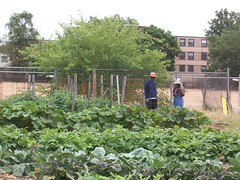
Common Good City Farm, located about a half a mile from BFC’s NW center, is a neighborhood farm dedicated to raising awareness about food and food justice in DC. In addition to selling some of their produce to local restaurants, CGCF runs programs and workshops for low-income volunteers and school-aged children, as well as the curious, casual gardener. Several clients expressed interest in Common Good's "Green Tomorrows" program, which provides a bag of fresh produce to low-income residents in exchange for two or more hours per week of instructional, hands-on work on the farm.
Spencer Ellsworth and the other staff at Common Good City Farm generously took time to share their knowledge of urban gardening, basic plant care and food preparation.
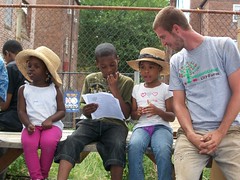 | |
| Spencer Ellsworth, our CGCF guide for the day |
They weren't the only ones ready to teach. Antoinette Jones, a grandmother born and raised in North Carolina, was one of the stars of the day. A long time client, Ms. Jones embodied the excitement and enthusiasm of our volunteers, waxing lyrical about a childhood in the country and the joys of gardening. She helped to make everyone feel at home in the garden, more specifically the cabbage patch. She taught everyone, even Spencer, a thing or two about how to keep your cabbages healthy and how to get the most out of your plants.
“It’s too late in the year for another [cabbage] head to grow, so you pop them out like collard greens...cut ‘em, clean ‘em, throw ‘em in the pot with a piece of meat, whatever you got and it taste just like collard greens!” Even if down home cooking isn’t your thing, Ms. Jones had some money-saving advice we could all use. “How many know how to make spices from the tops of your vegetables?” She asked the group as we rested in the shade. She patiently explained how to dry and prepare the tops of vegetables to make the spices normally sold for $7 or $8 dollars at the supermarket; chive from spring onions and a parsley substitute from carrot tops. “And now, what you’d buy in the store for $8 somethin’ dollars, you made it for free!”
 |
| Ms. Jones shows another client how to pull cabbage |
But wisdom doesn’t always come from the most experienced among us. One of our clients, India, brought along her son and daughter at their expressed wish. “I told them about the trip and they were so excited...we love fruits and vegetables so anything they can dig up out of the ground, that’s good for them.” Antonio, 10, and Ania, 4, were a testament to their mother’s pride, ducking excitedly from patch to patch, pleading to be allowed to cut, pull, or dig something. “What can I do next?!” was a near constant chorus from the siblings and Ms. Jone’s young granddaughter Kayla.
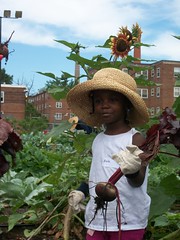 |
| Ania, 4, was our youngest gleaner of the day |
The joy was palpable as our clients cut kale, pulled carrots and and clipped cucumbers to replace the canned goods that ordinarily adorn our food bags in the NW center.
Many of our clients were especially touched when they brought the gleaned produce back to our NW food pantry and saw how their hard work would translate into better food for them and their fellow clients. “This is so wonderful,” remarked one client. “”I’ve been [wanting] to volunteer for BFC for a long time! It’s great to pick produce for the pantry! We need to do this again!”
We ended the day tasting just-ripe peaches and discussing the meals people would make with the food they had picked with their own hands. BFC’s nutrition consultant Sharon Gruber spoke about the importance of “eating with the seasons,” using all the parts of the fruit and vegetables, and how to maximize your spending potential at farmer’s markets.
Many clients expressed an interest in returning to CGCF. None had heard of the urban farm before this trip, and all were impressed at the scale, scope, and mission of the organization’s work. Despite the convenient location of the community garden, few clients were aware of the possibilities that lay in this once-fallow field. Upon seeing the farm for the first time, one client remarked, “I never knew this garden was here! This is so cool to have right in our backyard!”
As we gathered for a picture to commemorate what we hope will be the first of many opportunities for our clients to be an active part of Bread, Kayla summed up our feelings in a way only a child can. “What a perfect picture for a perfect day!”
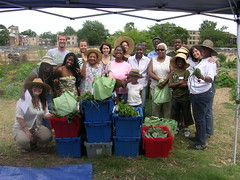 |
| Our first ever client gleaners! |
August 12, 2009
Ousting Obesity: Strategies from the Tobacco Wars
It is very much a crisis: A full third of American adults and one out of six American children are obese. These numbers are alarming, because obesity has been directly tied to chronic illnesses such as heart disease, diabetes and hypertension. In fact, according to featured panelist Arthur Garson, Executive Vice-President & Provost of the University of Virginia, this is the first period of time since the Civil War that life expectancy in the United States has gone down.
I see the potential benefits of these tactics - but I also see complications. While he is correct that taxing tobacco reduced consumption of cigarettes, unlike cigarettes food is a necessity. Taxes on fatty foods would put further pressure upon people who already have a hard time putting food on the table -- and what's more, in neighborhoods like some served by Bread for the City, there simply aren't many alternatives to unhealthy foods. So it's just not as simple as changing people's incentives.
Though this panel discussion did not provide all the answers, it did make one thing clear. Something must be done about obesity, and it must start now.
Bread for the City is conscious of the health problems that surround obesity and has recently taken initiatives to bring nutritious foods into our communities. Bread for the City’s Glean for the City program allows us to provide clients with fresh produce thus adding healthier items and better nutrients to their diets. Through our Nutrition Initiative, Bread for the City has also eliminated trans fat foods from the bags we give our clients. And we are eager to find new ways to partner with organizations like DC Hunger Solutions, which work to expand access to healthy foods in our highly food insecure city.
Contact Jeff Wankel in order to get involved with Bread for the City’s Glen for the City Program. And stay tuned for more!
July 23, 2009
Glean for the City: Corn and More
Monday was our second Glean for the City event, again at Parker Farms.
I was accompanied by 20 volunteers from the Washington Quaker Workcamps. With this large volunteer group we picked literally tons of corn -- and fast. We filled every produce bin, and decided to stuff every picking bag full for good measure. On the drive home, I was accompanied by the sweet scent of nearly 2,000 lbs of corn in the van.
Our volunteers wanted more. "I wish we could keep going! We’ve barely put a dent in this field, and I can't believe the rest will go to waste."
Another volunteer remarked to me that, "The government should create a volunteer corps to organize gleanings with farms and food pantries. But I am happy that Bread for the City is doing their part."
The corn will be split up between our SE and NW centers. This will provide a fresh produce staple for our food bags for the rest of the week.
As a side note: We typically offer canned corn in our pantry, which is very popular with our clients - but also high in sodium! Fresh corn is very high in fiber and generally healthy. Just as important, it is easy to prepare: boil for 15 minutes, grill for 10 minutes, cut it off the cob and put it in salsa or salad. Our volunteers were eating it right off the cob, and so was I. We even brought some back for the Bread for the City parking lot barbecue, where it was a big hit.
In trying to bring in more fresh produce to the pantry, we're also working toward variety. Sharon, our in-house nutritionist, likes to say " people should eat a variety of colors.” The more colors, the more variety of vitamins and minerals. A large array of nutrients supports and protects the body from illness and chronic conditions. So on Sunday, I picked up over 800 lbs. of fresh fruits and veggies from our friends at the West End Farmer's Market. Our fridge is now stocked with a rainbow variety, including squash, eggplants, peppers, greens, cucumbers, tomatoes, and fresh bread.
The quantity has increased with every trip to the West End Market, and I will go every Sunday until they close for the season. Combined with our gleanings, this will enable us to bring both variety and quantity to our food pantry for months.
We’re deeply grateful to Parker Farms, FreshFarms Markets, and all of our community partners for helping us make sure that this surplus food will go to those who need it most, instead of going to waste.
April 29, 2011
We Join U.S. Secretary of Agriculture Tom Vilsack in the fight to end hunger
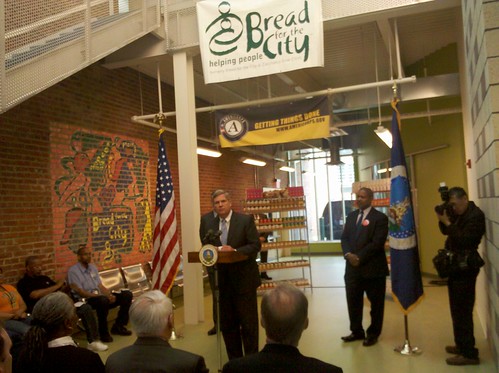 We had an honor of a visit today: U.S. Secretary of Agriculture Tom Vilsack came to Bread for the City.
"It's amazing what's being done here," Secretary Vilsack told us. "You are doing phenomenal work, making a difference in the lives of people every day."
The Secretary was here to announce important new federal anti-hunger initiatives. More than 50 million Americans are "food insecure" (in other words, they struggle daily to acquire nutritionally adequate food). Here in DC, one in eight people are food insecure, including two out of every five children.
"These are friends and neighbors, folks we know," said Secretary Vilsack.
It's an outrage. And it's a complex problem with no easy solutions. However, Secretary Vilsack and I both agree: the solutions are there. It's just up to us to make them work.
So let's get started. Will you stand with us?
Today, Secretary Vilsack unveiled new USDA resources like an anti-hunger tool kit for community leaders like us, and an online commitment drive for pledges of anti-hunger action. "It's necessary for the community to get engaged to ensure that these youngsters are not left alone," said the Secretary.
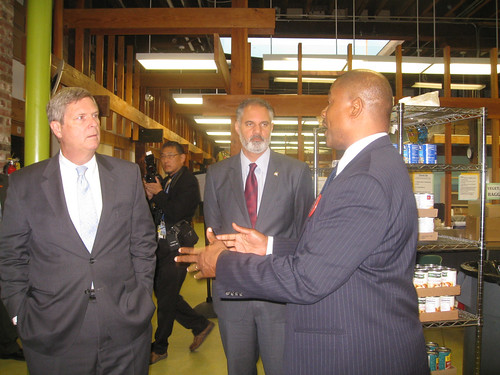
We've been working long and hard to end hunger. Bread for the City now offers food assistance to more than 23,000 people in a year, making us the largest food pantry in DC. With the hard work of Americorps members and volunteers like you, we've launched initiatives like Glean for the City to great success, reaping tens of thousands of pounds of surplus produce that now goes to the tables of the hungry instead of to waste.
But providing food to the hungry is just the start.
In recent years, we've helped to successfully lobby the District government to expand eligibility for food stamps in our city. Through cooking classes, we are actively promoting change at home. And our rooftop garden project is creating a vision of a healthy, green community right above us.
October 5, 2009
Help us glean for another year!
Today's post is by our new Gleaning Coordinator-in-Training, Vince Hill. But before we let Vince take the stage, first we want to note that Glean for the City is nominated to win $20,000 in the Tom's of Maine "50 States for Good" contest... and we need you to help us win!
To vote for us: a) click here b) find Bread for the City's entry (shortcut it by typing Ctrl-F and 'bread') and click to vote for us! You can vote every day, so the best way to help is by taking a pledge to make that daily vote on our Facebook petition here — and spread the word to your friends!
Okay take it away Vince. —ed
Hello! I was thrilled to take my first gleaning trip a week ago, as a new part of Bread for the City's staff. I took a drive out with Jeff Wankel to Crooked Run where we met with 4 more volunteers -- including people from an organization called Mover Moms. This being my first time participating in the gleaning project, I had no idea what to expect when we arrived.
What I saw was incredible. I’d already heard staggering statics on the amount of food waste in our country – but the numbers are hard to grasp in and of themselves. As bag after bag of apples accumulated under the mere 10 trees that we gleaned from, I realized the extent of this  opportunity. 1000 lbs of apples filled the floor of our cargo van by the end of the day—store-bought quality produce for Bread for the City’s clients, who often have little to no access to fresh produce. The Mover Moms were also gracious enough to give us a sizable donation of children’s books.
In the van ride back, Jeff and I talked about ways to improve the weekly gleaning. My hope is to expand this project to the next level, so that we can do that much more to fight the food crisis in DC. Publicity, coordination and cooperation with other organization– and though the opportunity to open up new access to farm surplus is great in the DC area, I even think it’s something with national potential. I’m excited for the next trip, and even more excited for the upcoming year.
December 29, 2010
2010: a Year in Review
 As we wrap up this crazy holiday season, let’s take a moment to reflect on the year that was 2010. It was a busy one for Bread for the City, filled with challenges, loss, innovation and growth. Have a look:
For most of the year, we watched the ongoing construction on our new Northwest Center facility (which includes a major expansion for our Medical Clinic). The expansion was finally completed in November, and we’ve moved in this month. (The Grand Opening is next Friday - you should come!)
But even before the move, our Medical Program was busy innovating - developing health-oriented literacy classes for both kids (with childrens’ books) and adults (with computer classes). Our cooking and nutrition classes ventured into ethnic cuisines, and even launched weight loss support groups.
Meanwhile, our Legal Team won some major victories for tenants that resonated across the city - like pressuring the Powers that Be to create a docket for tenants to file complaints about housing conditions in Landlord/Tenant court, and successfully representing the rent-striking tenants of Marbury Plaza as they demanded improvements to one of the largest housing complexes in the city. Other Big Wins included the Jerrold Scoutt Prize (Lord High Legal Director Vytas V. Vergeer) and Jeopardy (power-blogger Stacy Braverman).
Our food pantry saw both great steps forward and a devastating loss this year. Our Southeast Center introduced a whole new model of distributing food called “Client Choice,” which we've subsequently worked to improve, and ultimately permanently adopt, to widespread approval from staff, clients, and volunteers. Our second annual Glean for the City season was such a success that we actually had to put surplus fresh veggies out for anyone to take as much as they wanted; we even hosted a Free Farmers Market (which we hope to reintroduce and expand next summer). Amid all this, however, we said goodbye to our Food Pantry director, Ted Pringle, who built Bread for the City’s pantry into what it is today, and whose legacy will stay right with us in the future. Rest in Peace, Ted.
Even as we dealt with loss in our own family, we also took note that this was an especially difficult year for many of our clients. As the Great Recession trudged on, this blog recorded the dramatic rise in the need for utility assistance, the diminishing stock of affordable housing, and the devastating impact of budget cuts to critical programs such as disability benefits. Our social services staff worked furiously to meet new needs; for instance, Southeast’s Sherita Evans developed specialized protocols for working with low-income veterans who are increasingly turning to us. We also took more active advocacy responses to rising poverty, helping to launch the Save Our Safety Net campaign, and championing the expansion of food stamps in the District. You could even turn to the blog to hear it directly from our clients themselves, like Patty Anne, who is becoming something of a Beyond Bread regular.
That’s just a sampling of the year behind us; and, of course, we considered many issues that we’ll have even more to say about in the future (like our seedling rooftop garden program!). Here’s a huge thank you for everyone who helped us over the course of the past year. Your support makes all of this work possible.
If you haven’t yet, please consider making a year-end donation -- and share that with your friends and loved ones. And to all of us, HAPPY NEW YEAR!
July 29, 2009
Gleaning Provides Opportunities for Education
Two days ago I made my third trip to Parker Farms in Virginia to gather fresh crops for our pantry.
I was met by volunteers from Setauket Presbyterian Church. Rev. Jeff Geary, the group leader, brought a group of 8 volunteers to hit the fields with Glean for the City. After two successful gleanings, I am expanding our trips to include education and dialogue regarding food security (similar to the discussions we've been posting on this blog).
I took the opportunity to speak with our young volunteers about food waste, gleaning, and the role that Bread for the City takes in addressing poverty. It turns out Rev. Geary had education on his agenda as well. His church works to educate their youth about commercial agriculture and its exploitative use of underpaid farm workers. He hoped that Glean for the City would provide hands-on example of the arduous task of handpicking crops.
After gleaning 1,000 lbs. of corn, we loaded up the van and took a step back to admire our work. Rev. Geary remarked that a day laborer picking tomatoes in Florida would have made only $10-25 for gathering the entire quantity on his/her own. As we looked out at the endless acres of corn we couldn’t glean, we discussed the utility of this fresh food for our clients.
Glean for the City provided a rare opportunity for education in agriculture. Most of our volunteers had never been to a farm, and none had ever worked in a field. Picking produce is a strenuous activity, and I'm glad we're able to provide this type of exposure to our volunteers while being able to help our clients access nutritional foods.
August 11, 2009
A volunteer perspective on gleaning
 [Another guest post! This one is from Kelly A. Campbell, a graduate student at Johns Hopkins University and a Bread for the City volunteer. --Jeffrey]
Last Saturday was my first day as a Bread for the City volunteer. When my alarm went off at the ungodly hour of 6AM (ungodly for a weekend at least), I was actually pretty excited.
Not only was I going to glean for apples to help provide fresh fruit for food bags to feed Bread for the City’s clients, I was also going to observe and interact with everyone involved.
On the way to Crooked Run Orchard in Purcellville, VA, I learned about how a change from canned goods to fresh produce can help reduce chronic conditions like diabetes. I learned that providing fresh fruits and vegetables to vulnerable residents of Washington D.C. is truly a group effort. Several local farms and farmer’s markets donate the left over fresh produce that they don’t sell to fill Bread for the City’s pantries, truly paying it forward.
In just over a month, between the gleanings, farm pick-ups and farmers market pickups, Bread for the City has received almost 20,000 pounds of fresh food that has helped feed D.C’s low-income population.
When we arrived at Crooked Run Orchard, we were greeted by a diverse group of volunteers who were ready to glean the ripe apples that had already fallen to the ground.
There were young people and older people from all walks of life: college students, professionals, retirees, church members and families with young children. Although we didn’t all know each other, we quickly bonded while we gleaned. We helped fill each other’s bags and issued gentle warnings to beware of poison ivy.
When I arrived back in D.C. and watched the crates of apples being unloaded, it felt great knowing that come Monday morning, some hungry D.C. residents would receive bags of fresh fruits and vegetables.
And, that’s worth getting up for at 6AM any day of the week.
[So far, Bread for the City has brought in nearly $10,000 worth of free produce from regional farms - in just one month! Thanks to all of our participating farms, markets, and volunteers. Please contact me if you'd like to be involved.]
July 7, 2009
Announcing Our Latest Initiative: Glean for the City!
 Time to bring fresh produce to everybody.
This week, Bread for the City is proud to announce our latest and most ambitious volunteer initiative—Glean for the City!
We’ve posted before on this blog about how much perfectly good food gets wasted, for a variety of reasons, between the farms that grow it and the stores that sell it. There are estimates that up to 50% of all food produced in the United States ultimately goes to waste. We plan to tap into some of this abundant produce supply so we can bring it to the District and give it to the people who would otherwise have to go without.
This weekend our first group will go to Parker Farm, about an hour away from DC, to pick corn. Every Saturday between July 11th and the middle of November, we will be asking other groups of 20-25 people to go to other farms in Virginia and Maryland to pick or “glean” the excess produce the machines leave behind so that we can offer fresh, free, local produce to neglected neighborhoods in our city. We estimate that one group can bring back enough produce to feed 1750 hungry people!
If you are interested in learning more, organizing a volunteer group, or donating to support this new effort, we’ve got specifics on our website for you. We’ll also be putting updates here on the blog as Glean for the City gets underway. Finally, many thanks to all of you in the community who have made this new initiative possible!


 Posts


