April 29, 2011

We Join U.S. Secretary of Agriculture Tom Vilsack in the fight to end hunger

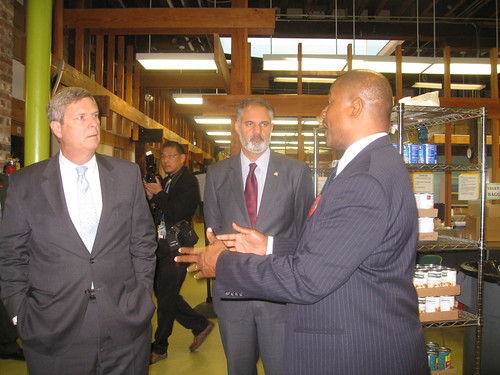
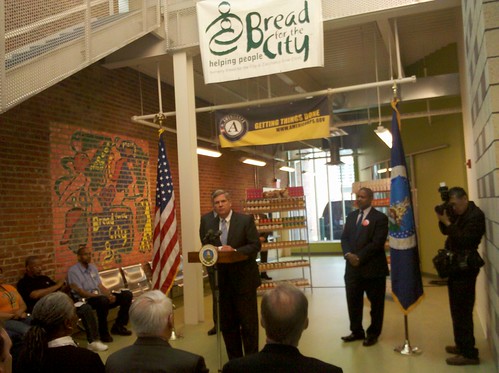
We had an honor of a visit today: U.S. Secretary of Agriculture Tom Vilsack came to Bread for the City.

"It's amazing what's being done here," Secretary Vilsack told us. "You are doing phenomenal work, making a difference in the lives of people every day."

The Secretary was here to announce important new federal anti-hunger initiatives. More than 50 million Americans are "food insecure" (in other words, they struggle daily to acquire nutritionally adequate food). Here in DC, one in eight people are food insecure, including two out of every five children.


"These are friends and neighbors, folks we know," said Secretary Vilsack.

It's an outrage. And it's a complex problem with no easy solutions. However, Secretary Vilsack and I both agree: the solutions are there. It's just up to us to make them work.

So let's get started. Will you stand with us?

Today, Secretary Vilsack unveiled new USDA resources like an anti-hunger tool kit for community leaders like us, and an online commitment drive for pledges of anti-hunger action. "It's necessary for the community to get engaged to ensure that these youngsters are not left alone," said the Secretary.


See more about these USDA initiatives at their new website: Endhunger.USDA.gov

We've been working long and hard to end hunger. Bread for the City now offers food assistance to more than 23,000 people in a year, making us the largest food pantry in DC. With the hard work of Americorps members and volunteers like you, we've launched initiatives like Glean for the City to great success, reaping tens of thousands of pounds of surplus produce that now goes to the tables of the hungry instead of to waste.

But providing food to the hungry is just the start.

In recent years, we've helped to successfully lobby the District government to expand eligibility for food stamps in our city. Through cooking classes, we are actively promoting change at home. And our rooftop garden project is creating a vision of a healthy, green community right above us.

We know we can't do it alone. It's up to all of us. As Secretary Vilsack said today, "It’s not just the responsibility of the volunteers of the country, or the non-profits of the country, or the Department of Agriculture. It’s our individual responsibility to be engaged." That's why our clients and staff have joined 35 organizations, coalitions, and passionate individuals around the city to call for the creation of a formal food systems network in DC.

And there are so many ways we can push for a hunger-free community -- and they all start with you. So will you answer Secretary Vilsack's call? Stand with the USDA, Americorps, Bread for the City and your fellow neighbors as we work together to eliminate hunger from our cities.

Make a donation today, as we champion the effort for a hunger-free community.

Stay tuned for more reports from today's exciting event. Meanwhile, join the DC Food For All google group if you'd like to learn about how to work for food justice right here in the District today.

April 28, 2011

Concerns of a Senior Citizen

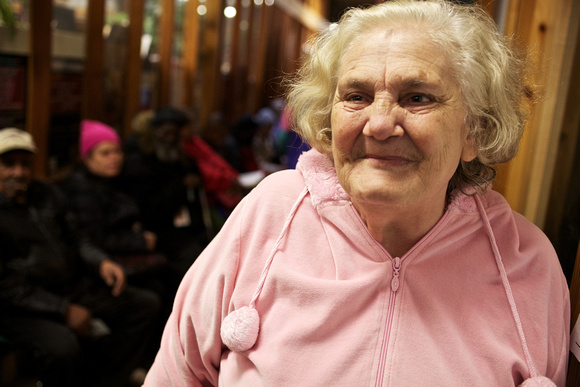
This post is the first by Donna Hendricks, a Rep Payee client who we’ve raved about before. She is passionate about the issues of affordable housing and mental health, because funding for those programs impacts her personally, so she's been a regular participant in the budget discussions each Friday from 11:30 - 1:00 at our Northwest Center. Last week she sat down to share her opinion on the DC budget cuts.

What happened to the homeless? What happened to low- and middle-income people? They got lost in a crowd. What happens to us, the money we need to live, to eat, just to survive, and depend on?

I’m a 61 year old woman who has been homeless and now has a roof over my head. But with the budget cuts, I live in fear of my rent being cut, fear of being back on the streets. Not only do I have mental health issues, I have physical health issues too. I have no use of my knees any more, and other problems. I’m scared of what would happen if I became homeless again.

I don’t need the pressure. We don’t need the pressure.

We have an overpopulation of the homeless already, so what’s going to happen when they close all the shelters for singles, when they end programs like IDA (Interim Disability Assistance) and stop building affordable housing?


If these cuts happen, more people will be homeless, which will drive them to mental illness, drinking, drugs, and other things they’ll do to survive and belong. When you’re homeless, it can feel like nobody cares. It’s lonely. You have no place to take a bath, no roof over your head, no necessities. It’s a hopeless situation.

Our Councilmembers need to hear from people who’ve experienced these things. It’s very important to voice our opinions. Otherwise they won’t know what it’s like. And if they don’t know what’s going on, what can they do about it? They’ll ignore the situation. They’ll keep their priorities in the wrong place. Streetcars and convention centers instead of homeless shelters and affordable housing. They think so much of the well-to-do that the low- and middle-income get forgotten. People who are really wealthy should pay their fair share, which isn’t happening right now.

So please, do all that you can to not make me homeless again.


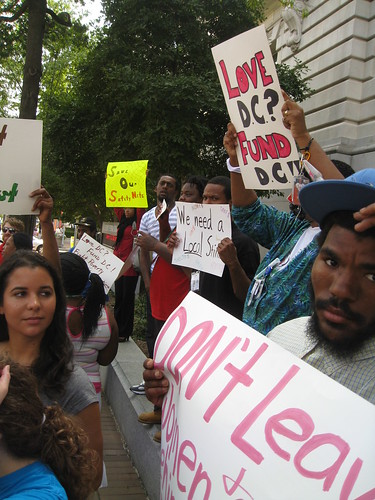
Editor’s Note: You can join Donna and other clients and staff at 6:00 pm on Tuesday, May 3rd at the John A. Wilson Building, as we rally together with the Continuum of Housing Campaign at CNHED and Latino Economic Development Corporation. Help us tell the City Council that we need funding for the housing to keep our neighborhoods healthy and whole.


April 25, 2011

New Budget Info and YOU!

The more we learn about the Mayor’s proposed budget, the less we like. We here at Bread for the City believe it’s the responsibility of the DC government to fund the safety net programs that keep families healthy and make our city strong. Instead of this vision, our Mayor proposed a budget with alarming and disproportionate divestment. Two dollars out of every $3 cut in the budget comes from human services, even though these programs make up only one fourth of the total budget. We need more money – not less – for homeless services, affordable child care, adult literacy, mental health services, affordable housing, and support for disabled residents.

Here’s more information on the specific issues our clients and staff are working on right now:

TANF
The Mayor wants to cut cash assistance for about 7,000 families with children. The benefit for a mother and two children would be reduced to $257 per month, a reduction that's on top of cuts enacted last December. Also, household where parents don’t attend the required work or work-readiness activities would lose all TANF benefits, whereas in the past children remained in the case load even if their parents weren't fulfilling the requirements. This policy change that harms children rather than supporting TANF recipients meet their goals.


Housing
The Mayor proposes major cuts to housing programs.
- Elimination of the Local Rent Supplement Program by not issuing any new rental vouchers, which creates a savings of $4 million in FY2012.
- Cut of $18 million from the Housing Production Trust Fund, which is used for construction of affordable housing and loans for tenants to buy their buildings.

Interim Disability Assistance Program
This program provides temporary cash assistance as DC residents with a disability wait for approval or denial for SSI. The budget eliminates this vital program.

If you’d like to join us in our fight to save safety net funding, come to a Bread for the City Budget Lunch. They happen every Wednesday in our Southeast Center and every Friday in our Northwest Center. We eat at 11:30 am, then start sharing information and working on projects from 12:00 to 1:00 pm. It’s a great way to meet our clients and staff, and spend an hour each week getting things done. If you'd like to learn more, contact me at jpodschun(at)breadforthecity.org or 202-553-7248.

April 22, 2011

It's Earth Day every day... on our roofs!

It’s Earth Day! So on this day of our earth, let's celebrate our progress in the Grow for the City rooftop garden projects. (How about celebrating Earth Day by making a donation in honor this innovative project? Make your gift here now, or read on...)


Over in our Southeast Center, Bread for the City was just paid a visit by Gifts of the Good Earth, which will be providing us with innovative self-irrigating planters for the container garden. Last year, this garden was the inspirational innovation that planted the seeds we see sprouting today, so we are excited to see it improved this time around.

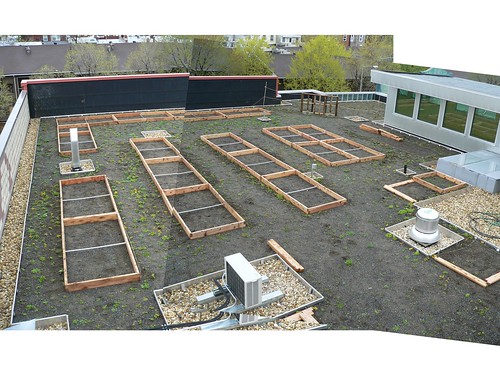
And our Northwest Center has hosted Bread for the City clients, board members, staff, neighbors and new friends, who've constructed nearly 30 beds and prepared the site for great growth to come. dc greenworks has been instrumental in this process, designing the garden and overseeing its construction.

Before to After!

Last Saturday, despite forecasts that forewarned of a 100% chance of torrential rain, our hardy volunteers still showed up to build the first of our beds. This Saturday (tomorrow!) a crane will hoist the rest of our growing medium (aka dirt) to fill the beds.

On Sunday May 1st, we’ll plant the first vegetable seedlings.

BFC clients have been playing an active role in the visioning, planning, and construction of the space. For instance, take Rosa.


Rosa has been a volunteer at Bread for the City for a long time -- and was a client back in the 80s, when she and her husband struggled with unemployment -- and she was thrilled to hear about this project because she used to garden as a child with her mother. Rosa hasn’t had the space to work on a garden in a long time, and was simply ecstatic to be on the roof. “Rain or shine, I knew I was going to be here today,” she said. “Not only because it was an opportunity to give back, but to get back!”

Diana, in the video below, has been a client at BFC for just two years.


She heard about our garden project through her friend Antoinette, another client who grew up in rural North Carolina and is intimately familiar with growing her own food. Diana is a native Washingtonian and has seen a lot of changes in her neighborhood, but this is the first time she’s been on top of a roof for a garden. “It’s driving me crazy, but I love it.”

Another exciting part of the rooftop garden project: we’re buzzing! Literally. We invited DC Honeybees to install two beehives that will supply our space with active pollinators and delicious honey. Watch Jeff Miller from DC Honeybees set up our hives:


And you can see our whole Flickr set documenting our progress here.

It's all very exciting, and we've had an outpouring of people offering to help make it happen. In fact, we've had so many people to volunteer that we've totally met our goal of 200 pledged volunteer garden-building hours. It's inspiring! But now we need the resources to give this vision life.

You can join this Community Supported Agriculture project. Help us celebrate Earth Day by:
Let's grow this thing!

April 21, 2011

Celebrating Language Access, and Giving Teeth to the DC Language Access Act

April is Language Access Month, which marks the 7th anniversary since the passing of the DC Language Access Act, which provides meaningful access to DC government services for limited and non-English proficient individuals through oral interpretation and translation of vital government documents. In celebration of Language Access Month, we invite you to join Bread for the City, Many Languages One Voice, and the DC Language Access Coalition on April 27 at 6:30 PM at the All Souls Church, 2835 16th Street NW. An excerpt of the film "Communities in Translation" will be shown for the first time in public. For more details and to RSVP, please contact info@dclanguageaccess.org.


There’s certainly lots to celebrate during Language Access Month – both the landmark act itself and the recent success of a Language Access Act complaint against the DC Department of Human Services filed by my Bread for the City colleague Stacy Braverman. (See her compelling report on the case in this recent blog post.)

However, we also recognize that there are larger systemic problems with the legislation and its oversight. Currently, the only way to enforce the Act is to file a complaint through the Office of Human Rights (OHR). At OHR’s recent performance oversight hearing, I gave testimony that called for amending the Act to allow individuals to sue agencies in a DC court and provide a right to appeal an OHR decision.

As my testimony below lays out, in recent decisions regarding oral interpretation, OHR is not effectively fulfilling its role to oversee and ensure compliance with the Language Access Act. If it is not enforceable, the DC Language Access Act is just a law on the books, with no teeth. In order to ensure that the Act is enforced, individuals must have a private right of action to sue agencies in court. In addition, if individuals choose to file complaints through OHR, there must be a way to challenge unfavorable OHR decisions. Though we received a successful OHR decision recently, other complainants have not. As I outlined in my testimony, even though we believe OHR has misapplied the law in some cases, there is no mechanism to appeal a decision by OHR.

Under DC law, people who have suffered other types of discrimination have several options to enforce their rights. If a DC agency treats me unfairly because of my race, for instance, I can choose to file a complaint with the Office of Human Rights or I can sue the agency directly. If I choose to file a complaint with OHR and I disagree with its decision, I have a right to appeal that decision.

To bring the process in line with what governs OHR discrimination complaints, Bread for the City is working with our fellow members of the DC Language Access Coalition to propose an amendment to the DC Language Access Act. Our proposed amendment would give teeth to the Act, by ensuring that language discrimination is treated the same way as other forms of discrimination.

For more information, check out my testimony:

Testimony of Allison Miles-Lee
Staff Attorney, Bread for the City
D.C. Council Committee on Aging and Community Affairs
Public Performance Oversight Hearing on the Office of Human Rights
March 3, 2011


Good morning. My name is Allison Miles-Lee. I am a staff attorney at Bread for the City, which is a non-profit organization in D.C. and a member of the D.C. Language Access Coalition. I’d like to share some concerns we have about the Office of Human Rights’ (OHR) oversight and enforcement of the Language Access Act (“Act”) through its complaint process.

Under the Act, the OHR complaint process is the only way to hold agencies accountable for violations of the Act. Specifically, the Language Access Director of OHR is required to “track, monitor, and investigate public complaints regarding language access violations at covered entities, and where necessary, issue written findings of noncompliance to the covered entities regarding failures to provide language access.” D.C. Code § 2-1935(b)(2) (2011). Currently, the Language Access Act does not provide a private right of action that would give individuals an alternative to filing a complaint with OHR, nor does the Act provide an explicit right to appeal an unfavorable OHR decision.

In recent OHR determinations regarding oral interpretation, OHR is essentially rewriting the Act by its misapplication of the Act. In passing the Language Access Act, the Council clearly mandated that agencies provide oral interpretation in all languages needed by their customers. In contrast, the Act does not require agencies to provide written translation in all languages. The Act provides a framework for each agency to determine the languages for which it is required to provide written translation. Again, with respect to oral interpretation, it does not matter whether the individual speaks Spanish or Swahili, everyone must receive oral interpretation. There are no exceptions.

In coming to its determinations, however, OHR appears to apply other standards not provided for in the Language Access Act, such as the agency’s reasonableness and provision of partial services. As a result, OHR is finding that agencies are in compliance when we believe they have actually violated the law. Complainants then have no other recourse to challenge the agency or encourage it to come into compliance.

While the Language Access Act makes it clear that oral interpretation must be provided in all languages, it does not specify which type of oral interpretation service is required. For instance, agencies could rely on bilingual employees, paid live interpreters, or a telephone interpretation line. On an annual basis, agencies are required to make a determination of the type of oral language services they will provide, based on a four-factor analysis. This analysis includes: 1) The number or proportion of limited or no-English proficient (LEP/NEP) persons of the population served or encountered, or likely to be served or encountered, by the agency (agencies should already be doing this analysis to determine which languages require written translation); 2) The frequency with which LEP/NEP individuals come into contact with the agency; 3) The importance of the service provided by the agency; and 4) the resources available to the agency. The Act offers further guidance for factor 1, offering suggestions of data sources that agencies can consult in making their determinations.

The four-factor analysis is a requirement imposed on agencies as they decide the types of oral interpretation they will provide. For example, the Department of Human Services (DHS) might determine that it has a large population of Spanish speakers already frequently accessing its important services and that it is able to hire Spanish-speaking staff without difficulty. Accordingly, for Spanish oral interpretation, DHS may decide to staff all its service centers with bilingual staff who can provide Spanish oral interpretation to customers. For a language like Swahili, however, DHS may determine that it does not have a large number of people currently accessing services at the agency and does not anticipate having a large number in the future, after consulting data sources. So, for Swahili, DHS may decide that, at least for now, oral interpretation will be provided by a telephone interpretation line.

In several recent determinations, OHR appeared to mistakenly apply the four-factor analysis described above to determine whether an agency was required to provide any oral interpretation for a certain language or not, when this analysis should only be used when agencies determine the type of oral interpretation to provide.

In addition to mistakenly applying the four-factor analysis to determine whether agencies are, at the outset, required to provide oral interpretation in a certain language or not, OHR has applied standards not outlined in the Act, including a reasonableness standard and a capacity standard. In another case, OHR considered the fact that at least some people were given oral interpretation, though not all. With regard to oral interpretation, none of these lines of inquiry is relevant under the Act to determine if the agency is in compliance with the Act.

In two recent determinations, OHR acknowledged that the agency did not provide needed oral interpretation to the complainants. However in both cases, OHR went on to apply an additional reasonableness standard that is not outlined in the Act. Since OHR determined that the agency acted “reasonably,” it found that it did not violate the Act.

In another written determination, OHR did an analysis of whether an agency had the capacity to provide oral interpretation services before it determined whether the agency complied with the Act. Again, this standard is not outlined in the Act.

Finally, OHR found that another agency did not provide adequate oral interpretation. In fact, the agency itself admitted that it had used bad interpreters and a number of Mandarin-speaking individuals were denied access to the agency’s services as a result. Nonetheless, OHR found no violation since the agency showed that it made an effort to get better interpreters at subsequent events, and eventually “some of the participants were able to have meaningful participation in the process,” though not all.

As these recent examples show, OHR is not effectively fulfilling its role to oversee and ensure compliance with the Language Access Act through its written determinations. Based on how OHR is coming to its determinations, it is clear that OHR is applying standards that do not exist in the Act. The standards that OHR applies are changing the requirements of the Act, and there is currently no mechanism for review of OHR determinations under the Act. We urge the Council to amend the Act to provide a private right of action and right to appeal an unfavorable OHR determination.

The Language Access Act is an important piece of legislation that brings D.C. to the national forefront of language access. If it is not enforced, though, it is meaningless. Thank you.

April 19, 2011

Job openings in our medical clinic!

We've got two positions opening up in Bread for the City's Northwest Medical Clinic. Spread the word!


SEEKING: Medical Clinic Enrollment Coordinator

The Medical Enrollment Coordinator's primary responsibility is the screening and assessment of all medical patients for healthcare program eligibility.

Reports to: Enrollment Supervisor

Responsibilities:

  • Screen all medical patients for healthcare program eligibility
  • Perform general intake for patients
  • Complete and follow up on applications for healthcare programs
  • Work with the enrollment supervisor and medical clinic director in problem solving and planning for the future
  • Assist with other administrative medical tasks as assigned

Requirements:
  • Exemplary interpersonal skills
  • Ability to work with a wide variety of people including patients suffering from a variety of physical and/or mental illnesses and volunteer doctors, nurses and other health care professionals
  • Strong organizational and computer skills
  • Ability to manage multiple projects and responsibilities simultaneously
  • Good listening skills, patience, perseverance, flexibility and a commitment to working for and with low income people
  • Spanish fluency.
  • Sense of humor, flexibility, optimism, and a cooperative spirit in a fast-paced and familial environment
Bread for the City is an equal opportunity employer and does not discriminate on the basis of race, color, religion, sex, pregnancy, national origin, ancestry, age, marital status, sexual orientation, family responsibility, physical or mental disability, medical condition, status as a veteran, or any other category protected by applicable federal, state, or local law, except where a bona fide occupational qualification applies. Please send résumé to Dr. Randi Abramson via e-mail to medicalclinic[AT]breadforthecity[DOT]org.


###

SEEKING: Medical Assistant

Responsibilities:

  • Work in lab as phlebotomist
  • Order supplies for lab, exam room, medications, patient assistant medications
  • Keep exam rooms and supply room stocked and organized
  • Maintain the quality control logs in the lab to comply with OSHA standards and overseen by the medical director
  • Maintain medical equipment through annual check and as needed for broken equipment
  • Copy medical records to be sent to outside sources
  • Maintain immunization inventory
  • Perform needle exchange and track data

Requirements:

  • Commitment to working with low-income residents of DC
  • Completion of a training program for medical assistants or equivalent experience
  • Strong interpersonal skills, and an ability to work well with a wide variety of people
  • Strong organizational skills and attention to detailFlexibility, optimism, and a cooperative spirit in a fast-paced and familial environment
  • Efficient, hard working, and punctual

Reports to: Medical Director

Bread for the City is an equal opportunity employer and does not discriminate on the basis of race, color, religion, sex, pregnancy, national origin, ancestry, age, marital status, sexual orientation, family responsibility, physical or mental disability, medical condition, status as a veteran, or any other category protected by applicable federal, state, or local law, except where a bona fide occupational qualification applies. Please send résumé to Dr. Randi Abramson via e-mail to Medicalclinic[AT]breadforthecity[DOT]org.

April 18, 2011

Why we need needle exchange.

In recent weeks, we’ve watched as DC’s needle exchange programs were used, once again, as a bargaining chip in the national political arena. The federal budget bill passed by House Republicans included a rider that would have prohibited the District from funding its own needle exchange programs.


The needle exchange rider seems to have since been pulled off the table. (Though Congress did pass a rider prohibiting the use of federal funding for abortions.)

The episode has left us thinking back to the 90’s, when
a Congressional ban on federal funding for needle exchange actually did prevent these programs from spreading through the District. For many years, Bread for the City’s medical clinic was pretty much the only source of free, clean needles aside from the mobile distribution operation PreventionWorks!, which just recently closed.

In a quote that we’ve cited before and almost surely will again, our deputy director Jeannine Sanford is more blunt: “We did it because we don’t just stick our heads in the sand. Bread for the City does what’s going to save lives. We do what works.”

To get a sense of what this program looks like and why it’s important, consider our story about Lisa. Lisa has suffered from various ailments -- including abscess in her stomach and Hepatitis C -- that are attributable to her drug abuse. The Hepatitis C, she believes, was received from a dirty needle.

But Lisa can’t get clean needles at a pharmacy, because you needs to have a prescription or some other demonstrated proof of need. Without health insurance, this isn’t a viable option for Lisa one way or another. And she is justifiably wary about being reported to the police.

Lisa used to rely on the PreventionWorks mobile needle exchange program -- and since receiving free, clean needles, she’s remained infection-free. Now that PreventionWorks! has closed, however, Lisa would have few options for a reliable and regular supply of clean needles.

But Lisa can turn to Bread for the City. And she trusts us. We’ve been doing this for more than a decade, and she knows from word of mouth on the street that our services are safe, reliable, and respectful. She’s developed a relationship with our lab technician, Kayleigh. And through that relationship, she became a primary patient at our medical clinic. Since then, her health has improved even more.

Our medical clinic director Dr. Randi explains: “When Bread for the City describes itself as a medical home, we imagine a place for all members of the community to have access to resources to keep themselves healthier and safer. Just as medical care is offered in conjunction with food and legal assistance and so on, it makes sense to offer needle exchange as part of the continuum of screening, diagnosing, education, and treatment that we provide with each visit.”

Indeed, though the longtime federal obstruction of needle exchange in the District is far from the only reason our HIV/AIDS rate is the worst in the United States, it’s certainly a factor. One in five cases of HIV/AIDS infection occurs as a result of intravenous drug use. Research indicates that cities with needle exchange programs have seen an 11% decrease in infections-by-syringe when compared to cities without such programs.

After some tentative progress forward, DC is currently falling backwards on this front. Bread for the City is now one of the District’s only three providers of needle exchange services, along with Helping Individual Prostitutes Survive (or HIPS) and Family and Medical Counseling Services. And in the time since PreventionWorks closed at the end of February, our monthly amount of exchanged needles has more than doubled.

Though this matter may be "last week's news" as far as the media is concerned, the need is not going to go away. So even if needle exchange is off the table in this round of congressional budget debate, we believe it’s important to continue to convey the value of this preventive program to the health of our city.

In the meantime, if you'd like to support our needle exchange program in this time of need, please make a donation to the program at this page.


Bread for the City's needle exchange program is funded in part by the DC Government’s Department of Health (HIV/AIDS, Hepatitis, STD, and TB Administration - or HAHSTA).

April 15, 2011

Bringing our community to the next level: the roof!


—George Jones, Executive Director

It's springtime, and we're gardening -- on our roof. You may find that announcement to be strange, even surprising; but it's true. And I think it's awesome.

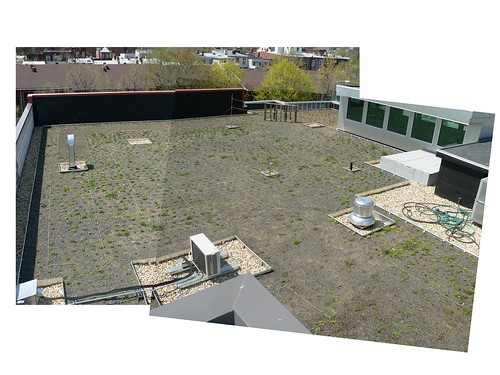
Above our Southeast Center (below, left), we've already installed rain barrels; a proud little village of pots, tires and other containers; even a repurposed kitchen sink that's currently sprouting a cabbage plant. And our newly-expanded Northwest Center (right) will soon feature the largest rooftop agriculture site in the DC area -- built and maintained with direction from dc greenworks -- with thirty raised beds growing as many as a thousand vegetable plants.


Will you help us build these gardens? We're looking for volunteers to get to work, and donors to make it all possible. The garden installation will take about 200 hours of volunteer labor, and cost $50,000. Help us make this vision a reality.


Of course, the yield from these gardens will be just a drop in the bucket compared to all of the food that passes through our pantries. But the true value of these spaces will be more than just the weight of the vegetables that grow there. Already, we've seen how fertile the sites will be: more than a hundred Bread for the City clients have signed up to help build and maintain these gardens, and participate in workshops about healthy eating and living.

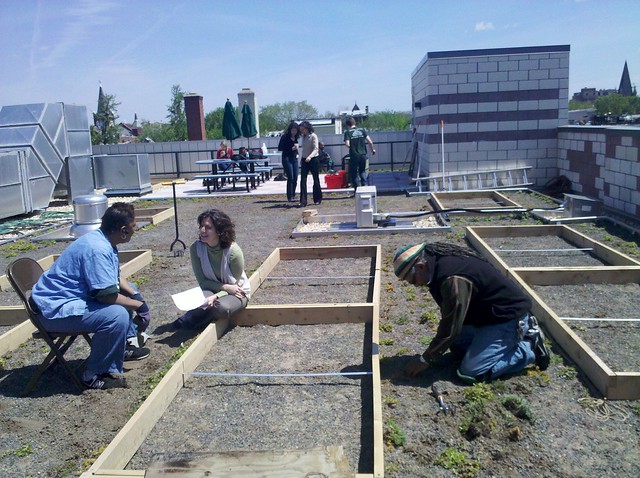
Just this past Saturday, a small team of clients and staff worked together to prepare the Northwest site for the upcoming construction. One woman, Mrs. Jones (no relation), told us stories about her upbringing on a farm in North Carolina. She listed in detail all the ingredients of a hearty, healthy meal that could be found on her family's property.

That way of life is long gone. Mrs. Jones is now a grandmother of four, and still spry--but she relies on our pantry to make ends meet month-to-month. It's been many years since she's had space of her own in which she can engage with the earth, let alone grow food that would sustain a nutritious diet.

As we worked together on the roof, laying out plots for the raised beds to come, we talked about what kinds of vegetables we should grow in the garden, and how that food could be prepared and shared with clients in the pantry below. Mrs. Jones talked about bringing her grandchildren to this space so that they, too, could have the experience of growing with a community. Together, we could see glimmers of something new and exciting. A space that will nourish bodies, minds, and souls.


That's what I love about this project: it won't just be vegetables that we grow here, but relationships that lead us all down a path toward a community rich with dignity and shared responsibility.

We'll need help to make it happen, of course. We've had an inspiring outpouring of offers to volunteer in the garden building (and you can still sign up for a volunteer shift). Please note that tomorrow's scheduled build-day is about to be rained out -- but we'll be making up the lost time with big build days on Saturday April 23rd and Sunday May 1st (in two shifts each, 8am to noon and noon to 4pm). RSVP here.

And we're also calling on our community of supporters to sponsor those volunteer efforts. Match these 200 garden-building hours with garden-building dollars -- at a rate of $20 per hour. (And please note: Any gift to the green roof of $500 or more will be recognized on the primary honor wall of our Northwest Center.) You can become a member of this Community Supported Agriculture project here.

Can't wait to share this great green space with you all.

April 13, 2011

Introducing Bread for the City's Job Developer, Malton Edwards!

We’re pleased to introduce Malton Edwards IV, Bread for the City’s first Job Developer! Malton comes to us from Hartford, Connecticut, and has a masters in public administration, with a minor in economic development and urban planning. That makes him a perfect fit for us! And especially given the recent news about Wards 7 and 8 having some of the worst unemployment in the country, we’re excited to announce the expansion of our job development program. --ed


As an undergrad at Howard University in 2005, I first came to Bread for the City to volunteer in the food pantry -- and the organization impressed me right away. From then on, when I thought of service in DC, I immediately thought of Bread for the City. It’s very comprehensive. In some communities it’s hard enough to find medical and legal services, let alone food -- and for them to be all encompassed in one space, it’s just really exceptional.

I was actually coming back to volunteer on the day that I saw the job opportunity and applied.

Now I’m working here as as their first job developer in their Pre-Employment Program; also knows as PEP. PEP helps clients build job readiness skills, self confidence and self esteem. We look at the whole person and identify their needs. From what I can see, being a professional job developer is about three things: Development, Research, Advocacy.

By developing a person – getting them ready, building their portfolio, and bringing them through a personal metamorphosis – we’re able to prepare them for the job that they desire (not just the one that we can fit them into).

By engaging in research, we can see what’s out there. Using the web and our networking skills and even just a cold telephone call -- that’s what helps us find the opportunities for our clients.

Then, advocacy. That part is actually going out to the employers and advocating for the clients and our program itself. We talk to employers about our clients, and we talk to them about our services and our program, so that they know and trust us. Even if they don’t hire a particular applicant whose resume they have in hand, they know about us in the future.

I’m finding that this job is tons of trial and error. Throw out stuff and see what works. But that’s something I like to do. I’m dressed in a tucked shirt and tie four days out of five. And you really don’t have to do that at Bread for the City. But I’m making sure to demonstrate to the clients that this is what it means to be employable, to be professional.

And it’s starting to work. The classes in our Pre-Employment Program are still small -- just 8 people. But we’ve already had 5 successful job placements so far.

One person had a criminal record in his background, which would normally prevent him from getting a job. Originally he was averse to things like dressing up. He wanted to be a chef, so from his perspective, wearing a tie wasn’t necessary. We had to explain that in a job interview, you’re marketing yourself -- and not just one specific skill, but yourself as a whole person. We worked with him to revamp his resume and cover letter and groom him for the workplace. When he came back to us and told us his story of meeting with the employer, he said the employer loved his resume and loved his deportment. And now he has a job as a cook. He’s on his way.

Another client doesn’t have a high school education, and she didn’t have high confidence or interpersonal skills. But she’s been dedicated in coming to class, revamping her resume and cover letter. The other week she went out and applied to 14 jobs. That’s just not something she’d done before. And she got two interviews this week. She said it’s all been a liberating experience for her – not just the work on getting the jobs, but the whole process of personal evolution. Now she comes to PEP classes in business attire. You have to dress yourself mentally before you can go out and do these things, and that’s what we help with here.

One of my great inspirations is Newark’s mayor, Cory Booker. He says ‘you’ll never have a great Newark without a great educational system.’ And you can see that here in DC, especially east of the river. The educational system is broken, which leaves people without hope. If people are better educated and better trained, things will start to turn around.

Though Bread for the City’s services haven’t included education per se, we do consider ourselves a center for personal development -- and so a curriculum of things like job readiness fits right into our model and worldview (alongside classes like cooking and computer literacy). In this, like everything, we take a holistic approach: it’s not just trying to help you to find a job, but about helping you become a whole person.

April 11, 2011

Building Budgets: Because All the Cool Kids Are Doing It

We talked last week about Mayor Vincent Gray’s budget and it’s proposed $130 million in cuts to human services. It bears repeating that these funding cuts are really disproportionate: $2 out of every $3 in cuts are from safety net programs.

That’s why we’re hosting Winning a Better Budget: Dinner and Action Session at our Northwest Center this evening. The response to the event has been amazing. At least ten different budget campaigns will come together to share what they know and lead work on projects to help reshape the budget. And we expect around a hundred DC residents from all over the city.

Anything could come out of it -- an amazing event at City Hall, the best blog post you’ve ever read, a brand new organizing project, or even just some new friends. (If there’s one thing this work has taught me, it’s that you’ve gotta have friends.)

It’s tonight, 5:30 to 8:00 pm. It’s free and you don’t need to RSVP. Dinner, Spanish interpretation, and child care will be provided. We’re at 1525 7th St NW, two blocks from the Shaw/Howard Metro and on the G2 and 70 buses.

Will you join us?

Eat, Learn, and Build a Better Budget With Us

Are you coming to our awesome action session, Winning a Better Budget, tomorrow evening? In case you haven’t signed up yet (or even if you have!) I want to share a few reasons why I’m excited about this event.

Three reasons this event is going to blow your mind:
1. You’ll get to learn and work alongside our staff and clients, some of the best and most passionate advocates I know.
2. Fantastic local campaigns will be showcasing their strategies, sharing their skills, and working together.
3. You can propose anything related to the DC budget and see if there are other people that want to build a project or talk through an issue with you.

I sat down with my intern Joei to hear what she thought about the proposal to reduce cash assistance and make it harder to get help through the TANF program. Among other things, she’s studying communications in college, raising two boys, and using Food Stamps to make ends meet. Here’s what she had to say about what these changes will mean and why the community needs to be involved in budget decisions.


Please join us tomorrow as we stand up for the services we need for healthy families and strong communities. Dinner is served at 5:30 pm and budget information and action will happen from 6:00 to 8:00. The event is at our Northwest Center, 1525 7th St NW, two blocks south of the Shaw/Howard Green Line Station; parking is available.

Whether or not you can come tomorrow, you can send an email to the Council now asking them to restore funding for safety net programs.

April 8, 2011

Susan Jackson: Homelessness Advocate

This post is by Nathan Karrel, an intern with the Advocacy Department. He sat down recently with Susan Jackson, a former Bread for the City client and homeless advocate, who offered to share her story with us.

Washington DC has 5,518 individuals living in homelessness. Susan Jackson, born and raised in DC, is one of those adults. Recently, I sat down with Susan to speak with her about her activism and her struggle with homelessness. Susan shared that as a homeless resident, she’s had a difficult time getting access to nutritious food, especially fresh fruits and vegetables. This challenge is what Susan links to her early onset of diabetes. Nearly 9% of DC adults have diabetes, ranking it 4th highest in the nation for the percentage of people with diabetes in the general population. Susan noted that her homelessness was also exacerbated by the lack of shelters and transitional housing afforded to women. As she said to me, “Many women are living on the streets because of the lack of adequate space…Women are not at the forefront of anyone's mind; it’s only when an advocate, like myself, stands up and asks pointed questions about shelter space for women is it even discussed.” Through a District social worker, Susan became aware of N Street Village in Northwest DC. N Street Village provides housing for low-income and moderate-income individuals and families. As a member of the N Street Village community, Susan found the stability that allowed her transform the difficulties of her homeless situation to advocate on behalf of the homeless women in the District. “My experience of being homeless has afforded me opportunities or lessons of how to advocate for myself and my needs and in doing so caused me to advocate for others,” she said. “It’s not something that I set out to do, but I believe that it is necessary and I can't see myself doing anything else.”

If you want to learn to advocate like Susan, Bread for the City invites you to Winning a Better Budget: Dinner and Action Session, 5:30 to 8:00 pm Tuesday, April 12th at our Northwest Center. (If evening doesn't work for you, you can join our weekly luncheons from 12:00 to 1:00 pm each Wednesday at our Southeast location and Friday at our Northwest location.) Susan is a face behind the statistics of homelessness and poverty. She has struggled with adversity to become a powerful advocate on behalf of women in situations of homelessness and poverty in the District. She is pursuing a Human Services Administration Certificate at Catholic University, is a well-respected presence in the Logan Circle neighborhood, and active in food policy council organizing and the Fair Budget Coalition. Follow her inspiring example at Winning a Better Budget next Tuesday.

April 6, 2011

Rep Payee: Managing Money and Mental Illness

[Note: There's a job opening in the Rep Payee department! See Monday's post for more information. —ed]

We've recently been blogging about Bread for the City's Representative (“Rep”) Payee Program -- "the most important program you never knew we had."

This program is unique in that, through it, we are the only agency contracted by the Department of Mental Health to provide payee services to its 'consumers.'

This means that our Rep Payee clients are receiving treatment services at many different mental health agencies around DC -- and they reflect a broad spectrum of personal circumstances. While most of our clients are single adults, they may be homeless, institutionalized at St. Elizabeth’s Hospital, living alone in a subsidized apartment in the community, or living in a supervised group home. Some have an extensive work history while others have never been able to work. Perhaps the most common thread among all of our clients is that they do not have anyone in their lives, such as a relative or friend, whom they can trust to manage their money. Because of this and their own struggles with chronic mental illness, and sometimes with substance abuse, our clients are vulnerable to being taken advantage of financially, may have very poor credit, and may have a history of housing instability or food insecurity.

The Rep Payee Program has many different facets, but its core service is the writing and disbursement of about 2,500 checks per month. Through this, we ensure that our clients’ rents and bills are being paid on time and that they have money in their pockets for food and transportation. Establishing this reliability and regularity is the first step to financial security and recovery.

As a case manager in the Rep Payee Program, I enroll new clients at our NW Center. This means that I meet with each client and his or her mental health case manager to explain how the program works and to answer questions about the ins and outs of having a representative payee.

Just the other day, I was enrolling a consumer who expressed her gratitude to me for us becoming her payee. She had been without funds for some time as Social Security awarded her benefits but required that she identify a payee before she could be paid. At the end of the meeting she said, “while I understand I need help managing my money now, Jo, is there any way in the future I will be able to be my own payee?”

I was happy to share with her the story of Donna, whom we told you about last month.

In that post, we explained how Donna has come to move on from our representative payee program, having come to the point where she can be paid directly. Donna has made a lot of progress, gaining skills with which she can manage her own budget and pay her own rent and bills.

I recently spoke with Donna on the phone about her experience in the Representative Payee Program and she told me about her previous attempt to manage her own money -- back in 2007. Donna did well on her own for a while, but she soon suffered a relapse of her mental illness. Suddenly, it became difficult -- if not impossible -- for Donna focus on her finances and bills. All of her energy needed to be focused on her mental health and recovery, but her bills and rent still needed to be paid. Donna knew that she needed help, so she asked to be re-enrolled in the Rep Payee Program here at Bread.

Years later, Donna explains that with the help of various supports and her continued participation in the Rep Payee Program, she learned valuable skills to cope day to day on her own. She also learned how to keep a monthly budget that guides her spending.

Donna’s success, however, is pretty exceptional. Many of our clients face even greater challenges than Donna - struggles with addiction, severe mental illness, even difficulty understanding the basic concept of money. In a given year, out of all 800 of our Rep Payee clients, only a small handful (ten or less) successfully move on to being paid directly. For everyone else, Rep Payee creates an environment of security and reliability -- ensuring that they can stay in their homes with their electricity and heat on or that homeless clients have dependable access to money for food and personal needs throughout the month.

I saw Donna last week, when she was coming by our offices for a Client Advisory Board meeting. She showed me a $10 bill -- her donation to Bread for the City for this month.

“It’s not as big as it usually is,” Donna explained to me, “This week I had to buy socks.” Needless to say, we are deeply honored to count Donna as a donor, regardless of the amount she can afford to give that month.


The Rep Payee Program is now hiring! See here for more information.

April 5, 2011

Winning a Better Budget: Education and Action Session

Mayor Vince Gray’s proposed budget came out last Friday. We’re still working to understand all that it means, but we know that the cuts are bad. Two out of every three dollars cut in the Mayor’s budget come from programs that support DC residents struggling with poverty, even though these programs make up only one out of every four dollars in the entire budget. We have less than two months to fight for affordable housing, Interim Disability Assistance, health insurance, TANF, and other programs. We can’t do it alone. Will you help?


Join us next Tuesday evening to learn more about what’s in the city budget and what’s not, meet other people that care about these issues, and take action together.

The event is Tuesday, April 12. Dinner is at 5:30pm, followed by budget news and an open action session facilitated by various campaigns from 6:00 to 8:00 pm. It's at Bread for the City's Northwest Center, 1525 7th Street NW (two blocks south of the Green Line Shaw/Howard Metro, 70 and G2 buses). It's free!

Come to learn from our partners in the struggle -- ONE DC, Continuum of Housing Campaign, Save Our Safety Net, Fair Budget Coalition, Empower DC -- and work on projects while building advocacy skills like blogging, delivering testimony, and poster making. Get the word out on Facebook and join us Tuesday.

Email me at jpodschun(at)breadforthecity.org or 202-587-0524 to RSVP and request child care.

April 4, 2011

Now Hiring: Representative Payee Benefits Coordinator

Bread for the City seeks a full-time Benefits Coordinator to work in our Representative Payee Program.

The Benefits Coordinator serves as the program’s liaison to the Social Security Administration and advocates on behalf of clients in order to maintain their eligibility for disability benefits. The ideal candidate has strong organizational skills and attention to detail as well as strong interpersonal skills allowing her/him to develop a strong working relationship with our contacts at the Social Security Administration, mental health professionals, and our clients. He or she will be committed to getting results in a fast-paced environment and able to handle a heavy workload without dropping the ball. This position is an excellent opportunity to develop an expertise in public policy as it relates to Social Security Disability benefits, Supplemental Security Income eligibility, Representative Payee responsibilities, and other public benefit programs.

About Bread for the City

Bread for the City is a dynamic non-profit organization whose mission is to provide vulnerable residents of Washington, DC, with comprehensive services, including food, clothing, medical care, and legal and social services, in an atmosphere of dignity and respect. The Representative Payee Program provides services to consumers with chronic mental illness in collaboration with the DC Department of Mental Health and its Core Service Agencies. As an Organizational Payee we provide on-going support to 800 clients by managing their monthly income to cover expenses such as rent, utilities, food, transportation and personal needs on the basis of individualized budget plans and fulfill the reporting requirements of the Social Security Administration to maintain each client’s benefit eligibility.

Job Responsibilities

The Benefits Coordinator will be responsible for the following:
  • Serve as the program’s liaison to the Social Security Administration to monitor and maintain clients’ eligibility for disability benefits.
  • Develop and implement expertise in the area of Supplemental Security Income and Social Security Disability Income eligibility and other related benefits (Medicaid, Medicare, etc.).
  • Coordinate with Representative Payee Program staff and clients’ mental health providers to develop information and documentation regarding changes in clients’ situations that may impact eligibility.
  • Maintain a rigorous organizational system to track all reporting activities and outstanding issues.
All staff members of the Representative Payee Program are expected to work as part of this energetic and innovative team in order to provide the highest level of service possible to our clients. Collaboration among team members is essential and creative problem solving is strongly encouraged.

Qualifications

Bread for the City seeks candidates who have excellent attention to detail and are highly organized. The Benefits Coordinator must have:
  • Excellent time management skills, including demonstrated ability to juggle multiple projects and set priorities to meet deadlines
  • The aptitude to develop and maintain a deep understanding of the eligibility criteria and policies related to various federal and local public benefit programs
  • The ability to work independently and solve problems creatively
  • Strong interpersonal skills and the ability to work with diverse populations, as well as superior written and oral communication skills
  • Outstanding computer skills, including the capacity to use Microsoft Office and learn other programs to manage a high volume of detailed information and responsibilities
  • A commitment to providing services in an atmosphere of dignity and respect
The following are a plus but not requirements:
  • Previous knowledge of Social Security Administration benefits and the responsibilities of a Representative payee or other District of Columbia public benefits
  • Experience working with populations with chronic mental illness

Bread for the City is an equal opportunity employer and does not discriminate on the basis of race, color, religion, sex, pregnancy, national origin, ancestry, age, marital status, sexual orientation, family responsibility, physical or mental disability, medical condition, status as a veteran, or any other category protected by applicable federal, state, or local law, except where a bona fide occupational qualification applies.

Bread for the City offers competitive compensation and excellent benefits, including health and dental insurance coverage, vacation and sick leave, and a highly supportive working environment.

How to apply

Please send a cover letter, resume, and writing sample to Susanne Horn, Representative Payee Program Manager, at Bread for the City at shorn [AT] breadforthecity [DOT] org with Benefits Coordinator Opening in the subject line. No telephone inquiries please.

April 1, 2011

Bread for the City presents: Community Supported Agriculture

Bread for the City is bringing our healthy community to the next level: the roof!

This spring, we are building vegetable gardens on the roofs of each of our two centers. These gardens will grow lots of fresh, healthy food for use in our pantries and cooking workshops -- and, more importantly, they will be spaces that foster reflection, learning, and dialog about health and food justice, across lines of class, race, and age.

We need your help to make this vision a reality! Become a member of Bread for the City’s Community Supported Agriculture project.


On our Northwest Center, located at 1525 7th Street NW, we will convert our extensive green roof into the first large-scale roof top agriculture project in the DC region. DC Greenworks is providing us the technical support and know-how for this project, helping us build the now intensive green roof that will feature near 30 raised beds that will grow a variety of vegetables and herbs.


Our Southeast Center will feature an eclectic array of containers to grow herbs and vegetables specially selected by our clientele. The garden features rain barrels provided by DDOE and will utilize innovative irrigation systems developed by Gifts of Good Earth.

Get Involved!

We need your help to make these projects happen! We’ll be constructing the NW garden throughout this month, and maintaining both gardens throughout the growing season. We’ll also be hosting workshops, classes, and special events in each space, and need help coordinating these and preparing meals for our clients and volunteers. If you are interested in volunteering in any of these capacities, please fill out an application here!

You can also view our calendar of events here.

DC Greenworks estimates that the garden will cost $50,000 (and 200 hours) to build, and $15,000 a year to maintain. That’s a significant cost, but we believe that our community deserves spaces such as these -- so we’re asking you to help us make it possible.

Become a member of Bread for the City’s Community Supported Agriculture project! Donate to the green roof project today.

For more information, please send an email to Erin Garnaas-Holmes or call him at 202-386-7006!