
The City Council votes tomorrow on the budget for Fiscal Year 2012. Chairman Kwame Brown, responding to public pressure, showed leadership to restore a portion of the cuts.
Save Our Safety Net reports that his budget will include $24 million to partially fund Interim Disability Assistance, homeless services, and Temporary Assistance for Needy Families. But there are still $32 million in cuts on the table, and instead of using all progressive revenue to fund the safety net, the Chairman and others are planning to use a portion of the money to reverse the marginal income tax increase proposed by the Mayor.
Please take a minute today to email your Councilmembers to ask them to fully fund safety net programs. They need to hear from you. If you have time, call their offices as well. The numbers are below.
Take a look at this amazing video from Save Our Safety Net. It will inspire you as you talk to your elected officials:
Here's what Save Our Safety Net reports is still being cut:
-- $2m from childcare subsidies
-- $2m from Local Rent Supplement Program, eliminating the vouchers
-- $18m from the Housing Production Trust Fund
-- $900k from Children's Mental Health Services
-- $1.3m from Domestic Violence Services
-- $600k from the Low-income Heating and Energy Assistance Program
-- $3.3m from Interim Disability Assistance, leaving 1000 on the waiting list and 600 removed from the program
-- $3.5m million from homeless services, for transportation to shelters, feeding, and supportive services
And here are the numbers to call the City Council as well as email:
Kwame Brown (Chairman) 724-8032
Vincent Orange (at-large) 724-8174
David Catania (at-large) 724-7772
Phil Mendelson (at-large) 724-8064
Michael Brown (at-large) 724-8105
Jim Graham (Ward 1) 724-8181
Jack Evans (Ward 2) 724-8058
Mary Cheh (Ward 3) 724-8062
Muriel Bowser (Ward 4) 724-8052
Harry Thomas, Jr. (Ward 5) 724-8028
Tommy Wells (Ward 6) 724-8072
Yvette Alexander (Ward 7) 724-8068
Marion Barry (Ward 8) 724-8045
Jen Budoff, Council Budget Director 724-8139
May 24, 2011
City Council votes tomorrow. Ask them to save our safety net today.


May 23, 2011
Save IDA: Save Dollars and Save Lives
We’ve blogged a lot about Interim Disability Assistance (IDA), a program that provides low-income District residents with $270 a month while they wait for Social Security to approve them for disability benefits. We’ve even advocated for a similar program for TANF recipients, to help them get on SSI and pay TANF costs back to the District. We are pleased to note that such a program appears in the Mayor’s proposed TANF budget for Fiscal Year 2012, but we vigorously oppose another line in the budget—one that would completely eliminate the IDA program, putting more than 900 lives in turmoil. Watch this video from SOME and the DC Fiscal Policy Institute to learn about the support IDA provided to three men who are too disabled to work:
I work in the legal clinic, and represented a client with a similar story. Ms. C has several serious mental illnesses, along with orthopedic problems that have left her with pins and screws in several joints. She had worked for many years in the construction and food service industries, but she became sicker and was no longer able to work. She applied for benefits in September 2008; it took two denials and 31 months for her to have a hearing before one of Social Security’s administrative law judges. Ms. C was homeless, and IDA helped her afford some important items, like soap and socks and bus passes. Bread for the City represented Ms. C at her hearing and won.
Ms. C is now entering Bread for the City’s representative payee program and is excited to have an income she can use to apply for apartments. In addition, Ms. C won back benefits for all the months she was awaiting Social Security’s decision. She will be able to pay the District back for all the IDA she received, and can use the remaining lump-sum payment for expenses such as a security deposit -- and even potentially an apartment of her own, though even on a budget with Social Security benefits, this is no easy task (and still more budget cuts threaten to make it even harder). But it’s clear that Social Security benefits will dramatically increase Ms. C’s stability, and IDA was the bridge that helped her get there.
As we blogged about on Tuesday, our social services program helps people apply for these benefits. Our cases have a very high approval rate, as we gather medical evidence, write supportive reports, and advocate with the disability examiners. If social service clients or other low-income DC residents have their initial application for benefits denied, and are then denied at the reconsideration stage, Bread for the City’s legal clinic evaluates their cases for representation at a hearing before an Administrative Law Judge. Staff attorneys, volunteer attorney Bruce Mayor (who has been representing Bread clients in Social Security matters for nearly a decade!), and non-attorney interns and volunteers gather medical records, write briefs, and attend hearings for the clients we accept. We also refer cases to attorneys through the DC Bar Pro Bono Program.
And we’ve been remarkably successful. Our social services program has helped 43 people apply for benefits so far this year and already 23 have been approved. Meanwhile, our legal clinic just won our 27th hearing of 2011. All 27 of those victories are for people who have been denied benefits at earlier stages in the process! That’s a lot of federal dollars coming to low-income DC residents: to spend in local businesses, to reduce the need for emergency assistance, to keep up with rent and avoid eviction. The cases our legal clinic alone has won so far in 2011 will bring over $220,000 in federal dollars into the District each year, and provide much-needed stability to dozens of disabled people who are unable to work.
We are eager to continue to make money for the District, but we need help. It’s much easier to represent a client that can afford a phone, transportation, and sometimes even a stable address. These basics for communication and peace of mind enable faster determinations and ultimately more money in back payments for DC. We hope the City Council will find the money to keep this program.
You can tell them to do so yourself. Contact Chairman Kwame Brown at 724-8032 or kbrown@dccouncil.us, and tell him something along the lines of this:
The Interim Disability Assistance Program is an essential part of the safety net for District residents with disabilities. It’s also a mechanism for drawing down federal revenue to serve extremely low-income District residents and for transitioning those disabled individuals to a federal income source that will better allow them to sustain themselves. Please do not allow IDA to be eliminated and ensure that it has the funds necessary to serve those who need it.
April 25, 2011
New Budget Info and YOU!
Here’s more information on the specific issues our clients and staff are working on right now:
TANF
The Mayor wants to cut cash assistance for about 7,000 families with children. The benefit for a mother and two children would be reduced to $257 per month, a reduction that's on top of cuts enacted last December. Also, household where parents don’t attend the required work or work-readiness activities would lose all TANF benefits, whereas in the past children remained in the case load even if their parents weren't fulfilling the requirements. This policy change that harms children rather than supporting TANF recipients meet their goals. 
Housing
The Mayor proposes major cuts to housing programs.
- Elimination of the Local Rent Supplement Program by not issuing any new rental vouchers, which creates a savings of $4 million in FY2012.
- Cut of $18 million from the Housing Production Trust Fund, which is used for construction of affordable housing and loans for tenants to buy their buildings.
Interim Disability Assistance Program
This program provides temporary cash assistance as DC residents with a disability wait for approval or denial for SSI. The budget eliminates this vital program.
If you’d like to join us in our fight to save safety net funding, come to a Bread for the City Budget Lunch. They happen every Wednesday in our Southeast Center and every Friday in our Northwest Center. We eat at 11:30 am, then start sharing information and working on projects from 12:00 to 1:00 pm. It’s a great way to meet our clients and staff, and spend an hour each week getting things done. If you'd like to learn more, contact me at jpodschun(at)breadforthecity.org or 202-553-7248.
April 5, 2011
Winning a Better Budget: Education and Action Session
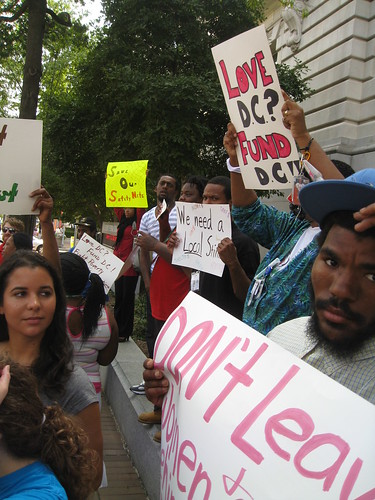 Mayor Vince Gray’s proposed budget came out last Friday. We’re still working to understand all that it means, but we know that the cuts are bad. Two out of every three dollars cut in the Mayor’s budget come from programs that support DC residents struggling with poverty, even though these programs make up only one out of every four dollars in the entire budget. We have less than two months to fight for affordable housing, Interim Disability Assistance, health insurance, TANF, and other programs. We can’t do it alone. Will you help?
Join us next Tuesday evening to learn more about what’s in the city budget and what’s not, meet other people that care about these issues, and take action together.
The event is Tuesday, April 12. Dinner is at 5:30pm, followed by budget news and an open action session facilitated by various campaigns from 6:00 to 8:00 pm. It's at Bread for the City's Northwest Center, 1525 7th Street NW (two blocks south of the Green Line Shaw/Howard Metro, 70 and G2 buses). It's free!
Come to learn from our partners in the struggle -- ONE DC, Continuum of Housing Campaign, Save Our Safety Net, Fair Budget Coalition, Empower DC -- and work on projects while building advocacy skills like blogging, delivering testimony, and poster making. Get the word out on Facebook and join us Tuesday.
Email me at jpodschun(at)breadforthecity.org or 202-587-0524 to RSVP and request child care.
March 22, 2011
Budget Basics, Briefly
Budget season is well underway, and in the run-up to the April 1st release of the Mayor’s proposed FY2012 budget, there are plenty of opportunities this week to get involved.
But what is the budget anyway and why should we care about it? The budget itself is a massive document that lays out in detail the amount of money required to implement all DC government policies, programs, and strategies over the course of the next fiscal year. (A fiscal year for DC government, by the way, is Oct 1st - Sept 30th.) It outlines how DC government plans on getting the money to pay for those programs (eg. income, sales, or property taxes, as well as federal funds) and determines funding levels accordingly.
As budget blogger extraordinaire Susie Cambria puts it, the budget is arguably “the most important of all legislation considered by the City Council and mayor each year.” It determines funding levels for all DC-government activities, shaping everything from school food to TANF to legal services to public works, and everything in between. (See past testimonies from Bread for the City staff and clients about the importance of programs funded by the city budget.)
Currently, the Mayor’s office is working on its proposed budget for the 2012 fiscal year (and is seeking input on their website – check it out). Starting in April, City Council works within agency committees to make additions, subtractions, and revisions to the budget before they vote on it in May. During this time, the different committees host a series of budget hearings – the public’s chance to give input directly to the council. The schedule of budget hearings is available online in PDF form and anyone can testify. See this how-to guide from So Others Might Eat for more, or call Kristi Matthews at the Fair Budget Coalition (202-328-1262) for help preparing your testimony.
Another round of projected shortfalls in revenue means that more than ever, all of our voices are needed to protect the programs that serve our city’s families. Thankfully many of Bread for the City’s allies have useful guides and resources that make it easier for all of us to get involved. Here are a few that I’ve found helpful:
- Susie Cambria’s has some basic resources: What the Budget Is and Isn’t (PDF) and DC Budget Process Explained (PDF) Her blog, Susie’s Budget and Policy Corner is a top spot for up-to-date info on the budget.
- Fair Budget Coalition recently released its annual budget report, in which it outlines the Coalition’s analysis of what programs make up the bare minimum safety net to meet most basic needs of District residents and help them to move towards providing for their own basic needs.
- DC Fiscal Policy Institute's research and analysis highlights how DC budget impacts low-income residents. Their most-recent report focuses on last fall’s gap-closing measures. Look for an updated budget toolkit soon!
- The Mayor’s office is seeking input on their website – fill out their survey today.
- Save Our Safety Net can also help you send a message to the mayor – click here!
- Take your lunch to the Mayor’s office anytime this week with the Save Our Safety Net Campaign!
March 16, 2011
Gearing up for the Budget
It’s crunch time for the Mayor. Mayor Vince Gray’s first budget comes out Friday, April 1. This is the last opportunity for constituents to let the newly elected mayor know what choices we want him to make with the budget.
Gray’s job isn’t easy. The local budget, which totals around $7 billion, has a shortfall of $322 million. In events during the last two weeks, the mayor’s Budget Director, Eric Goulet, has said that the cuts will come from health and human services, even though safety net programs have already been cut by one-third in the last three years. He also said that they won’t cut health and human services if they fill the gap with revenue.
One of the programs that could face cuts is affordable child care. According to the Grassroots Media Project, funding for the District’s Child Care Subsidy Program, which benefits community-based child care providers as well as parents in need of affordable child care, has been cut each of the past five years. We see many families, particularly at our Southeast Center, that are unable to get and keep good jobs without a child care subsidy. (More here)
We think it’s time to share the burden. That’s why we support Save Our Safety Net, Invest in DC, and the Fair Budget Coalition in asking for a more progressive income tax structure.
If you agree, send an email or call the Mayor now at eom@dc.gov or (202)727-6300. Let them know you support progressive taxes to pay for safety net programs.
Come to one of these events to raise your voice with Bread for the City and our partners:
Empower DC Show Us the Green Rally for Child Care
On Facebook
Tomorrow, 10:00 am - 1:00 pm
Wilson Building, 1350 Pennsylvania Ave NW
Take the Safety Net Off the Lunch Table with Save Our Safety Net
On Facebook
Monday March 21 - Friday March 25, 1:00 pm
Wilson Building, 1350 Pennsylvania Ave NW
February 23, 2011
The Budget Countdown Begins
The city budget season is just around the corner. The release of the our newest Mayor’s proposed budget happens April 1st, and the advocacy community is gearing up for big cuts. There have been more than $120 million in reductions to safety net programs in the last three years. With another $400-600 million city revenue shortfall -- the most yet -- we’re anticipating whole programs on the chopping block.
Do you want to know how best to take action to save city services? Are you curious about the process? Come to one of the many budget trainings taking place at Bread for the City and around the city. These trainings are appropriate for staff of non-profits, curious citizens, volunteers, etc.
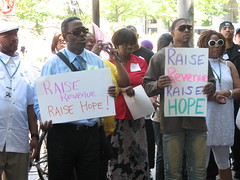
Here’s our roundup:
Fair Budget Coalition Breakfast Briefing on Tax and Revenue
9:30 - 11:00 am, Friday February 25th
Wilson Building, 1350 Pennsylvania Ave NW, Room 120
Our friends at the DC Fiscal Policy Institute will talk about how tax works and the importance of a balanced approach to the budget, including progressive revenue.
Fair Budget Coalition Meeting
9:00 - 11:00 am, Wednesday March 2nd
True Reformer Building, 1200 U St NW
Guests Eric Goulet (Budget Director for the Mayor) and Jennifer Budoff (Budget Director for the Council) will brief the coalition on the upcoming budget, followed by Q&A.
Bread Budget Training #1
5:30 - 7:30 pm, Monday March 7th
1640 Good Hope Rd SE
Kristi Matthews (Fair Budget Coalition) will lead this training geared toward Bread for the City clients and open to the public. We will talk about the budget process and tools for advocacy.
Bread Budget Training #2
11:30 - 1:30, Tuesday March 8th
1525 7th St NW
Susie Cambria (Consultant Extraordinaire) is leading this training geared toward Bread for the City staff and open to the public. We will learn about the budget process and the roles of various agencies, and discuss strategies for effective campaigns and advocacy.
What’s in Store for FY 2012?
9:30 - 11:30 am, Wednesday March 9th
Goethe Institute, 812 7th St NW
A forum on the latest information and perspectives on the D.C. budget outlook, including panelists Jennifer Budoff, Eric Goulet, Fitzroy Lee (Office of the Chief Financial Officer), Jenny Reed (DC Fiscal Policy Institute).
Bread Budget Training #3
5:30 - 7:30 pm, Monday March 14th
1525 7th St NW
Kristi Matthews will lead this training geared toward Bread for the City clients and open to the public. We will talk about the budget process and tools for advocacy.
Contact me at jpodschun(at)breadforthecity.org or 202-587-0524 to RSVP or learn more about any of these meetings.
February 17, 2011
City Divests from Supports for Low-Income Families and the Local Economy
The Income Maintenance Administration announced yesterday that TANF cash assistance will be cut by 20% for most households that have received TANF for at least five years. This benefit reduction, which impacts about half of the 16,000 households on TANF, was decided at the last moment as part of the budget shortfall decisions by the City Council in December. It goes into effect April 1.
The TANF program is the primary source of support for women who are raising children and struggling to get and keep good jobs. One in three children in DC is raised with a parent in the TANF program. Beyond Bread blogger Patty Anne wrote about the shortsightedness of removing supports for TANF recipients, and Save Our Safety Net added that the decision was made even as high-income households -- those who have suffered the least in the recession -- were not asked to invest in a strong safety net.
Families face many different situations -- waiting for job training, dealing with a domestic violence situation, recovering from a health problem, looking for work, etc. Regardless of their different timelines, needs, and goals, families need enough cash assistance to stay stable. At an event last month, TANF recipient and Academy of Hope student Ernestine McSwain said, “It helps you to buy food and puts clothes on your children’s back.” Given all the expenses these families face, nearly every penny leads to even more local economic activity. This reduction will put assistance at $342 for families that have been in the program more than five years and do not meet one of three very narrow exemptions. (The benefit is currently set at $428 for a family of three.)
The notice from IMA about the reduction says, “We want to help you find a job so you can leave TANF. If you got a letter to go to a work program, you should go to the program.” Unfortunately, TANF is not set up to support women as they work toward their goals. Program administrators, TANF recipients, and advocates have pushed for better assessments to determine the appropriate mix of education, job training, and support services (like mental health treatment) for each recipient. There’s also an education and job training capacity issue. While additional funding for training was put in the budget voted on last fall, the DC Fiscal Policy Institute reports that “even if every new adult training slot went to a long-term TANF recipient — which is not required under the current plan — only one of eight affected families could participate.” 
Suggestions for how the District could better provide opportunity and stability to TANF recipients were identified by TANF recipients themselves in a 2009 report that I authored along with the DC Fiscal Policy Institute. While the administration has been receptive to the changes we suggested, very little has been implemented. Why punish TANF recipients for the District’s shortcomings? Instead, our city should invest greater oversight and funding for these programs to ensure we can emerge from the recession with healthy families and a strong local workforce.
December 29, 2010
2010: a Year in Review
 As we wrap up this crazy holiday season, let’s take a moment to reflect on the year that was 2010. It was a busy one for Bread for the City, filled with challenges, loss, innovation and growth. Have a look:
For most of the year, we watched the ongoing construction on our new Northwest Center facility (which includes a major expansion for our Medical Clinic). The expansion was finally completed in November, and we’ve moved in this month. (The Grand Opening is next Friday - you should come!)
But even before the move, our Medical Program was busy innovating - developing health-oriented literacy classes for both kids (with childrens’ books) and adults (with computer classes). Our cooking and nutrition classes ventured into ethnic cuisines, and even launched weight loss support groups.
Meanwhile, our Legal Team won some major victories for tenants that resonated across the city - like pressuring the Powers that Be to create a docket for tenants to file complaints about housing conditions in Landlord/Tenant court, and successfully representing the rent-striking tenants of Marbury Plaza as they demanded improvements to one of the largest housing complexes in the city. Other Big Wins included the Jerrold Scoutt Prize (Lord High Legal Director Vytas V. Vergeer) and Jeopardy (power-blogger Stacy Braverman).
Our food pantry saw both great steps forward and a devastating loss this year. Our Southeast Center introduced a whole new model of distributing food called “Client Choice,” which we've subsequently worked to improve, and ultimately permanently adopt, to widespread approval from staff, clients, and volunteers. Our second annual Glean for the City season was such a success that we actually had to put surplus fresh veggies out for anyone to take as much as they wanted; we even hosted a Free Farmers Market (which we hope to reintroduce and expand next summer). Amid all this, however, we said goodbye to our Food Pantry director, Ted Pringle, who built Bread for the City’s pantry into what it is today, and whose legacy will stay right with us in the future. Rest in Peace, Ted.
Even as we dealt with loss in our own family, we also took note that this was an especially difficult year for many of our clients. As the Great Recession trudged on, this blog recorded the dramatic rise in the need for utility assistance, the diminishing stock of affordable housing, and the devastating impact of budget cuts to critical programs such as disability benefits. Our social services staff worked furiously to meet new needs; for instance, Southeast’s Sherita Evans developed specialized protocols for working with low-income veterans who are increasingly turning to us. We also took more active advocacy responses to rising poverty, helping to launch the Save Our Safety Net campaign, and championing the expansion of food stamps in the District. You could even turn to the blog to hear it directly from our clients themselves, like Patty Anne, who is becoming something of a Beyond Bread regular.
That’s just a sampling of the year behind us; and, of course, we considered many issues that we’ll have even more to say about in the future (like our seedling rooftop garden program!). Here’s a huge thank you for everyone who helped us over the course of the past year. Your support makes all of this work possible.
If you haven’t yet, please consider making a year-end donation -- and share that with your friends and loved ones. And to all of us, HAPPY NEW YEAR!
December 6, 2010
City Council votes today. Here's what we're saying.
Here are a few letters from people close to Bread for the City, to inspire you as you share your thoughts with our elected officials.
From Leonard Edwards, Bread for the City client:
Dear City Council,
My name is Leonard J. Edwards, and I have been a resident of Washington, D.C., for over thirty years. I have a disability, and at the present time I am working towards my Associates Degree, in Health Care Administration.
I used to work construction, but I cannot do that work any longer because of my disability. I take on-line classes, and I depend on the disability services and other parts of the safety net to help with just about everything. This is where I am in my life right now, and if it was not for places like Bread for the City I can truly say that I do not know where I would be right now.
How am I supposed to complete my education if my utilities are disrupted? How can I keep my strength and health to study if I do not have a place to live, or food in my refrigerator? How am I supposed to improve my situation if I cannot even get back and forth to school?
I am not asking for hand outs, just a hand. These few services help me to keep some dignity. These few services are the only thing, at the present time, that are keeping me from being homeless and helping me to complete my studies. When I complete my education, I will get that job in the health care industry, so I can get back on my feet and help others.
I have always worked, and I enjoy working, and I have always been a good employee, with many letters of recommendation. With my disability, I had to re-tool my skills for the 21st century. If the cuts are as bad as I hear, I am afraid that I will become a statistic.
Sincerely,
Leonard J. Edwards
I live in Mt. Pleasant and have been active in advocating against safety net budget cuts over the last year. I'm also likely among those who would pay more taxes if rates for high-income earning DC residents were raised. And I want to say that I fully support such new tax proposals.
I also want to thank you for introducing new brackets at $350,000 in the spring. I'm writing because I believe we need even lower brackets for meaningful, new revenue to fund safety net programs. I support two possible solutions: a 1% increase on income over $200,000 a year or Tommy Wells' plan for comprehensive tax reform.
Please do the right thing and take a stand this week in favor of increased income taxes.
Thank you,
Burke Stansbury
Take a moment to send your own email now.
May 20, 2010
Building a Human Safety Net

Standing at the Wilson building today, chanting phrases like “Save Our Safety Net,” holding a net, and the hands of fellow advocates from across the city, I felt renewed in my commitment to serving my clients each day. I have journeyed this year with clients like Mr. S., Ms. N., and Mr. K. I have sat down with them, listened to their stories, and together, we have gone to their Social Security disability hearings hoping to win them Social Security benefits. Each day at Bread for the City, I meet with walk-ins and take calls from many people across the city calling because they have found themselves in need of an attorney. I have listened to their stories and have seen the effects of both personal choices and structural inequalities.
In the last month, the Wilson building has become quite familiar to me. Together with Eli and Legal Clinic for the Homeless attorney Scott McNeilly, we have gone door to door to Council Members, asking them to reconsider the proposed cuts to IDA, the program our SSI clients need to survive each month. I have helped the Fair Budget Coalition plan a budget briefing on housing, and have attended a previous rally urging City Council members to vote for progressive tax reform so that our social safety net services might be spared in the $500 million of proposed budget cuts this year.
Today felt different than those previous visits to the Wilson building. Today we stood, holding hands and nets, circling the entire building. This literal joining of hands, the literal act of building a human safety net, was a public testament of how important these services are to our clients. It is more than just about progressive tax increases or fighting for what I believe is right. It’s about making sure our clients can simply live.
Standing around the Wilson building, seeing familiar faces of the advocates I’ve met this year, holding hands and passionately chanting, my heart was flooded with emotions of connection, passion, dedication, and increased vigor. I felt a sense of renewal and recommitment. I am here for my clients, and for the ways we are growing together.
For more information about the Save Our Safety Net Campaign or for more pictures of this rally, please click here.
May 19, 2010
Save IDA!
This post brought to you by BFC legal clinic coordinator Eli Sevcik-Timberg.
Yesterday, advocates from the Washington Legal Clinic for the Homeless, So Others Might Eat (SOME) and Bread for the City joined a group of men and women who currently receive Interim Disability Assistance (IDA), and the group paid visits to the offices of six councilmembers.
Their goal: to save IDA.
We’ve been blogging about IDA here a lot recently, because it is one of the most heavily-cut items in Mayor Fenty's proposed budget. IDA is a city program that provides $270 per month to individuals waiting for Social Security disability benefits. It's fairly common for people to wait for years.
Like my client, Dexter, who came along on our visit to City Council. NPR actually profiled Dexter in a story about delays in Social Security; at the time, Dexter had been waiting for Social Security for almost three years. That was in early 2007.
In the meantime, Dexter subsists on $270 a month in IDA support. Hundreds of DC residents like Dexter (perhaps even more than 1,000) now face the prospect of life without Social Security or IDA.
So what does that $270/month mean to those who receive it? For many in DC, $270 is the price of a monthly pass at the yoga studio or a bar tab after a big night out.
$270 means something more to James, who had been addicted to drugs and homeless for years prior to receiving IDA (“All that society don’t want to see…I was that”). IDA benefits allowed James to pay the $81/month that his subsidized group-home charges for rent, and bus fare for his therapy appointments. It gave James enough stability to concentrate on kicking his addiction. James has been clean for over a year now, but when talking with city council members, he didn’t talk much about himself: “I’m worried about the people who aren’t able to get [IDA] now…they’re gonna be on the street for good.”
$270 means something more to Christina, who is able to buy toilet paper because CCNV, DC’s largest shelter, often runs out. She is able to buy her medication—only $1/prescription through Medicaid—but she has ten different medications to treat asthma, bi-polar disorder, and high blood pressure. In the past, she had to beg for change on the street to buy her medicine. Most importantly, she was able to buy a cell phone with a few minutes in order to receive calls from her doctor, social worker and the pro-bono attorney who was representing her in her Social Security hearing—calls that she can’t reliably get at a shelter.
And $270 means something more to Dexter. Bread for the City has represented him for three of his five years of waiting, as his application was kicked from office to office, from Social Security court to Appellate court and then back again to Social Security court. Joseph receives dialysis treatment three times a week but he missed Monday’s appointment to tell his story to councilmembers and their staffers. Dexter realizes that if it weren’t for IDA, he wouldn’t have been able to survive. “I’m 56 years-old and my liver doesn’t work. IDA gives me a place to live, and combined with foodstamps, I make it work. [IDA] might be small to other people, but it gives me a chance to survive.”
These are not unique stories. These are the stories of the approximately 1,500 people who won’t be receiving IDA next year if new revenue sources aren’t found. You can help save IDA by supporting the Save our Safety Net campaign. Call your Councilmembers. Let's save IDA.
March 29, 2010
Michelle says: Save Our Safety Net!
 Last week I sat down with Bread for the City client, computer literacy peer educator, and Save Our Safety Net lead volunteer, Michelle Washington, to learn a little about her story.
Michelle taught at DC Public Schools for many years, but one day about 10 years ago she fell on the steps at school and was seriously injured. She needed surgery and extended recovery — and when the new school year rolled around, Michelle's principal fired her and refused to sign off on her workman's compensation. She ended up with no job, no workman's comp and no health insurance.
Here's some of what she shared with me:
When you can't work, you risk getting to a place where you feel like you're not worth anything. My elderly parents were taking care of me for years in which I had no income. I became very depressed - never even had the lights on because I couldn't afford the electric bill. My friends would come over and sit in the dark. I remember being down in Eastern Market and some guy was singing "Nobody Wants you When You're Down and Out." And I turned to him and I said "I only have one dollar but I'm going to give it to you because you're so right."
I'd believed in the system but the system was failing me -- and I was coming to be just like the people you see on the street. I needed counseling and I needed education. And I needed support. And that's when I found Bread for the City.
They have a holistic approach, a multi-disciplinary team that worked not only on your health, but on your mind and your soul. The doctors knew my name and always treated me with respect -- which is just what I needed at the time. They were also able to refer me to all kinds of different programs that I needed.
That's how eventually I obtained my Social Security Insurance. SSI denied me at first, as I was having trouble validating my injury. Bread for the City's case manager helped with the paperwork and arranged for me to see a medical specialist who confirmed my disability.
Eventually I came to the point where I wake up at 5:30am and dress like I have somewhere to go. And then Dr. Randi gave me a real reason: through the new computer literacy course, I'm able to share my computer skills with other Bread for the City clients. It's a new niche for me. And I'm so thankful for that, because when you go out to help somebody, you forget about the problems that you have yourself.
Think of someone not as strong as myself, without parents to turn to. People you see walking around, failed by the system, with no one to trust.
Today, the safety net that saved me is itself in need of saving. Case managers can't manage the flood of cases. It's so hard to get food stamps, housing waitlists are stalled, and shelters are full.
It's a trickle out effect: when people get desperate, relationships between individuals deteriorate. Community falls apart.
Now the city's budget deficit is even worse. But the Mayor is downplaying the situation, and the articles about what's happening to the city's services aren't front page any more, or even front page on the Metro section. You have to read that whole paper to find the little article that says "this is getting shut down."
So that's where we come in. Our mission at Save Our Safety Net is to convey this reality to people. We have to shake things up. We have to let the Mayor know that this is a crisis that demands better leadership. Stand with us and Save Our Safety Net!
January 21, 2010
Contemplating a future without hunger
[Cross-posted at the DC Food For All.] In celebration of their 30th Anniversary, the Capital Area Food Bank hosted a Hunger Policy Forum last Friday, January 15 at the offices of The Washington Post. Entitled, “Ideas & Inspirations for the Future,” the forum centered on a discussion by local and national experts about hunger in our nation and in the nation’s capital.
A few central themes emerged from the discussion. First and foremost among them was the notion that hunger is a problem that we can solve. Jim Weill, president of the Food Research and Action Center (FRAC), noted that “the recession is the worst since the 30’s, but we’re rich enough to end hunger overnight. It’s a political problem.”
In other words, as a society we are capable of ending hunger. But do we have the will? And what roles do food pantries play in the problem?
"The time has come to maximize our impact in the political arena,” added Janet Poppendieck, professor at City University in New York and author of several books on poverty, but this mandate has a double edge: if we fail in that, Poppendieck said, then we “allow the marginally concerned to feel much better about hunger, and we are in danger of functioning as a moral safety valve.”

The other theme I noticed was that this potential political willpower for the pursuit of policy change can only be realized through the development of community. John Cook of the Boston Medical Center noted that we are infringing upon a "great awakening in the United States about our community." He spoke hopefully about the opportunity that could come with a dawning awareness that "we are not individuals pursuing our own needs, but rather we are all connected."
From my brief time studying hunger in America, I've seen a little bit of both sides of this issue. In college, I interviewed 15 administrators at small food pantries in Salem, OR, and what I found was, honestly, a little disheartening: many viewed the food pantries solely as a place to receive emergency food and had little interest in moving beyond charity and towards the community-building that would make social change possible. To a number of administrators, hunger was viewed as a personal problem that individuals needed to deal with. The role of these pantries, then, was just to help needy individuals, instead of working collaboratively with others to identify and change the greater societal issues that perpetuate of hunger.
Yet in just a few months here in DC, I have seen something different. I've seen the ways that Bread For the City takes its role as a charitable distribution center as just a starting point, from which it works to identify the needs of the community it serves. As George Jones, Executive Director of Bread For the City, mentioned on the Food Bank's panel, the Save Our Safety Net was launched here; we've also supported the efforts of groups like DC Hunger Solutions to expand food stamp eligibility. We are not alone. Many locally-based organizations (like Miriam's Kitchen, and the Food Bank itself) are working to empower making structural changes in our society. And in just a few months, this blog itself has brought people together from different parts of our still-fragmented community landscape, opening up new possibilities for partnership and action.
Thirty years after the founding of the Capital Area Food Bank, people need help more than ever before. Given the overlapping arrival of the Great Recession alongside an era of powerful new tools of sharing and community building, perhaps this really is the dawn of a new chapter.
Amy Johnson is an Emerson Hunger Fellow. Photos courtesy of Kevin Allen.
September 29, 2009
It's a bird! It's a plane! It's Roz Cohen!
 Board Member Roz Cohen at July's Save the
Safety Net Rally at the Wilson Building
Roz Cohen is a tank of an event planner. Frankly, that’s the best way I can think to describe her abilities, which then causes me to chuckle since she’s so petite. Roz knows how to rally the troops into action, she excels at recruiting new supporters, and she has such an amazing eye for detail—a gift that has saved my butt on more than one occasion.
Now, there are many people who have worked more closely with Roz over the years. When they learned she was receiving a Good Hope Award, here is what they had to say:
Adrienne Ammerman, Former Development Associate
“My favorite thing about Roz is her ability to meet the ever diverse needs of all Bread for the City stakeholders, whether she's protesting to protect the housing rights of our clients or ensuring that al dente veggies don't go flying off the table during Art with a Heart and ruin the fancy outfits our guests.”
Andrea Messina, Former Associate Director of Development
“I'm trying to think of just one word to describe Roz, and I can't. "Diligent" comes to mind, as does "focused". "Committed" is another good one, and not as in "should be committed” either! But I think the best word is 'generous'. Abundantly generous with her time…her many talents and skills, her resources and her tremendous energy."
Leslie White, Former Grant Writer & Development Director
"Roz is one of those rare people who organizations like Bread for the City depend on. She exemplifies what Margaret Mead said, "Never doubt that a small group of thoughtful, committed, citizens can change the world. Indeed, it is the only thing that ever has."
Scott Schenkelberg, Former Development Director
“I love Roz because she could plan Art with a Heart blindfolded and with one arm tied behind her back…Because she loves Bread for the City so very much. Because she's a great friend, sounding board, mentor, and organizer.”
Valentine Breitbarth, Former Development Associate
September 28, 2009
Give it up for DC Fiscal Policy Institute
 Wonks make the world go round, and the world needs more wonks like Ed Lazere and his all-star staff at the DC Fiscal Policy Institute: Katie Kerstetter, Jenny Reed, and Elissa Silverman.
Bread for the City works with the DC Fiscal Policy Institute as part of both the Coalition for Community Investment and Fair Budget Coalition. We also look to DCFPI as we organize the Save our Safety Net Campaign, for which we’ve talked a lot about here.
DCFPI conducts research and public education on budget and tax issues in the District of Columbia, with a particular emphasis on issues that affect low- and moderate-income residents. It’s DCFPI’s research that we refer to when talking to funders and policy leaders about why different government programs, policies, and public benefits are critical to the stability of our clients and our community.
In the coming years, as DC must find its way out of fiscal crisis and into economic recovery, DCFPI’s role will become ever more vital. While Bread for the City has a vivid on-the-ground perspective on the need for greater investment in our community, Ed and his staff are able to describe that need in ways that the budget-crunchers will actually understand.
It is our pleasure to name the DC Fiscal Policy Institute as Bread for the City’s 2009 Community Champion of the Year. We are looking forward to continuing our partnership in the years to come, as we strive to make this city a better place for its most vulnerable residents.
September 2, 2009
Save our Safety Net: Attend Our Campaign Meeting

Community event announcement! Save Our Safety Net campaign meeting at Busboys and Poets (5th and K NW) on September 17th, 6pm. RSVP here.
This summer, when the recession brought DC into a fiscal crisis, the Mayor proposed to balance the budget by divesting public funding from critical safety net programs. We took a stand, and in just under a week's time nearly 2,000 DC residents stood with us to urge City Council to save our safety net.
Our voice WAS heard: City Council restored some of the worst cuts to safety net programs. But the final budget was still severely imbalanced against the poor.
And this crisis is not over. Revised estimates of the city’s projected revenue will be released this month, and this could trigger a new round of cuts. Furthermore, we know that next year’s budget deliberations will be even harder.
Now is the time to start building pressure for smarter and more responsible leadership. You can help us make a difference.
Along with the Coalition for Community Investment, we are hosting a special "Save Our Safety Net" community event on September 17th, 6pm at Busboys and Poets (5th and K street NW).
We’ll meet to learn about the budget crisis and discuss alternative courses of action for our city’s leaders. We’ll also identify opportunities for concerned residents to take action and stay involved. RSVP here.
August 20, 2009
Netroots Nation: Progressive Local Blogging
 (Click to read my first and second debriefs of Netroots Nation.)
As the newspaper continues its steady decline, we're losing what little local news coverage we had. Given that local government plays such an active role in shaping the day-to-day lives of its citizens, this is a serious problem.
But already, we can see the shape of what can fill the gap as newspapers recede.
We've written here before about DC's local blogosphere, which is pretty large and lively. Most local DC blogs are written from the perspective of residents who want the best for their neighborhood.
Netroots Nation's "Local Blogs" panel offered up a group of folks who take that to a higher level: they blog with an agenda. (We've got one or two of those here in DC, too.)
On the panel were Dan Urevick-Ackelsberg of Philadelphia's Young Philly Blog, Paul Hogarth of the San Fransisco blog BeyondChron, Eli Ackerman of the New Orleans' Save Charity Hospital, and Josh Kalven who blogs about Chicago on Progress Illinois.
The panel was moderated by Evan Coren, who blogs in our neighboring Howard County.* Evan started blogging to shed light on a specific story: there were plans underway for a major real estate development that he believed "would destroy existing gathering places...and would not be socio-economically mixed."
"I realized there wasn't good way to get info out to the community," Evan said at the panel. "The local newspaper wasn't providing coverage."
So Evan started the Howard County Blog, recruited more writers, and soon this blog became a viable force in the local scene.
"It's not enough to tell people they should be outraged," said Evan about his mission. "By regularly writing about it, you can explain what would otherwise be a very opaque issue."
He explained that by identifying and occupying a specific niche, a blogger can add value to the discussion. "If you don't do it, no one else will."
Josh Kalven noted that bloggers can correct a deep flaw in the newspaper model: "When good muckraking uncovers small but important issues, we can keep them from falling down the memory hole."
The audience for these issues, of course, will rarely if ever compare to the reach of a major newspaper.
"But it's not about the number of readers," said Evan. "It's about who is reading."
The panelists reported that their readers include local politicians and staff, aspiring candidates, community leaders and especially local reporters from the flailing mainstream media. As a result, their coverage can have a clear influence on the public discourse.
But the capacity to write a deeply-informed, regularly updated blog -- usually without any form of compensation -- is fairly rare. Dan reports that finding and keeping contributors is a constant problem at Young Philly ("I would go to parties and actually harass people to write") and that a major blogger signing off can be a blow felt throughout an entire local blogosphere.
But the capacity to write a deeply-informed, regularly updated blog -- usually without any form of compensation -- is fairly rare. Dan reports that finding and keeping contributors is a constant problem at Young Philly ("I would go to parties and actually harass people to write") and that a major blogger signing off can be a blow felt throughout an entire local blogosphere.
Institutional support can help fill this gap: Josh Kalven's work at ProgressIllinois is sponsored by the state SEIU. Meanwhile, Beyond Chron is a project of Tenderloin Housing Clinic, which offers civil legal services to low income San Franciscans. (It's a model similar to Bread for the City and Beyond Bread.) Already, Beyond Chron's record suggests that small amounts of dedicated resources can fill the gap left by the passing of much larger news operations. When Mayor Gavin Newsom held an orchestrated press conference to announce his budget proposal, Beyond Chron's lawyer/writer/editor Paul Hogarth actually read the plan -- a step farther than most local reporters bothered to go. He discovered that Newsom's public announcement contained some significant deceptions that had serious implications for the health of the city's hospitals, mental health support systems, and other safety net programs.
Though we do need some sort of professional newsmaking capacity to survive even as newspapers fail, when it comes to exposing deception and bad governance, Hogarth says "it doesn't take a lot."
This was a repeated refrain: that small efforts to apply local pressure can have large impacts. "There's more energy around city-blogging than state blogging," suggested Josh Calven. "The issues are more immediate, and the characters are more familiar."
That said, each city struggles with similar problems -- and one of the most interesting suggestions from the panel was that of a future in which these networks link together such that local advocates can learn from what's happening in other cities. Like a League of Beleaguered Cities, suggested Eli Ackerman -- who blogs from post-Katrina New Orleans with a mission that recalls our own SaveOurSafetyNet campaign, with even more urgency.
* NB: Evan's blogging helped him acquire deep knowledge of the issues and the city, and also gave him a potent base when he decided to run for City Council. He opposed a candidate who was not likely to play an active role in pushing for smarter development plans. Evan's campaign -- which was waged both online and door-to-door -- doubled the turnout in the election; he won by 21 votes. Another indication that in local matters with large stakes, small organized efforts can have a big impact.
July 31, 2009
Beyond Bread: Budget Cuts and Growing Needs
~More and more Americans are asking where to go to receive social services, says the New York Times. This new group of people experiencing poverty and homelessness is comprised mostly of families whose breadwinners have lost their jobs due to the recession. For the first time, they are having to ask for help and are realizing that they have no idea how to go about navigating both non-profit and government-funded social service programs.
~According to a report by the Brookings Institution, unemployment rates have grown faster in DC suburbs than in the city itself.
~The About Homelessness blog asks “Why are people homeless?” and provides information on the four different types of homelessness that the National Alliance to End Homelessness focuses on.
~We’ve been spotted all over the blogosphere this past week, but we missed the ongoing coverage we've been getting on The Slow Cook blog, where both our Gleaning program and the Save our Safety Net campaign have been highlighted. Thanks for reading about, blogging about, and supporting our initiatives!
July 30, 2009
Budget update -- RALLY TODAY

Yesterday morning, we delivered the www.SaveOurSafetyNet.com petition to all City Councilmembers. Nearly 1,500 names in support of smart, responsible leadership that protects DC’s safety net.
Several Councilmembers thanked us for this display of support, and expressed their agreement with our position that the government must act responsibly during this budget crisis, fairly balancing cuts and revenue.
We still don’t know what was said in the course of yesterday's proceedings, since members of the public were not allowed in the chamber. But early reports indicate some promising movement in the right direction: the Council restored some of the Mayor's proposed cuts to programs including TANF, job training, legal services for the poor, Rapid Housing and Grandparent Caregivers. Also, several revenue raising measures (like a minor increase in the sales tax, and taxes on cigarettes and gas).

There are still severe cuts on the table to affordable housing, senior services, and legal services. In the meantime, the Council made few cuts to economic development, public safety, or public works. So we must take our message one step further.
You can help protect safety net services by coming to the John A Wilson Building today at noon. Meet us in front of 1350 Pennsylvania Ave, NW.
Join together with community leaders, business owners, service providers and fellow citizens, as we urge City Council to to invest in the safety net. After we hear from a brief set of speakers, we will divide into groups and meet personally with Councilmembers and staff.
If you aren't able to attend, you can still make a difference! Please call your Councilmember (or call Chairman Vince Gray or an At-Large Councilmember) to express your support for more balanced budget cuts and responsible revenue enhancements.


 Posts
Posts


